Chapter 1 of Solana Architecture Explained: Parallel Execution, Account Model, and High-Speed Infrastructure
TL;DR
- Solana’s strength lies in parallelism, speed, and data granularity.
- Its Account Model and Sealevel runtime let developers build scalable, low-cost applications — from DeFi to meme ecosystems.
- But its infrastructure requirements are steep — and Nodit helps developers and enterprises handle that complexity with optimized Node APIs.
- Meet Nodit at Solana Breakpoint
This article was prepared by **Owen** from Core Dev Team and edited by Marketing team of Nodit
How do you build smarter? You start by understanding the architecture beneath your application. With Solana Breakpoint approaching, it’s the perfect moment to revisit what makes Solana’s design so compelling and why its performance model inspires entirely new ways to build.

Before we dive deeper, let’s start with what usually attracts developers to Solana: speed.
Solana’s architecture is designed for high throughput and low latency — not just through consensus tweaks, but by fundamentally rethinking how transactions are executed. In addition, we will explain a bit of how Nodit helping power that ecosystem behind the scenes.
Solana Makes Every Transaction Faster
What draws most developers to Solana is simple — speed.
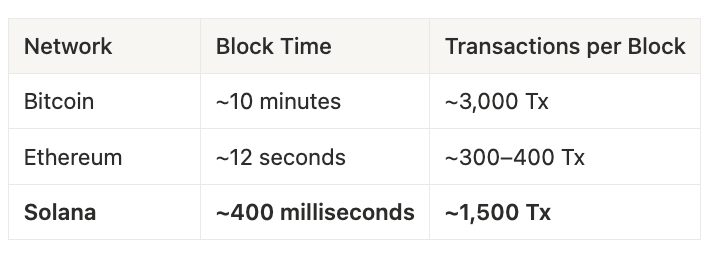
Solana’s architecture isn’t just an optimized version of existing chains; it’s a complete reimagination of how transactions are executed at scale.
Rather than processing transactions sequentially like Bitcoin or Ethereum, Solana leverages Sealevel, a parallel execution engine that enables simultaneous transaction processing by resolving potential write-conflicts at the account level.
This unique approach eliminates the single-threaded bottleneck most blockchains face.
Solana Makes Every Transaction Cheaper
High throughput means little if the chain is too expensive to use. Solana wins here as well.
A typical transaction costs around 5,000 lamports, or $0.00025 USD — practically free compared to other networks.
To put it in perspective:
1 SOL = 1,000,000,000 lamports
Tx Fee ≈ 0.000005 SOL
This efficiency makes Solana particularly well-suited for microtransactions, real-time gaming, and high-frequency DeFi protocols, where Ethereum’s gas-based model often becomes a bottleneck.
The Cost of Speed — Infrastructure and Data Load
Solana’s low fees and rapid block times come with a major engineering trade-off:
the network generates far more data per second than most blockchains.
Running a node requires:
- high-performance CPUs
- NVMe SSDs with large storage capacity
- substantial memory
- strong bandwidth and networking
Solana’s architecture makes it fast — but it also means validators and data providers must handle enormous data flows in real-time.
To understand why the data volume is so large, we need to look at Solana’s central architectural unit: the Account Model.
Solana Stores Everything in Accounts
At the architectural level, Solana’s most defining feature is its Account-Based Model — a framework that stores every piece of state, code, or data inside accounts.
Each account contains:
- A SOL balance (lamports)
- An owner program (which defines logic)
- Serialized data (the actual state)
By requiring every transaction to declare which accounts it will read or write, Solana enables safe parallel execution — the foundation of Sealevel’s scalability.
Types of Accounts on Solana
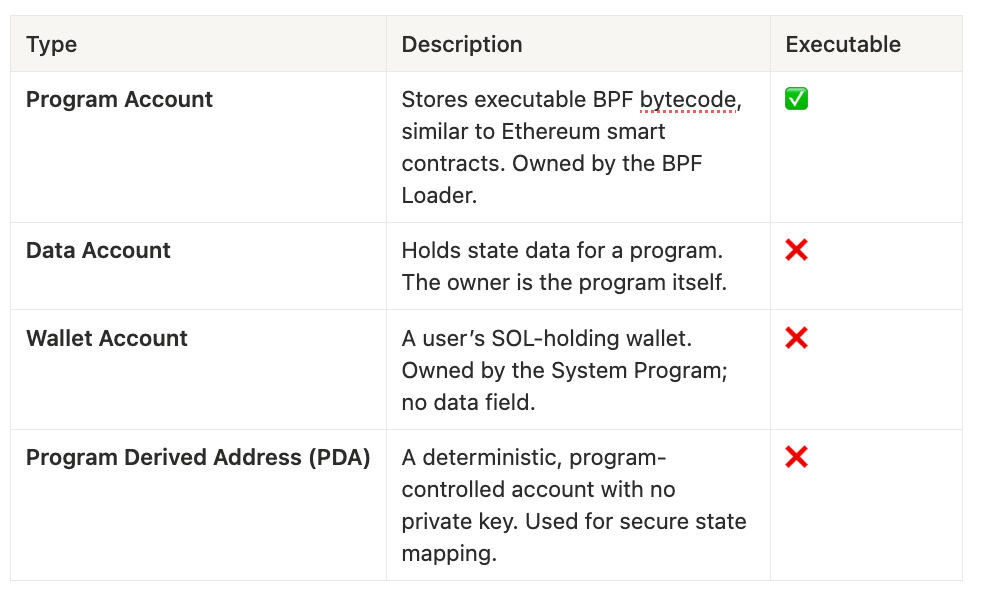
Each account has a unique 32-byte ed25519 address, typically represented in Base58 (e.g.,vines1vzrYbzLMRdu58ou5XTby4qAqVRLmqo6Xd7K).
To store data, an account must deposit rent-exempt, a refundable lamport fee based on data size (up to 10 MiB).
This ensures sustainable resource allocation — or you can fund enough lamports upfront to make it rent-exempt.
Why Meme Projects and DeFi Builders Choose Solana
So, what kinds of projects thrive on Solana?
It’s not just high-performance DeFi — meme tokens, social coins, and experimental on-chain communities are finding fertile ground here too.
Here’s the reason:
- Low fees make launching and trading new tokens trivial.
- DEXs like Jupiter and Raydium offer deep liquidity and fast settlement.
- Parallel execution ensures smoother trading even during market spikes.
In short, Solana gives meme and community-driven projects real utility flow — the ability to trade, distribute, and engage without gas barriers.
Building the Backbone — Nodit’s Role in Solana Infrastructure
All of this innovation depends on one critical layer: infrastructure. As Solana’s speed and data throughput mean not every provider can keep up with the network’s demands.
That’s why, Nodit has been providing:
- High-performance RPC nodes
- Archival Data APIs
- Reliable Hyper Node— all designed specifically for Solana’s scale.
Operating Solana infrastructure isn’t an easy mission.
The combination of ultra-fast blocks, high throughput, and massive state data requires deep engineering experience — and that’s exactly where Nodit excels, leveraging years of distributed system expertise to deliver stable, production-grade Solana nodes and data access.
Developer Takeaway
Solana isn’t just “a faster Ethereum.”
It’s a network engineered around explicit state management, parallelism, and performance-oriented design. By understanding its Account-based model and Sealevel runtime, developers can create smarter programs that scale natively with the network’s architecture.
If you think in accounts instead of contracts, you’ll start to see Solana not just as a chain — but as a high-performance runtime for decentralized computation.
High-Performance Solana Nodes, Built for Real Growth
Nodit has expanded its support for the Solana ecosystem through our advanced node pipeline.
With Solana’s high data throughput driven by Proof of History (PoH), Nodit operates its own IDC to minimize unexpected costs and ensure predictable usage for all developers. We now offer Solana services under both our Elastic Plan and Dedicated Plan, making it easy for startups and enterprises to build at any scale.
Want to connect with Team Nodit? Meet us at Breakpoint 2025!

🔎About Nodit
Nodit is a platform that provides reliable node and consistent data infrastructure to support the scaling of decentralized applications in a multi chain environment. The core technology of Nodit is a robust data pipeline that performs the crawling, indexing, storing, and processing of blockchain data, along with a dependable node operation service. Through its new Validator as a Service (VaaS) offering, Nodit delivers secure, transparent, and compliant validator operations that ensure stability, performance visibility, and regulatory assurance.
By utilizing processed blockchain data, developers and enterprises can achieve seamless on chain and off chain integration, advanced analytics, comprehensive visualization, and artificial intelligence modeling to build outstanding Web3 products.
Homepage l X (Twitter) l Linkedin
Join us and build more👊🏻
👉Start for Free (Click)