The Stablecoin Era Is Changing Compliance Infrastructure
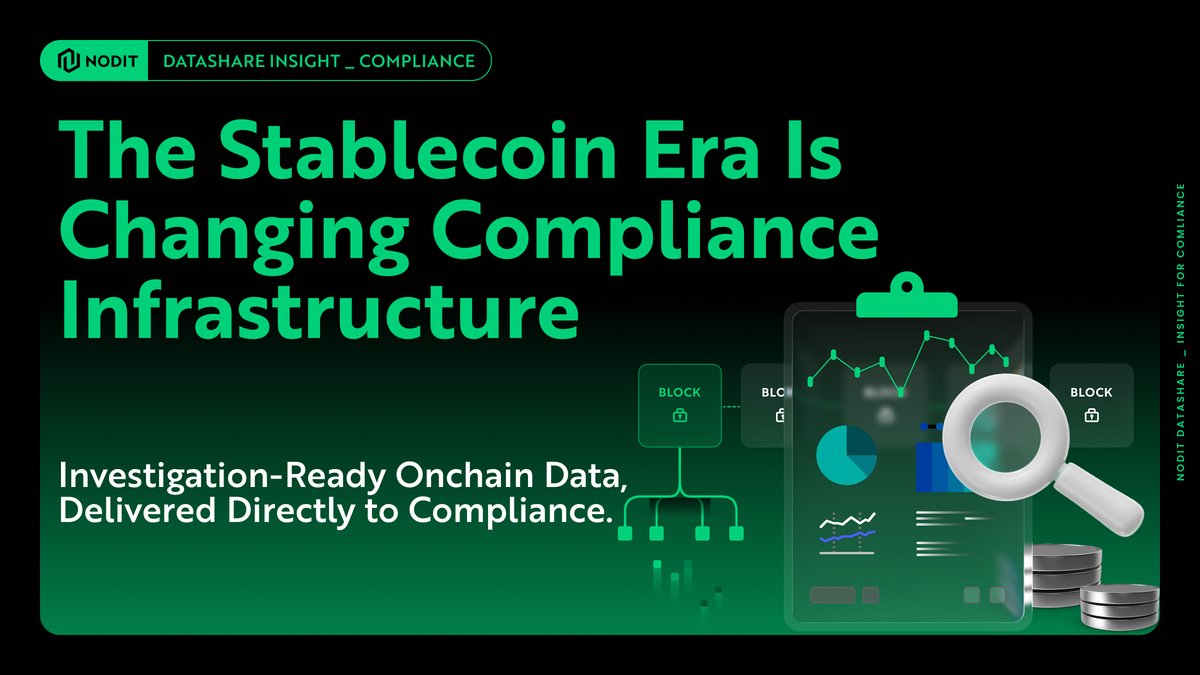
As stablecoin transaction volume grows, so does the complexity of how compliance teams depend on onchain data. Direct access to onchain audit data is becoming the foundation of next-generation compliance infrastructure.
TL;DR
- Stablecoins are bringing more regulated financial institutions onto shared blockchain payment rails, increasing compliance obligations across jurisdictions.
- Multi-chain stablecoins make investigations more complex because each blockchain stores and structures data differently.
- The biggest compliance bottleneck is no longer monitoring—it's getting trusted onchain data quickly without relying on Engineering.
- DataShare delivers verified blockchain data directly into enterprise data environments, enabling Compliance teams to investigate independently.
Stablecoins Are Becoming Core Financial Infrastructure
As of May 2026, the total stablecoin market cap has surpassed $322 billion (CoinDesk, 2026.05.26), with 2025 transaction volume reaching $33 trillion. (Artemis Analytics) On an annualized basis, volume is already approaching the scale of the ACH network. (a16z State of Crypto 2025)
Competition across chains is intensifying. Beyond Solana, Base, Stellar, and Polygon, new entrants have emerged: Stripe's payments-focused chain Tempo (CoinDesk, 2026.03) and Circle's institutional finance chain Arc (CNBC, 2026.05).
On June 30, 2026, a development pushed this trajectory further.
More Regulated Institutions on One Network Means More Independent Compliance Obligations
Over 140 companies, including Visa, Stripe, Mastercard, Coinbase, BlackRock, BNY, DBS, Standard Chartered, Google, and Shopify, formed a consortium to launch Open USD (OUSD). (Open Standard, 2026.06.30) Designed around three principles: zero-fee minting and redemption, reserve yield shared with partners, and consortium governance, OUSD launched simultaneously on Solana, Polygon, Aptos, and Stellar from day one, with expansion to Base and Tempo planned.
For compliance teams, the significance of OUSD is not that another stablecoin has launched. It is that regulated institutions like Visa, Mastercard, Stripe, Coinbase, DBS, and Standard Chartered are now sharing a single onchain payment network. Each participating institution must operate its own AML policies, internal audits, and regulatory reporting frameworks. Even when transactions occur on the same network, compliance investigations must be conducted independently by each institution.
OUSD signals something larger than a single stablecoin. It marks the beginning of an era in which banks, card networks, payment platforms, and cloud providers participate in the same onchain payment network.
Something we should keep in mind is that:
The problem for compliance teams is not a lack of monitoring tools. It is how quickly they can secure trusted data when they need it.
As the stablecoin market grows, the operational burden on compliance teams grows with it. Three dimensions stand out.
AML monitoring targets are expanding rapidly
The $33 trillion in stablecoin transaction volume (2025 figure) is entirely subject to AML monitoring. As zero-fee stablecoins spread across a network of 140+ partners, this volume is likely to accelerate further. More screening targets mean more investigations.
Stablecoins already move across dozens of chains
Solana, Ethereum, Base, Polygon, Tron, Stellar: each chain has a different transaction structure and data schema. The same stablecoin transfer is recorded in entirely different formats depending on the chain. Even tracking OUSD alone requires working with heterogeneous data across 4 to 6 chains: Solana, Polygon, Aptos, Stellar, and later Base and Tempo. Multi-chain simultaneous issuance is the most concrete example of the "every chain structures data differently" problem. Unified analysis requires the ability to query data from every chain in a single environment.
Regulation does not differentiate by chain
The FATF Travel Rule applies regardless of stablecoin type or chain. Key jurisdictional thresholds and obligations are summarized below.
Jurisdiction | Travel Rule Threshold | Key Additional Obligations |
EU (MiCA) | Zero threshold | Reserve disclosure, transparency reporting, ongoing reserve verification (ESMA) |
United States | $3,000 | GENIUS Act: 1:1 reserve backing, AML/CFT controls |
Hong Kong (HKMA) | HK$8,000 (~$1,000) | Licensing, AML/CFT framework, wallet identity verification (HKMA) |
Singapore (MAS) | SGD 1,500 | Reserve requirements, monthly reporting, redemption guarantee |
(Spark.money / CoinDesk, 2026.04)
Tracking stablecoin movement across chains is becoming a core compliance challenge.
Every Investigation Starts with the Same Dependency
Suspicious transaction flagged, regulator requesting additional evidence, SAR filing required, banking partner demanding AML due diligence materials. The situations differ, but every investigation begins at the same first step.
The first thing a compliance team does is open a messenger.
🔐Compliance: Can you pull this wallet's history?
⚙️Engineering: Sure. We'll add it to the next sprint.
🔐Compliance: ……
This is not an isolated case. It is a structural problem experienced by nearly every compliance team that works with onchain data.
The data needed for investigations already exists on the blockchain. It is public, immutable, and traceable. But most of raw blockchain data is not investigation-ready. Normalizing wallet addresses, logs, and events into a form usable for regulatory investigations is typically handled by data engineering teams. As a result, data preparation, not the investigation itself, often becomes the bottleneck. The problem is that compliance teams cannot use it directly. In most organizations, data preparation is still engineering's responsibility.
The Issue Is Not Engineering. It Is the Data Operating Model.
Looking at compliance investigation workflows one by one, they all stall at the same point.
SAR (Suspicious Activity Report) filing:
A suspicious transaction is flagged. A case opens. The team requests Engineering to reconstruct the onchain record. The investigation waits until the request is processed.
High-risk customer review:
A complete onchain history of the wallet is required before the review can begin. Data preparation alone can take days.
Regulatory licensing / FCC program documentation:
Licensing reviews by financial regulators require demonstrable data traceability across the FCC (Financial Crime Compliance) program. Onchain audit data must be available in structured form, immediately.
Banking partner AML due diligence:
Data must be organized in a structure that is externally explainable and defensible for banking partner due diligence requests.
Cross-border team collaboration:
When global compliance teams need to share data with regional operations teams, they need the ability to access the same data without routing through Engineering.
The situations look different, but the root cause is the same. Compliance teams do not have direct access to trusted onchain data.
DataShare Gives Compliance Teams Direct Access
Solutions such as Chainalysis, TRM Labs, and Elliptic help organizations identify risk through capabilities like wallet screening, entity attribution, and transaction monitoring. These platforms depend on reliable blockchain data to support compliance workflows.
Nodit DataShare serves a different role. It delivers verified onchain transaction data directly into an organization's own data environment, where it can be used for compliance operations, internal investigations, audit readiness, and regulatory reporting.
Rather than retrieving data only when an investigation begins, organizations maintain a continuously updated dataset within their own infrastructure. This allows compliance teams to access the information they need without relying on engineering teams to prepare or extract blockchain data.
As more financial institutions build internal compliance capabilities, data ownership is becoming an operational consideration. Maintaining blockchain data inside an organization's own environment provides greater control over governance, auditability, retention policies, and integration with existing compliance systems. When an investigation is required, compliance teams can query the data directly. The evidence is already available within the organization's own environment, reducing operational dependencies while supporting a faster investigation process.
Current Workflow in Your team | With DataShare |
Compliance → requests wallet history from Engineering | Compliance queries directly, stored in the organization's own environment |
Waits for pipeline updates | Data is already prepared |
Investigation starts only after data arrives | Investigation can begin immediately |
Engineering owns data preparation | Engineering maintains the platform; Compliance accesses trusted data independently |
The recurring cycle of requesting, waiting, and re-verifying data for every investigation disappears. Overhead from audit preparation and regulatory reporting decreases, and policy monitoring accuracy improves with consistently structured onchain data as the baseline. Compliance teams can focus on judgment, not on chasing data.
Onchain transaction data across major chains, including but not limited to ERC-20, TRC-20, XRP balance changes, and decoded Solana instructions, is delivered directly to the organization's own data environment, typically within three minutes of block confirmation, and operated in accordance with SOC 2 Type 2 standards.
Audit trails exist in structured form by the time a regulatory review occurs. What regulators require is not simply showing data. They require reproducible audit trails that document what data was collected, when, and on what basis investigation conclusions were reached. Because DataShare stores verified onchain data inside the organization, it provides an operational foundation for repeatedly reproducing and substantiating the same evidence. Data traceability for FCC programs can be demonstrated immediately during licensing reviews.
Why Solana Is Becoming a Critical Compliance Dataset
Global financial institutions and asset managers are increasingly selecting Solana as the chain for stablecoin and RWA (Real World Asset) issuance, driven by throughput, low fees, and high liquidity. OUSD selected Solana as one of its day-one launch chains.
Verifying and structuring Solana data to a level usable for regulatory work is technically demanding. Solana's transaction structure is fundamentally different from EVM-based chains. Fee-consuming failed transactions, compute unit fees, and continuously changing instruction formats create edge cases that standard parsers struggle to handle reliably. In compliance investigations, these edge cases translate directly into data gaps. Wallet histories may be incomplete, specific transactions may be missing, or transactions may be misclassified before entering SAR filings or audit materials. (ISSTA 2025, "Why Does My Transaction Fail? A First Look at Failed Transactions on the Solana Blockchain")
DataShare processes Solana datasets through the same verification pipeline as every other chain. Column-level validity checks, table-level consistency checks, and cross-table relationship verification. Verification is complete before an investigation begins.
💡DataShare launched its beta in June and currently offers 3 free exports, allowing teams to experience verified onchain data firsthand.
The Next Generation of Compliance Does Not Wait for Data
The OUSD launch is not simply news that another stablecoin has arrived. It is a signal that more financial institutions will adopt onchain payments, and more stablecoins will move across more chains. As transaction volume grows, the investigations and regulatory obligations that compliance teams must handle will grow with it.
In that environment, competitive advantage comes not from more monitoring tools, but from an operating model where the data needed for any investigation is immediately accessible. A structure that requires waiting on Engineering every time an investigation opens will struggle to keep pace with expanding data volumes and regulatory demands.
The compliance teams of the next generation will not be organizations that request data. They will be organizations that query data directly, run their own investigations, validate findings, and move straight to regulatory response. As regulation grows more complex, competitive advantage will come not from hiring more investigators, but from building an operating model that never waits for data.
DataShare is the data foundation that makes that operating structure possible. To explore DataShare for your compliance infrastructure, contact us below.
The next series will cover DataShare for payment and card businesses. Subscribe to the newsletter to receive it first.
Interested in reading more on DataShare?
 Nodit Team
Last but not least! We will also be at Solana Breakpoint 2026 in November to share more about the Datashare — details soon!
Disclaimer
This article is provided for general informational purposes only. By using the article, you agree that the information on this article does not constitute legal, financial or any other form of professional advice. No relationship is created with you, nor any duty of care assumed to you, when you use this article. The article is not a substitute for obtaining any legal, financial or any other form of professional advice from a suitably qualified and licensed advisor. The information on this article may be changed without notice and is not guaranteed to be complete, accurate, correct or up-to-date.