From Public to Audit-Grade: Making Onchain Data Institutions Can Actually Trust
TL;DR
- Public blockchain data isn't automatically audit-ready. Institutions need complete, consistent, and traceable data for settlement, compliance, and financial reporting.
- Decoding failures create silent data gaps. Missing IDLs don't generate errors—they simply cause transactions to disappear from analytical results.
- Audit-ready data requires more than indexing. Decoding coverage, finality handling, historical backfills, and full data lineage are essential for institutional use.
- This report examines how Dune, Helius, Allium, and Nodit DataShare address these challenges, highlighting the engineering tradeoffs behind building trustworthy onchain data infrastructure.
This research was produced in collaboration with Decipher, the blockchain association at Seoul National University.
Interested in building audit-ready blockchain infrastructure?
Book a meeting with the Nodit team to learn how institutions use our Web3 infrastructure and DataShare solutions.
Decoding Is the New Data Moat: What It Takes to Make Onchain Data Audit-Grade
Every blockchain publishes its data in real time, to anyone. But open isn't the same as usable, and usable isn't the same as trustworthy. As institutions bring RWA tokenization and stablecoin payments into production, the gap between "the data is public" and "the data is auditable" has become the real bottleneck to institutional adoption — not the underlying technology.
This article is a deep technical breakdown of why this gap exists and what closing it actually requires. Some of what we found:
- On Solana, a single one-hour window produced 33.88M raw instructions — roughly 810M a day. Every one of them has to be decoded correctly, or the numbers above it silently break.
- Decoding failures don't throw errors. A node returns raw bytes for programs it doesn't recognize, and that data just drops out of the result set — a "silent drop" that looks identical to a true zero.
- Reorgs on Solana aren't rare: at the fastest commitment level, roughly 5% of blocks get dropped from fork contention. Without a strategy for what counts as final, your "yesterday's balance" can quietly change today.
- Re-decoding 70,000+ instructions from properly stored raw source takes about 2 seconds. Re-fetching the same range from a node after the fact can take hundreds of hours and multiple terabytes.
Different Providers, Different Tradeoffs
The report also examines how leading blockchain data providers—including Dune, Helius, and Allium—approach these challenges.
Rather than comparing products, we focus on the engineering tradeoffs behind different architectural decisions, including:
- Decoding coverage
- Historical reconstruction
- Node ownership
- Data lineage
- Infrastructure responsibility
The report also explains where Nodit DataShare takes a different approach.
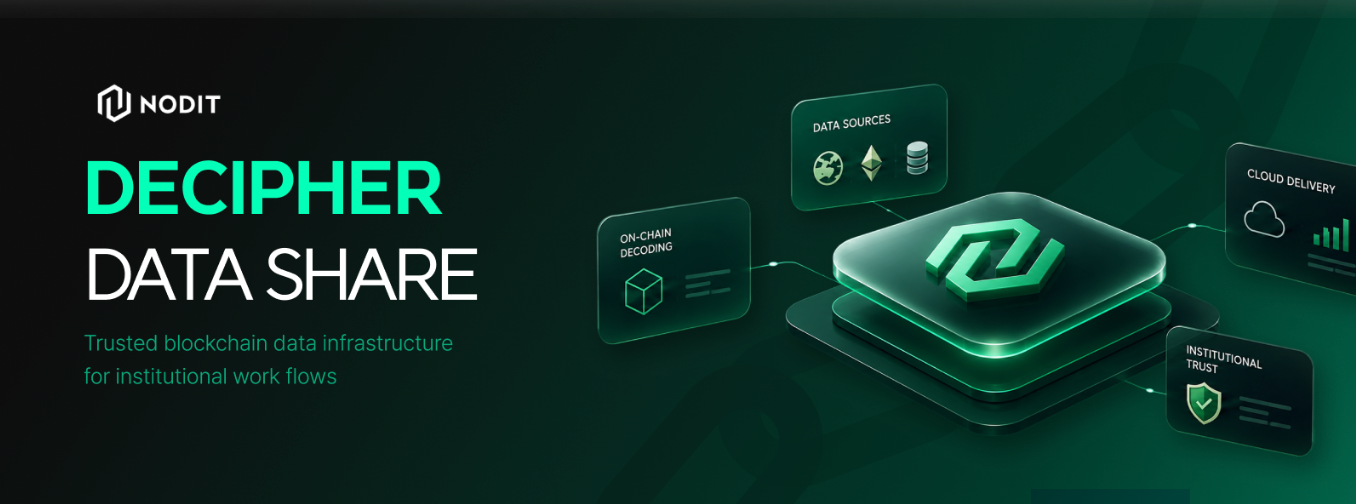
By operating blockchain nodes directly instead of relying on third-party RPC providers in the critical data path, maintaining institutional-grade IDL coverage beyond standard programs, and preserving complete transaction lineage, Nodit enables organizations to build blockchain data pipelines with stronger operational guarantees.
Combined with SOC 2 Type I and Type II certification, these capabilities help institutions move closer to truly audit-ready blockchain data.
Download the Full Report
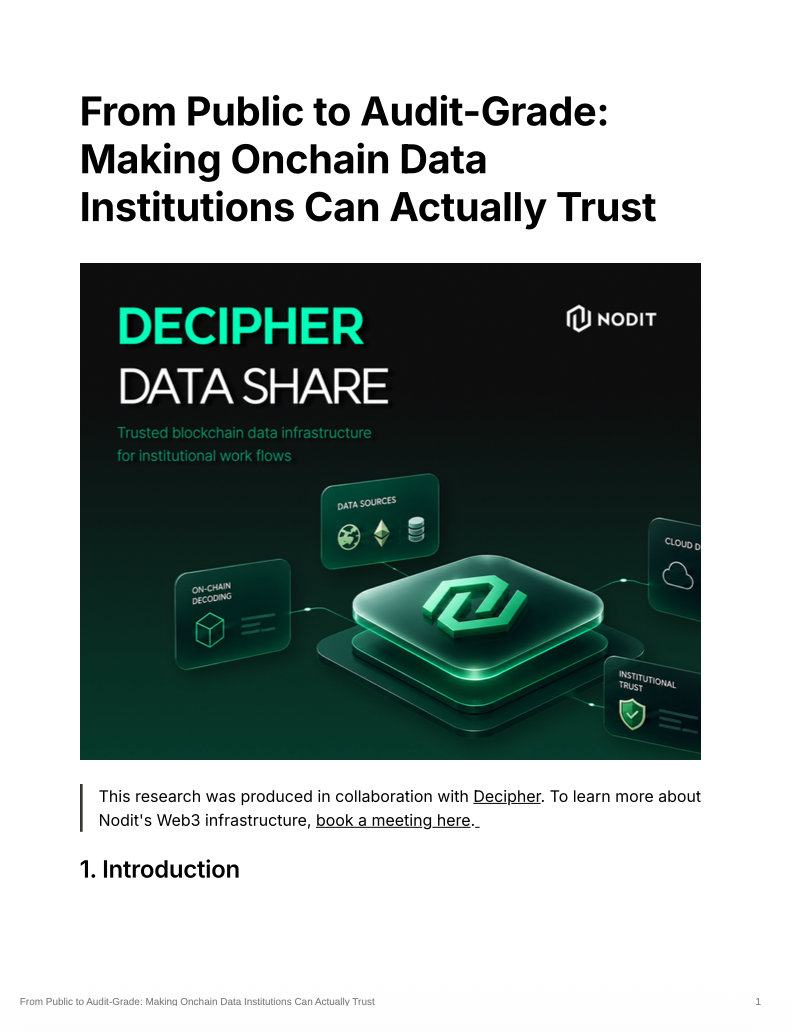
As blockchain becomes part of mainstream financial infrastructure, the quality of the underlying data matters just as much as the applications built on top of it.
Audit-ready blockchain data isn't created by simply collecting more transactions.
It requires reliable decoding, deterministic finality, complete historical reconstruction, and end-to-end traceability.
Our latest research with Decipher explores the engineering principles behind building blockchain data that institutions can actually trust.
🔎About Nodit
Nodit is an enterprise-grade Web3 platform that provides reliable node and consistent data infrastructure to support the scaling of decentralized applications in a multi chain environment. The core technology of Nodit is a robust data pipeline that performs the crawling, indexing, storing, and processing of blockchain data, along with a dependable node operation service. Through its new Validator as a Service (VaaS) offering, Nodit delivers secure, transparent, and compliant validator operations that ensure stability, performance visibility, and regulatory assurance.
By utilizing processed blockchain data, developers and enterprises can achieve seamless on chain and off chain integration, advanced analytics, comprehensive visualization, and artificial intelligence modeling to build outstanding Web3 products.
![[DataShare Insight] On-Chain Data as a Foundation for Market Intelligence](https://storage.ghost.io/c/00/e4/00e497ca-82e8-447b-9af3-b700db69ca26/content/images/size/w600/2026/09/Data-Analyst--_-Blog-Thumbnail.png)
![[DataShare Insight] AI-Ready On-Chain Data for Regulated Enterprises](https://storage.ghost.io/c/00/e4/00e497ca-82e8-447b-9af3-b700db69ca26/content/images/size/w600/2026/09/Group-C-_-AI-Blog-Thumbnail.png)