
[DataShare Insight] On-Chain Data as a Foundation for Market Intelligence
![[DataShare Insight] On-Chain Data as a Foundation for Market Intelligence](https://storage.ghost.io/c/00/e4/00e497ca-82e8-447b-9af3-b700db69ca26/content/images/size/w1200/2026/09/Data-Analyst--_-Blog-Thumbnail.png)
How research, data, and strategy teams, at independent research firms and within institutions, turn onchain activity across chains into repeatable market, ecosystem, and investment intelligence.
TL;DR
- Onchain analysis increasingly informs market, ecosystem, and investment decisions, yet every conclusion rests on the quality and continuity of the data beneath it.
- Public blockchain data is accessible, but converting historical activity into a consistent research dataset still requires substantial collection, validation, and ongoing maintenance.
- A reusable onchain dataset allows research and strategy teams to investigate new questions, compare activity over time, and reproduce analysis without rebuilding the data foundation for each project.
- DataShare delivers standardized onchain datasets directly into existing data environments, enabling analysts to focus on research and investigation instead of data preparation.
The Expanding Scope of Onchain Research
Research and strategy teams do not examine onchain data for its own sake. They begin with a question the organization needs answered: where capital is moving, whether an ecosystem is genuinely growing or being carried by a single event, what changed after a market shock and whether that change persisted, and what several months of history reveal that a current dashboard cannot.
The blockchain holds the evidence for each of these. The difficulty lies in moving from raw activity to a conclusion the team can publish internally or externally and defend, which requires more than querying a dashboard. A dashboard answers the question it was built for; research continually revises the question.
To do this well, a team needs history it can analyze across periods, combine with other datasets, revisit when a hypothesis changes, and reuse for the next question. The value of onchain research lies in the questions a team can answer, not in the volume of raw data it can collect.
The Gap Between Data Access and Research-Ready Data
Blockchain data is public, which is precisely why the data problem is so often assumed to be solved. It is not.
Professional research must still collect the data, organize it, validate it, maintain it as chains change, and only then query and analyze it. A dashboard conceals all of this behind a fixed set of answers. Research cannot, because analysts continually do what a fixed pipeline was never built to support: changing assumptions, examining different periods, comparing assets or ecosystems, joining onchain data with market or internal datasets, reproducing an earlier analysis, and pursuing a question that did not exist when the pipeline was first built.
At that point the underlying data ceases to be a research problem and becomes an engineering one. Access to blockchain data is abundant; research ready history is not.
From Data Access to a Research Data Foundation
Onchain analytics platforms have made blockchain data easier than ever to explore. Tools such as Dune are valuable when an analyst wants to query activity, test an idea, or stand up a dashboard quickly.
Institutional research needs more. The underlying data often has to be combined with proprietary datasets and internal models, reused across teams, and reproduced months later under the same methodology. There, a query interface is only the starting point. The team needs a consistent historical data foundation that stays in its own environment and can be reused and audited over time.
Exploration starts with access. Repeatable research starts with a data foundation. That is the layer DataShare is built for, and the rest of this piece is about what a team does with it.
Market Intelligence Use Cases

Each of the questions below corresponds to a dataset a team can retrieve today, across the chains DataShare already covers.
Cross-Chain Activity & Ecosystem Analysis
Track token movements and balance changes across wallets and accounts, and set them side by side across Solana, Ethereum, Base, Arbitrum, Tron, and Bitcoin. This gives a team the basis to judge whether activity is shifting into an ecosystem or a headline figure is being carried by a single event, a judgment the team makes from the evidence rather than one the data asserts. The output supports market intelligence, ecosystem research, and competitive analysis.
Onchain Asset & Market Analysis
On the chains where DataShare decodes it, teams can work directly from onchain DEX activity: token OHLCV prices, volume, and trade counts over time, swap records and traded pairs, and pool and market structure. This extends coverage to assets conventional market data vendors omit, including newly issued and long tail tokens without an exchange listing. DataShare supplies the onchain evidence; the pricing methodology and its interpretation remain with the team.
Historical & Event-Based Analysis
This is where historical data proves its value. Teams can examine activity before and after a token launch, an incentive program, or a period of volatility, observe how holder distribution and concentration shift over time, or reconstruct a token's supply at a past date from its mint and burn history. The emphasis is on how behavior evolved across a defined window rather than only its present state. The output supports event studies, historical market research, and recurring intelligence that can be rerun each quarter.
In each case, DataShare does not reach the conclusion. It provides analysts with the evidence to form and test one, and the interpretation remains with the researcher.
From One-Off Analysis to Reproducible Research
This is among the strongest arguments for a shared dataset, and it is easily overlooked.
For a professional research organization the question is not only how much data engineering can be avoided. It is whether an analysis can be reproduced, whether another analyst can audit it, whether it can be rerun next quarter on the same basis, and whether the hypothesis can change without recollecting everything. Those properties depend on a stable, historical foundation rather than a pipeline rebuilt for each project.
When the same historical foundation underlies every project, the work completed for one report becomes the starting point for the next. A single dataset feeds the team's SQL and Python, which feed dashboards, reports, and strategy work, which in turn raise new questions that draw on the same history again.
That one foundation can support recurring market reports, internal research, BI, strategy work, and AI assisted exploration, all without a fresh data build each time. The value of a research dataset compounds when the same base can answer new questions over time.
Nodit already demonstrates the depth of this base through a set of ready made onchain research views built from the same data: Uniswap analytics, aggregated ERC-20 metrics, stablecoin supply tracking, and address level activity, among others. Those views illustrate how far a single validated dataset can be taken. When a team needs to run the analysis in its own environment rather than view it, DataShare delivers the same class of data into that environment.
AI-Enabled Research on Trusted Historical Data
AI is making research faster, helping analysts generate queries, test hypotheses, and explore patterns. What it does not do is create the historical data those analyses depend on.
 Nodit Team
AI can accelerate the investigation. It cannot create the history behind it. A reusable historical dataset therefore becomes more valuable, not less: analysts spend less time preparing inputs and more time testing ideas. Insight #6 in this series asked whether AI can trust the data. This piece asks what teams can discover once that trustworthy data is available.
DataShare: A Reusable Onchain Data Foundation
With the questions and the workflow established, DataShare's role becomes clear.
DataShare delivers the underlying onchain dataset into the organization's own data environment, giving research and strategy teams a reusable foundation for analysis without building the blockchain data collection layer from scratch. Nodit operates the infrastructure, processes and validates the data, and delivers it; the team receives it inside its own research stack.
The confirmed shape of the product is as follows. Standardized datasets are delivered as files into the organization's own AWS S3, Google Cloud Storage, or Cloudflare R2, in Parquet, CSV, or JSON, ready to load into a warehouse, lakehouse, or notebooks. The data is corrected for the conditions that quietly compromise research: reorgs are reconciled, so a query returns what the network settled on; failed transactions are distinguished rather than silently counted; and the data carries lineage that can be audited when a reader or reviewer asks how a figure was produced. Because the files land directly in the organization's own storage environment, teams retain direct access to the underlying data and can work with it in their preferred analytical stack.
That foundation spans multiple chains rather than one. DataShare currently provides datasets across Solana, Ethereum, Base, Arbitrum, Bitcoin, and Tron, giving research teams a common starting point for cross ecosystem analysis. Conventions differ between chains, so the work of aligning them for a given comparison remains the team's, but it begins from one validated source rather than several independently maintained pipelines.
DataShare provides the underlying onchain primitives rather than prescribing the analytical methodology. Research teams retain control over how metrics are defined, calculated, and interpreted. The methodology is the team's product, and it stays with the team.
A Growing Research Surface: Solana
Solana is becoming more than a market for digital asset native activity. Tokenized equities, funds, treasuries, commodities, and other real world assets are increasingly issued and traded on the network, widening the range of financially relevant activity available for onchain research.
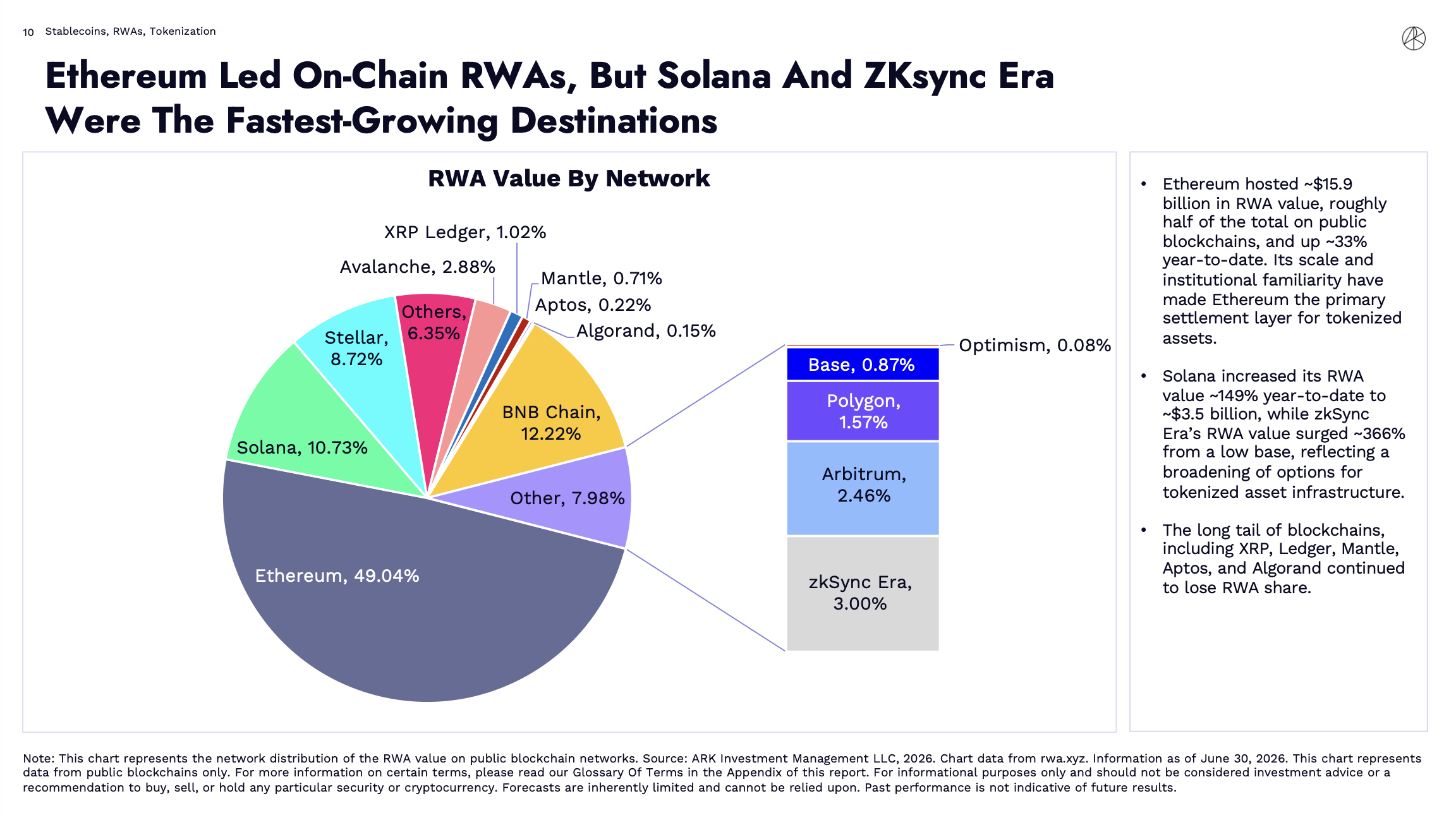
The scale of that shift is now measurable. As of June 30, 2026, tokenized RWA value on Solana reached approximately 3.5 billion dollars, up around 149 percent year to date, and ARK Invest identified Solana, alongside zkSync Era, as one of the fastest-growing networks for tokenized assets over the period. More telling than the number is the mix: the asset types are expanding from crypto native assets into treasuries, funds, credit, and equities. (Source: ARK Invest, The DeFi Quarterly (Q2 2026))
For a research team, the significance is not the number itself. As more financial products and market activity move onchain, the research surface expands with them, and questions about asset ownership, token supply, concentration, and behavior around market events increasingly require historical blockchain data that can be analyzed and revisited over time.
Solana also illustrates the underlying data challenge. Its account model separates token holdings from the wallet address, and its high, continuously growing activity makes longitudinal analysis data intensive. The challenge is not accessing the chain. It is maintaining enough consistent, correctly reconstructed history to investigate how activity changes over time.
That is where the data foundation matters. DataShare's Solana datasets sit at the token, account, supply, and balance level: token transfers, supply changes derived from full mint and burn history, balance changes, SOL transfers, and validator rewards, among others. That base is sufficient to investigate questions such as the following.
Where has token activity concentrated over the past six months, and is that concentration shifting? That draws on token transfers and balance changes. Can a token's circulating supply be reconstructed at a specific point in the past, including newly issued tokens? That draws on supply changes built from full mint and burn history. How did balances move across the ecosystem through a period of volatility? That draws on token and SOL balance changes.
None of these require protocol level decoding, and on Solana that decoding is not what the datasets provide. They require clean, historical, reconstructable activity data, which is precisely the base on offer. For onchain price and DEX market structure, the pricing and swap datasets described earlier are drawn from other chains DataShare covers, not from Solana. The objective is consistent across every chain: to give a research team data it can immediately test its own question against.
From Research Question to Data Validation
For this audience, a generic call to obtain an API key is poorly matched to the work. The invitation should reflect it.
A research question is what creates the interest: where activity is moving across chains, how an ecosystem has changed over recent months, or what occurred onchain around a major market event. The free experience is best used to answer a narrower and more practical question first, which is whether the data fits.
Explore a DataShare dataset, inspect its schema and coverage, and export a sample directly into your own environment, so the fit is confirmed before anything is built on it. The research question creates the interest; the export validates the fit.
Start with the question. Validate the data. Then build the research. → begin with a free dataset export
For production scale or scheduled delivery into a warehouse, contact us below:
From Data Foundation to Market Intelligence
As the final piece in the DataShare Insight series, this article warrants a wider view.
Across the series the use cases changed while the underlying requirement did not. Exchanges required operational data. Compliance teams required traceable data. Asset managers required decision ready data. AI required trustworthy data. Research and strategy teams require data they can investigate and revisit. Value is created differently in each case, but it begins from the same point: onchain data an organization does not have to reconstruct from scratch each time it is needed.
The advantage is not in owning more blockchain infrastructure. It is in what a team can discover, decide, and build once the data foundation is no longer the hard part.
Interested in reading more on DataShare?
 Nodit Team
 Nodit Team
 Nodit Team
 Nodit Team
 Nodit Team
 Nodit Team
Last but not least! We will also be at Solana Breakpoint 2026 in November to share more about the Datashare — details soon!
About Nodit
Nodit is an enterprise-grade blockchain infrastructure platform providing reliable node access and consistent on-chain data for digital asset services. Across 50+ networks, Nodit combines managed node infrastructure, standardized data processing and delivery, DataShare with specialized blockchain datasets, and Validator-as-a-Service (VaaS) to support production-scale operations, institutional analytics, and AI applications.
Backed by SOC 2 Type II and proven experience with major regulated exchanges worldwide, Nodit provides the complete on-chain data pipeline that powers the digital asset economy.
Homepage l X (Twitter) l LinkedIn
This article is provided for general informational purposes only. By using the article, you agree that the information on this article does not constitute legal, financial or any other form of professional advice. No relationship is created with you, nor any duty of care assumed to you, when you use this article. The article is not a substitute for obtaining any legal, financial or any other form of professional advice from a suitably qualified and licensed advisor. The information on this article may be changed without notice and is not guaranteed to be complete, accurate, correct or up-to-date.
![[DataShare Insight] AI-Ready On-Chain Data for Regulated Enterprises](https://storage.ghost.io/c/00/e4/00e497ca-82e8-447b-9af3-b700db69ca26/content/images/size/w600/2026/09/Group-C-_-AI-Blog-Thumbnail.png)
![[DataShare Insight] The Operating Model for Asset Management in the Age of RWAs and Tokenization](https://storage.ghost.io/c/00/e4/00e497ca-82e8-447b-9af3-b700db69ca26/content/images/size/w600/2026/09/Group-B-_-Asset-Managment-Blog-Thumbnail.png)