
[DataShare Insight] AI-Ready On-Chain Data for Regulated Enterprises
![[DataShare Insight] AI-Ready On-Chain Data for Regulated Enterprises](https://storage.ghost.io/c/00/e4/00e497ca-82e8-447b-9af3-b700db69ca26/content/images/size/w1200/2026/09/Group-C-_-AI-Blog-Thumbnail.png)
Trusted, AI-ready on-chain data, not the model, is where financial AI begins. From law enforcement fund tracing to global exchange fraud detection.
TL;DR
- On-chain data is no longer just an object of analysis; it is becoming a core input that models learn from and agents act on in real time.
- For regulated enterprises, accurate data alone is not enough. To produce results teams can trust, data must meet a standard that combines accuracy, business semantics, and verifiable lineage.
- This standard is the core of the AI-ready, institutional-grade on-chain data that financial services organizations and virtual asset exchanges have long required in production.
- Nodit DataShare delivers AI-ready on-chain data, and CLAIR, along with the fraud detection environment of a global Top 5 digital asset exchange, already runs on top of it.
Across APAC, even highly regulated financial markets such as South Korea are entering the next phase of enterprise AI adoption. As AI moves from pilot projects to production environments, the focus is shifting from adoption itself to the quality of the data that underpins it. The foundation of financial AI is established long before model selection. It begins with the data.
AI Is Only as Reliable as the Data Beneath It
Quant firms train signal models on historical on-chain flows; compliance teams use on-chain records as training data for anomaly detection. Autonomous agents reference balances, transactions, and contract state at the moment of execution to decide and act.
The challenge is that raw blockchain data is not AI-ready. Event logs must be decoded into meaningful business events, balances and aggregates vary across data sources, and chain reorganizations (reorgs) can alter previously ingested transaction states. Human analysts can investigate anomalies and question unexpected results. AI cannot. It assumes the data it receives is correct. When the underlying data is inaccurate or inconsistent, those errors propagate through every downstream model, decision, and automated workflow.
Web data and on chain data require fundamentally different data engineering approaches. With web data, the primary challenge lies in accessing and collecting fragmented information. With on chain data, the challenge is transforming publicly available blockchain records into data that enterprises can trust and operationalize. Collection is only the starting point. What determines the quality of on chain data is protocol interpretation, semantic normalization, data reconciliation, block finality management, and reorg handling.
In the AI era, competitive advantage comes not from access to on chain data, but from its quality, consistency, and verifiability.
Beyond Accuracy: Semantics and Verification
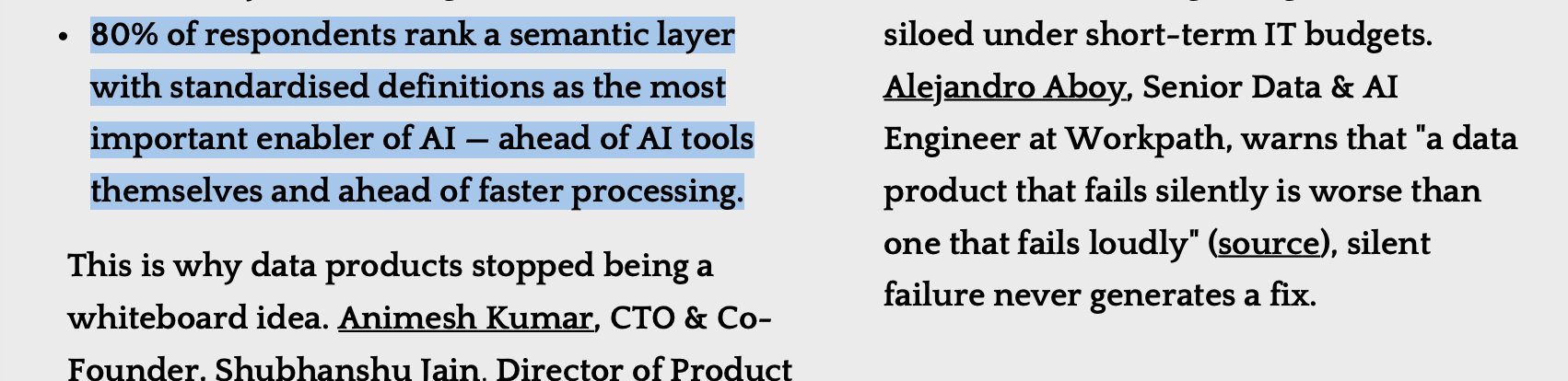
Enterprise AI priorities are moving in the same direction. In Modern Data 101's State of Data Products 2026 Q2 survey, 80% of respondents named a semantic layer with standardized definitions as the single most important factor for adopting AI, ranking it above AI tooling and above processing speed.
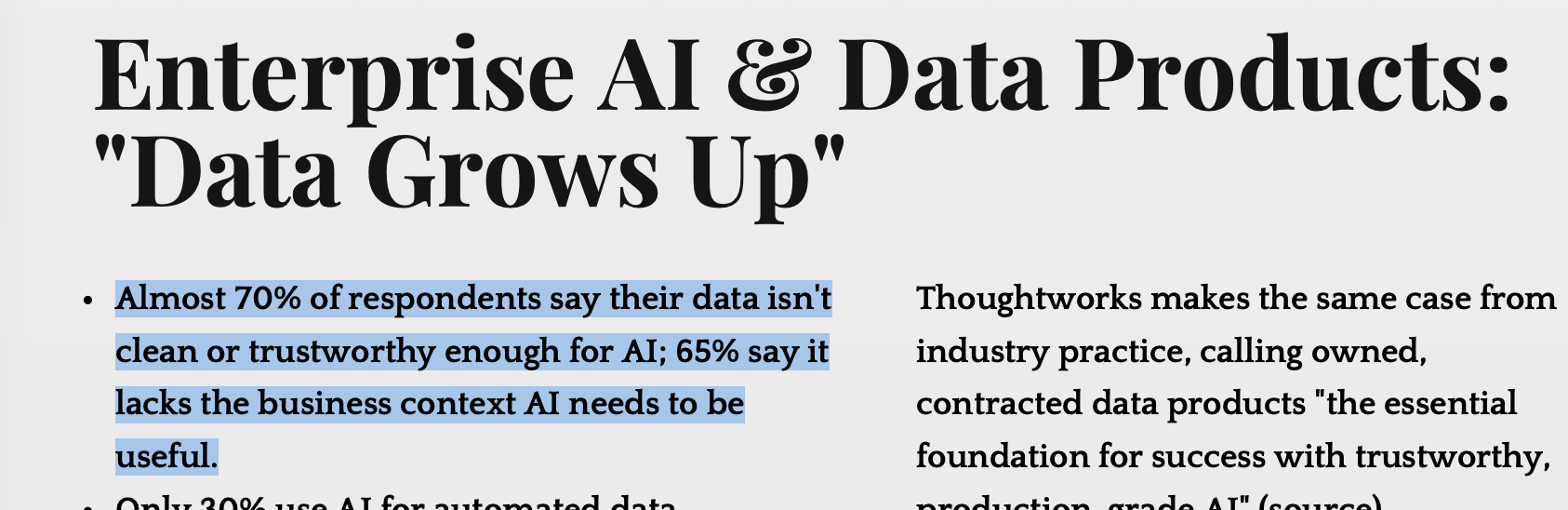
Another 65% said their data lacks the business context AI needs, and about 70% said data quality was not yet sufficient. Teams still treat quality as a real problem. They just no longer believe accuracy alone is enough to trust a model's output.
A model reads data, but it does not, on its own, understand what that data means. A person can read a single on-chain event as a bridge deposit, a DEX swap, or an internal transfer; a model cannot infer that meaning unless it is already encoded. And if an output cannot be traced back to the source transactions it came from, the result is hard to use for regulatory reporting or operational decisions.
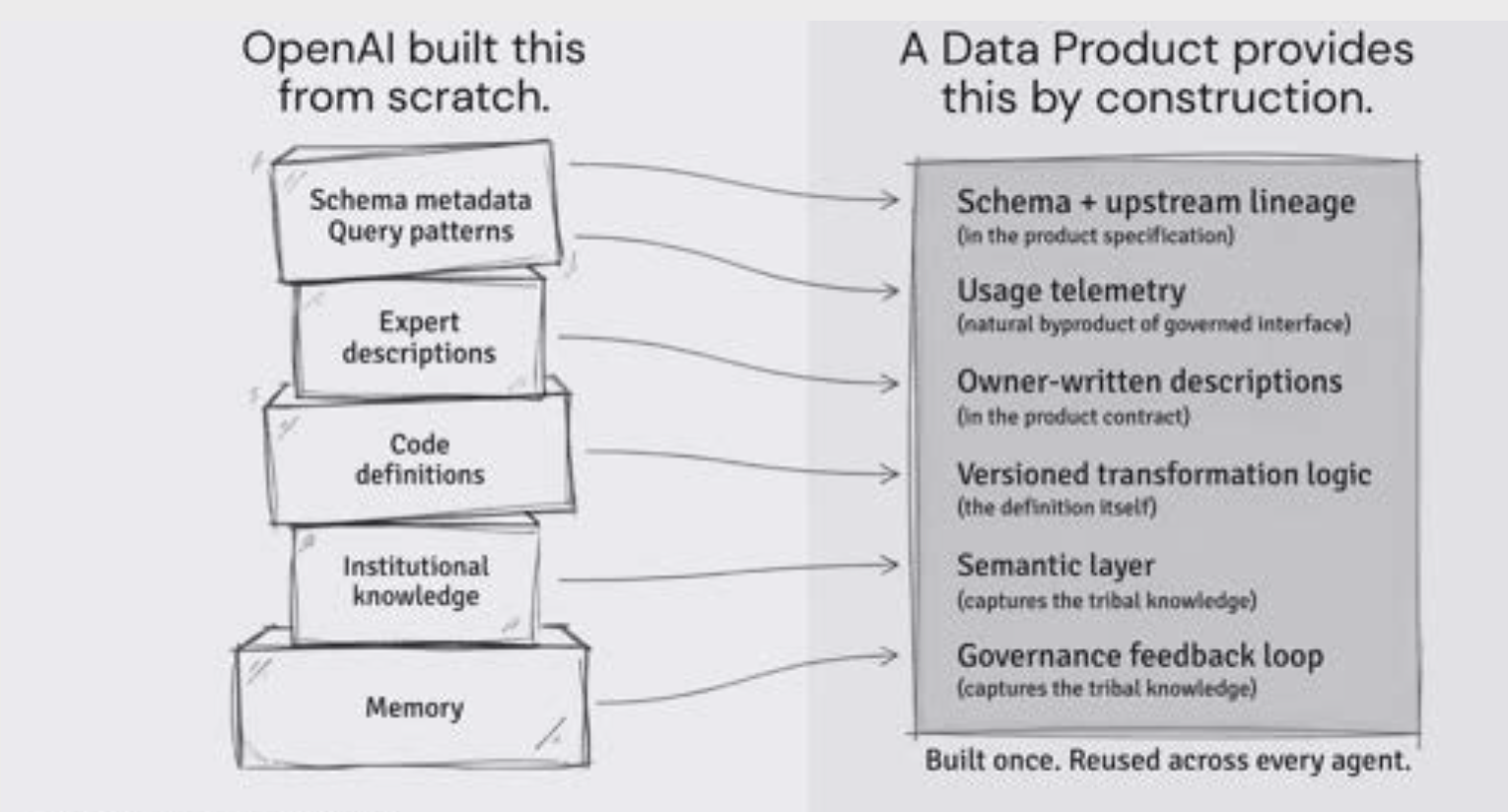
Ref. Modern Data 101's State of Data Products 2026 Q2
AI inherits the strengths and the weaknesses of the data beneath it.
Even with the same model, accuracy and reliability shift sharply with the data it learns from and references. Across APAC and other markets, AI adoption is expanding first in security and compliance, in anti-money laundering (AML), fraud detection (FDS), and risk management, where a small data error becomes operational burden or regulatory exposure. False positives drive unnecessary investigation and cost. False negatives miss laundering or illicit activity and create risk. As automation expands and the human review step shrinks, data reliability stops being something checked after the fact and becomes a standard the system has to assume up front.
The Data Standard for Financial AI
The competitiveness of financial AI is determined long before model selection. It begins with the data standard beneath it. Before deploying models or AI agents, organizations must establish whether their data is accurate, consistent, and verifiable. Without that foundation, no AI application can be trusted.
The clearest name for that bar is AI-ready. It does not simply mean data with few errors. It means data validated in an environment that has to satisfy financial regulation and internal controls, handle transactions at scale around the clock, and absorb small errors before they cascade into asset discrepancies and operational risk. Financial services organizations and virtual asset exchanges are the clearest example of environments that demand it. An incorrect balance or a missing deposit record turns directly into a customer asset discrepancy and regulatory exposure. What these organizations ask of AI is not simply a correct answer, but an answer that can explain why.
Data that AI can be trusted with must meet three criteria.
- Trusted FactsAccurate, reconciled, and validated blockchain data, free of missing transactions, incorrect balances, or unreflected reorgs.
- Business SemanticsRaw execution records translated into standardized events—Transfer, Swap, Balance Change—and delivered in one data model across chains and protocols, so models can interpret them consistently.
- Verifiable LineageEvery insight can be traced back to its originating transaction, the foundation for explaining and evaluating results.
Trusted Facts → Business Semantics → Verifiable Lineage
DataShare: AI-Ready On-Chain Data
Nodit DataShare is a data platform built to deliver this standard. On the blockchain data operations Nodit has run for years, it provides on-chain datasets with the accuracy, consistency, and continuity that exchange environments demand.
DataShare collects data from nodes Nodit operates directly, reflects chain reorganizations, and performs decoding at the protocol level and verification across multiple sources. This produces transactions, balances, and events in a single, consistent data model, brought together as one canonical dataset.
In this process, raw execution records are translated into standardized events such as Transfer, Swap, and Balance Change. This does not replace an enterprise semantic layer, but it gives on-chain data consistent business semantics that models can interpret the same way across chains and protocols.
DataShare also provides lineage from aggregate results back to the source transactions, so teams can reconcile an output against its origin and recheck the basis of a decision during audit and regulatory response.
Verifiability matters in particular. In the Modern Data 101 survey, 89% of organizations had built agent monitoring, but only 52% had an evaluation system. Monitoring shows whether an agent ran; it cannot tell you whether the judgment was right. That can only be confirmed on data that is traceable to its source.
DataShare supports 12 blockchains as standard datasets and covers 50+ more, that Nodit supports, through custom datasets, with especially deep coverage of APAC-region chains. For Solana, for example, it offers purpose-built dataset templates—SPL token movements, supply changes (mint/burn), balance changes across wallets and token accounts, native SOL transfers, and validator and staking-reward flows. Data is delivered to customer-managed Amazon S3, Google Cloud Storage (GCS), and Cloudflare R2, where it connects to existing data lakes, warehouses, and AI analytics environments with no separate transformation s
What Teams Build on Verified Data
What organizations care about is not the data itself, but what they can build on it. On-chain data verified and reconciled to an AI-ready standard becomes a shared foundation for fund tracing, risk monitoring, anomaly detection, and asset operations.
Use case 1: AI-driven on-chain fund tracing and FRAML
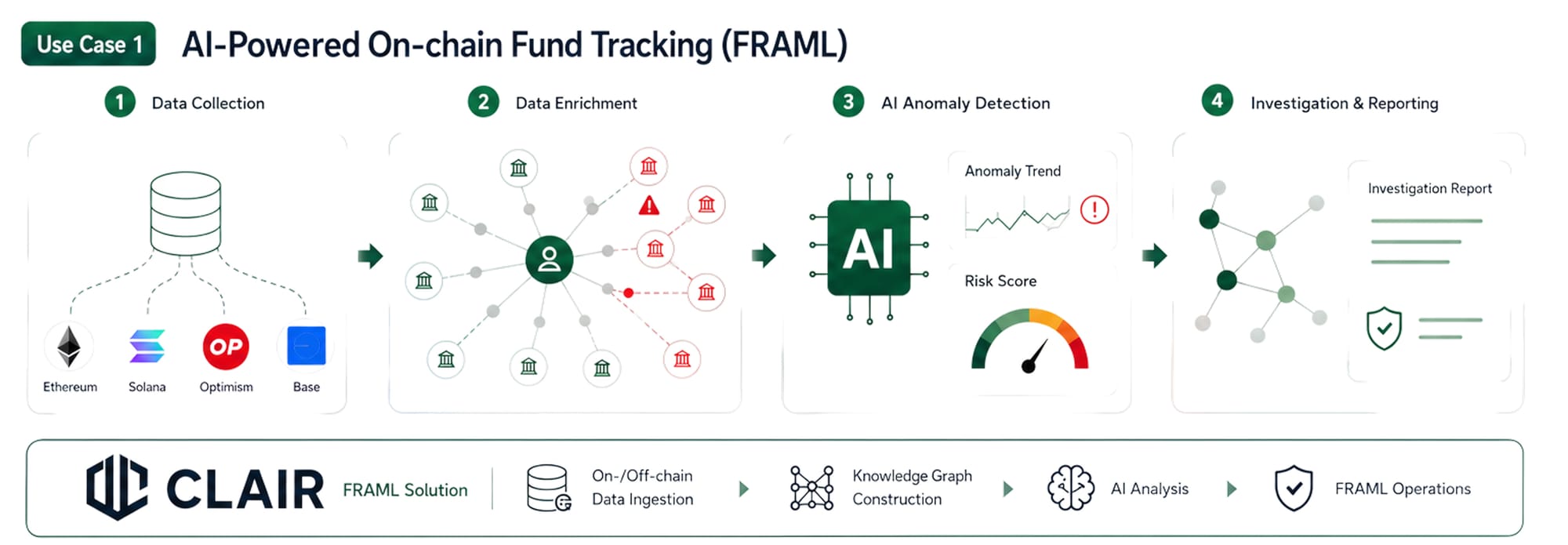
- DataShare delivers multi-chain transactions, deposits and withdrawals, and smart-contract events as a validated, reconciled dataset.
- Applications analyze address relationships and transaction patterns to identify flows routed through bridges, mixers, and high-risk addresses.
- Models flag anomalies and propose investigation priorities, and analysts decide on evidence traceable down to the source transaction.
CLAIR, our sister FRAML solution built on Nodit's verified on-chain dataset, shows this foundation running as a real service. An ontology-based platform, CLAIR integrates on-chain and off-chain information into a knowledge graph to support anomaly detection, fund-flow analysis, risk assessment, and regulatory response, and it is used in PoC and production environments with financial services organizations and more than 10 law enforcement agencies worldwide.
Use case 2: Operational automation and asset verification for digital asset services
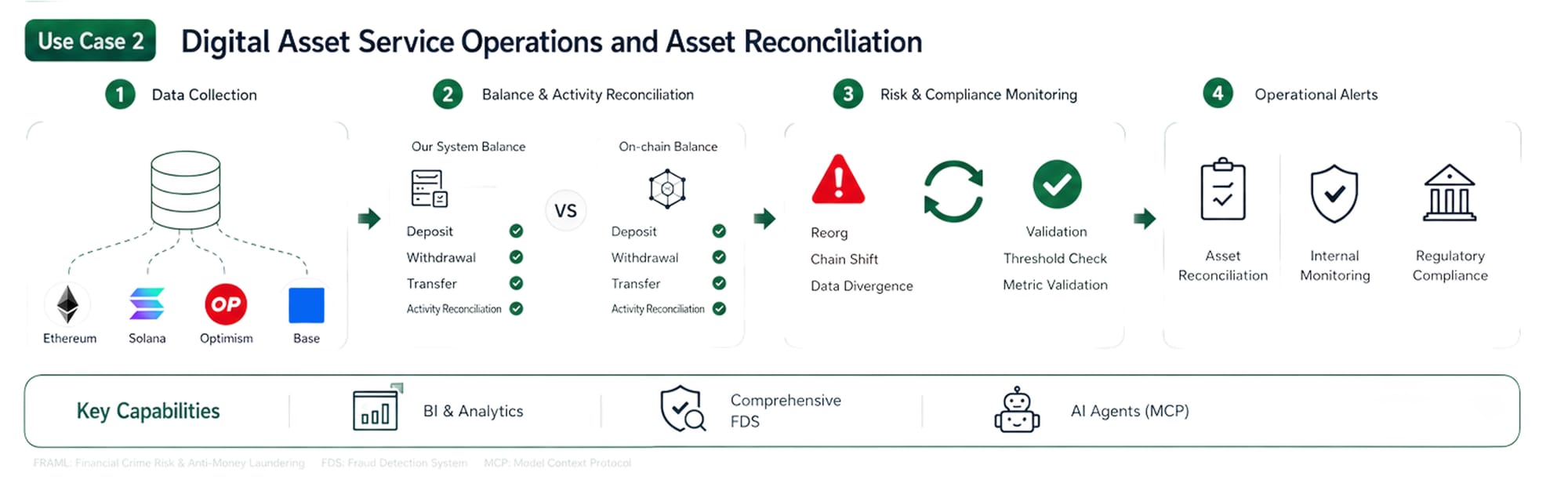
- DataShare delivers deposit and withdrawal transactions and wallet balances as a validated, reconciled dataset.
- Operational systems and models compare the internal ledger against on-chain data on the same basis to identify differences in deposit status, balances, and finality state, and re-verify against the latest finalized state when a reorg or update occurs.
- This supports asset reconciliation, internal controls, and reserve verification for digital asset service providers.
A trusted on-chain dataset becomes reusable AI infrastructure rather than a single-purpose data source. Once standardized and verified, the same data foundation can support natural-language analytics, executive reporting, AI-powered risk monitoring, next-generation FDS, and AI agents through interfaces such as MCP.
This approach is already proven in production. Nodit's verified on-chain dataset supports the FDS operations of a global Top 5 centralized exchange, demonstrating how a single data standard can power multiple AI applications while maintaining operational consistency and regulatory confidence. A detailed case study will be featured soon.
Where Financial AI Begins
The two use cases look like different services, yet they run on the same verified on-chain dataset. Rebuilding detection logic, risk judgments, and operating processes that were founded on inaccurate data costs far more than getting the data right the first time.
The competitiveness of financial AI is not decided by who adopts the newest model first. It begins with securing a data standard that models can rely on and that teams can verify and trace. An AI strategy starts with setting that standard, not with choosing a model. On-chain data that is accurate, consistent, and traceable is the foundation for trusted, explainable financial AI, and it becomes the common infrastructure under the services that follow.
If you are assessing whether your on-chain data meets the standard AI requires, talk through your data strategy with us.
The next article in this series turns to researchers and data analysts . Subscribe to the newsletter to receive the next insight.
Interested in reading more on DataShare?
 Nodit Team
 Nodit Team
 Nodit Team
 Nodit Team
 Nodit Team
Last but not least! We will also be at Solana Breakpoint 2026 in November to share more about the Datashare — details soon!
About Nodit
Nodit is an enterprise-grade blockchain infrastructure platform providing reliable node access and consistent on-chain data for digital asset services. Across 50+ networks, Nodit combines managed node infrastructure, standardized data processing and delivery, DataShare with specialized blockchain datasets, and Validator-as-a-Service (VaaS) to support production-scale operations, institutional analytics, and AI applications.
Backed by SOC 2 Type II and proven experience with major regulated exchanges worldwide, Nodit provides the complete on-chain data pipeline that powers the digital asset economy.
Homepage l X (Twitter) l LinkedIn
This article is provided for general informational purposes only. By using the article, you agree that the information on this article does not constitute legal, financial or any other form of professional advice. No relationship is created with you, nor any duty of care assumed to you, when you use this article. The article is not a substitute for obtaining any legal, financial or any other form of professional advice from a suitably qualified and licensed advisor. The information on this article may be changed without notice and is not guaranteed to be complete, accurate, correct or up-to-date.
![[DataShare Insight] On-Chain Data as a Foundation for Market Intelligence](https://storage.ghost.io/c/00/e4/00e497ca-82e8-447b-9af3-b700db69ca26/content/images/size/w600/2026/09/Data-Analyst--_-Blog-Thumbnail.png)
![[DataShare Insight] The Operating Model for Asset Management in the Age of RWAs and Tokenization](https://storage.ghost.io/c/00/e4/00e497ca-82e8-447b-9af3-b700db69ca26/content/images/size/w600/2026/09/Group-B-_-Asset-Managment-Blog-Thumbnail.png)