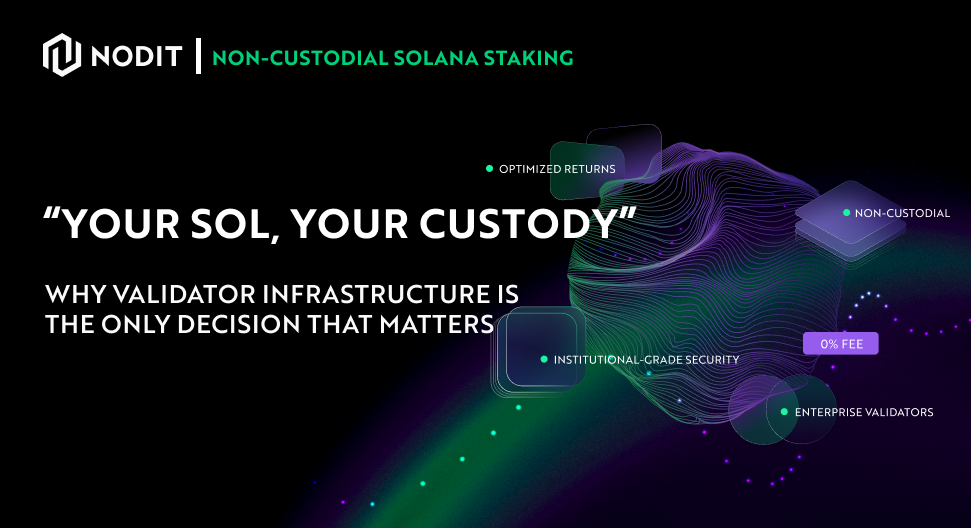
Your SOL, Your Custody: Why Validator Infrastructure Is the Only Decision That Matters
TL;DR
- Nodit's non-custodial Solana staking service is now available for institutional and enterprise clients.
- 0% commission and block rewards are passed directly to delegators.
- Built on the same validator infrastructure already supporting exchange and enterprise workloads across APAC
- No custody transfer required. Asset ownership remains with the delegator throughout the staking lifecycle.
Organizations holding SOL are already making a choice. Not staking is one of them.
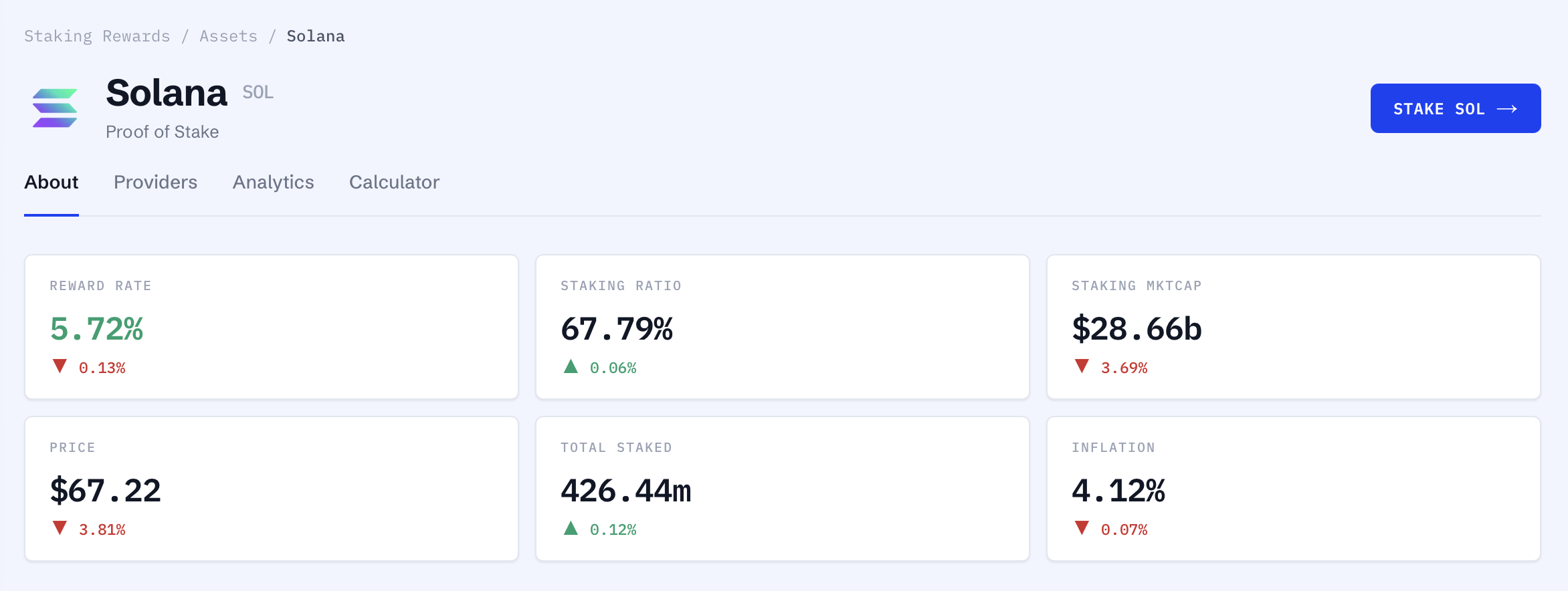
As of the date of this drafting, staked SOL earns around 5.72% APY (Ref. Staking Rewards). Every epoch that passes without staking is a missed yield opportunity. Holding SOL without staking means foregoing rewards generated by the network, as those rewards are distributed each epoch to participants who actively stake and help secure the network.
This article covers what you should know before staking, how to evaluate a validator, and how to stake your SOL by following our guide.
What Staking Actually Is
Before evaluating providers, it helps to be precise about what staking is, and what it is not.
Staking is not a yield product. It is a form of network participation. Solana combines Proof of History (PoH) for transaction ordering with a stake-weighted consensus layer for validator selection and rewards. Validators commit digital assets as collateral to participate in consensus. In return, the protocol generates rewards for those validators and the delegators who back them.
Those rewards come from two sources:
- Inflation rewards — new SOL issued each epoch to validators that participate in consensus, distributed proportionally to delegators
- MEV rewards — additional rewards are distributed to delegators whenever a block is produced. These rewards are generated through participation in JitoMEV and JitoBAM and are distributed proportionally among delegators based on their stake.
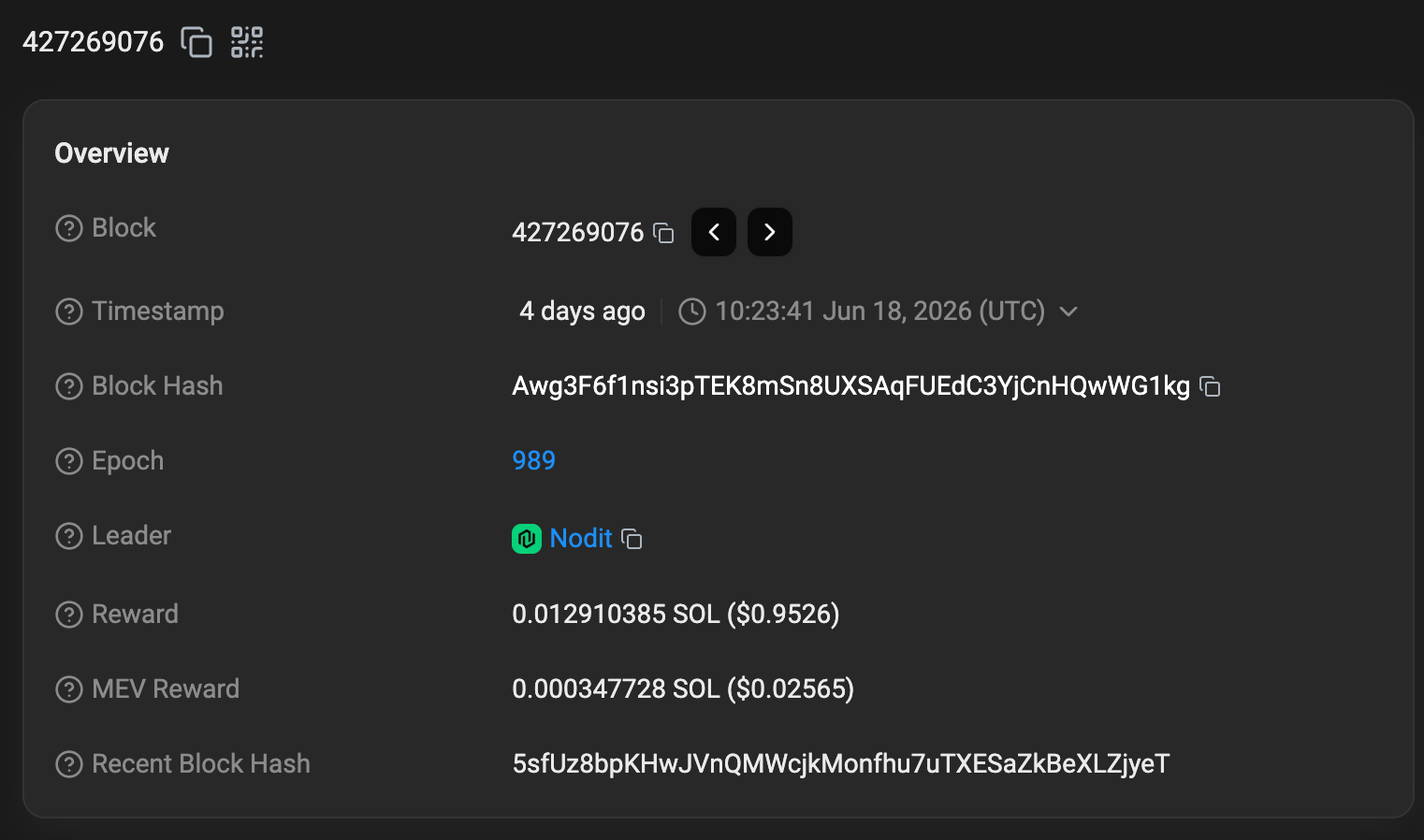
Consider a parallel from traditional finance. An institution holding US Treasury bonds expects to receive coupon payments. Leaving those bonds in a vault without registering them for yield would be considered an operational oversight, not a conservative strategy. SOL staking operates on the same logic. The network issues inflation rewards each epoch to validators and their delegators. That’s why holding SOL without staking means those rewards accrue to everyone else on the network.
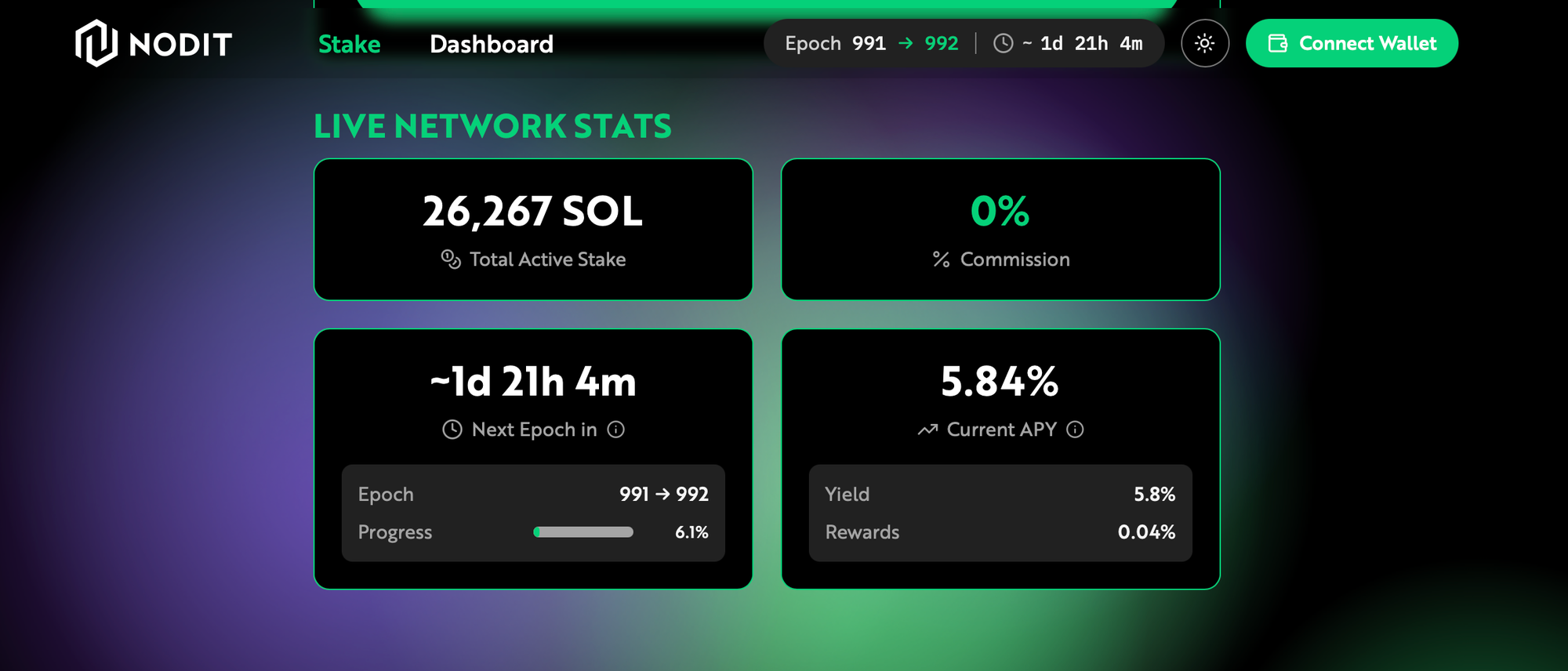
Based on current network conditions, delegators staking with Nodit earn approximately 5.84% APY. Staking rewards are distributed and compounded at the protocol level each epoch (approximately every two days). For the latest validator performance and reward rates, please visit stake.nodit.io .
Why Staking with a Service Provider Makes Sense
Running a validator independently requires dedicated hardware, consistent uptime management, and deep familiarity with protocol-level requirements. For most of institutions, that operational overhead is neither practical nor within scope.
Staking through an infrastructure provider addresses that directly.
Operational simplicity
The provider manages validator setup, maintenance, and performance monitoring. Organizations can delegate SOL without running any infrastructure of their own.
MEV reward optimization
Specialized providers integrate advanced block production tooling to capture additional rewards. Those rewards are then passed back to delegators, increasing effective yield beyond base inflation rewards. Additional, most staking services charge between 3% and 100% as an operation fee on these rewards. Nodit charges 0%, all rewards go directly to delegators, with no deduction.
Reporting and compliance support
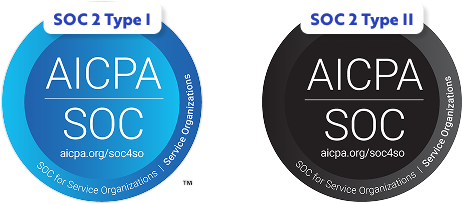
Enterprise operators typically require epoch-level reward tracking, audit-ready documentation, and exportable records for tax and compliance purposes. Infrastructure providers with institutional-grade processes are set up to deliver this. Nodit holds SOC 2 Type II certification covering its infrastructure operations, providing independent validation of the security, availability, and operational controls that regulated partners require.
Not all provider structures carry the same risk profile.
💡Pooled staking
Contracts lower the barrier to entry but introduce smart contract risk and require delegators to trust the pool operator to distribute rewards accurately. Counterparty risk is real if the operator suffers a breach or operational failure.
💡Centralized exchange staking
Requires transferring custody of assets to the exchange. Rewards are distributed at the exchange's discretion, and the delegator has no direct relationship with the underlying validator.
💡Non-custodial native staking
Delegating directly to a validator without transferring asset ownership, preserves full custody while still benefiting from the provider's infrastructure and block reward capabilities. For regulated entities with internal custody requirements, this is the structure that aligns most cleanly with existing compliance frameworks.
Institutional Staking Decision Framework
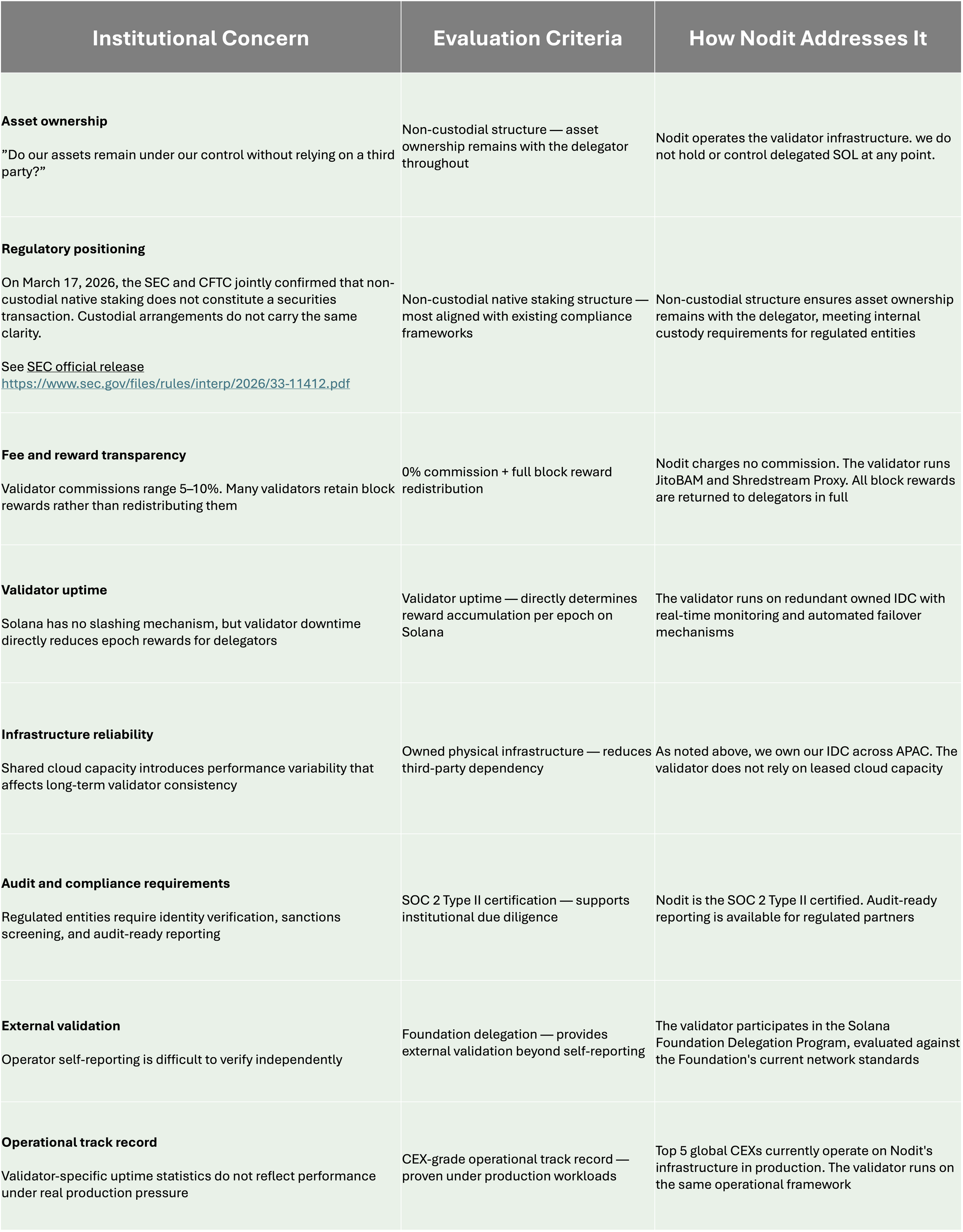
The challenge for treasury and compliance teams is rarely yield generation. Most institutions managing digital assets have already modeled the economics. What slows decisions down is structural.
The framework below consolidates the key institutional concerns, evaluation criteria, and how Nodit addresses each into a single reference.
Understanding the Solana Staking Lifecycle Before You Start
Before committing stake, treasury and operations teams benefit from understanding how Solana's epoch-based system works in practice.
1. Initiating stake
When delegation is submitted, SOL moves from the wallet into a dedicated stake account. The transaction is confirmed on chain, but the stake is not yet earning rewards. The account enters an activating state pending the next epoch boundary.
2. Activation (one epoch, approximately 2 to 3 days)
Stake becomes active at the next epoch boundary, not immediately upon transaction confirmation. This delay is by design: Solana's epoch structure prevents stake from being used to game reward distribution within a single epoch. Once active, the delegation begins earning inflation rewards.
3. Active (earning each epoch)
Active stake earns two types of rewards:
- Inflation rewards — automatically compounded into the stake account each epoch
- MEV rewards — aewards distributed from Nodit's participation in JitoMEV and JitoBAM
Stake remains active indefinitely until deactivation is explicitly requested.
4. Deactivation (one epoch, approximately 2 to 3 days)
When deactivation is initiated, the stake stops earning rewards at the next epoch boundary. During the deactivation epoch, the SOL is locked and unavailable for withdrawal or transfer.
5. Withdrawal
Once deactivation completes, the principal and all accumulated rewards are available for withdrawal to the originating wallet. No additional waiting period applies.
Key timing considerations for treasury planning:
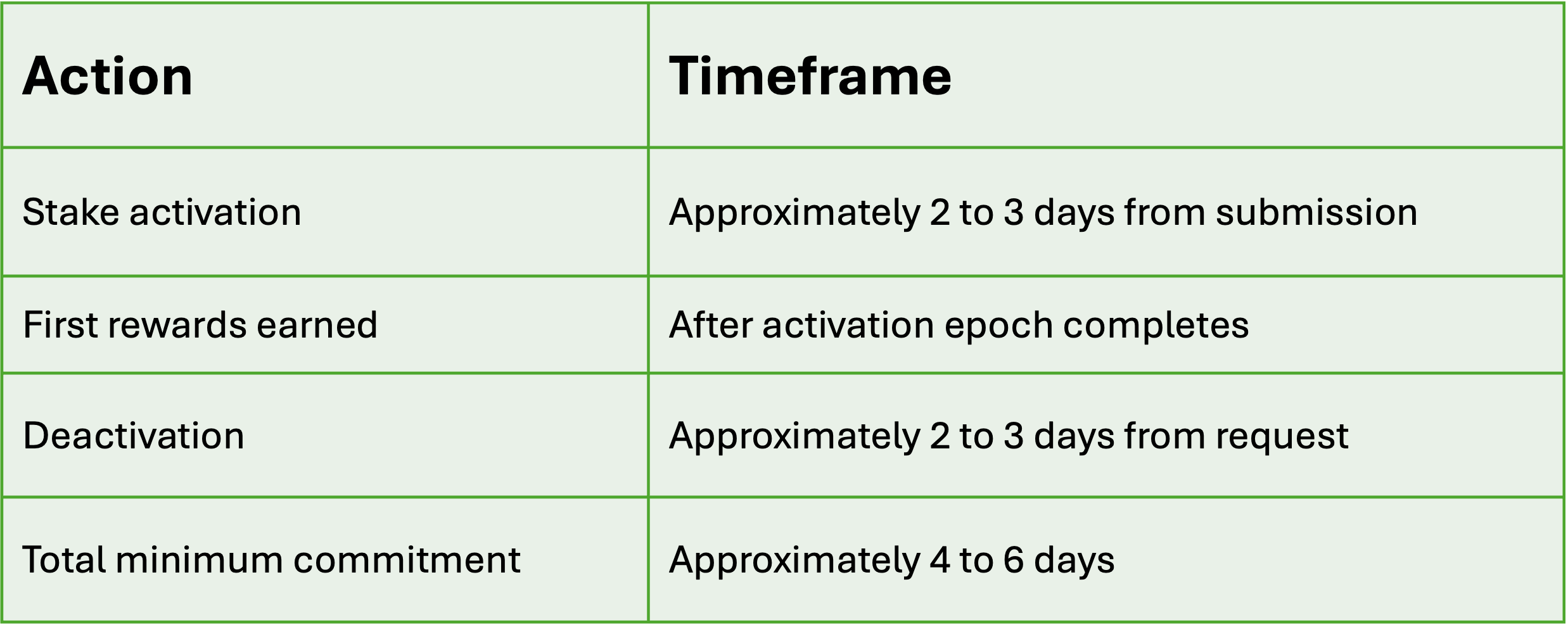
All state transitions occur at epoch boundaries. Understanding this timing is relevant for organizations that need liquidity by a specific date or are coordinating staking activity with broader treasury operations.
Start Staking Your Solana (SOL)
Stake is delegated directly to the validator, with no intermediary custody layer involved. Organizations can independently verify the validator's on-chain status, performance history, and operational track record before committing stake.
FAQ: Nodit Non-Custodial Solana Staking
This FAQ is intended for informational purposes only and does not constitute financial, legal, or investment advice. Organizations should evaluate their specific regulatory obligations independently before participating in staking activities.
General / Institutional
Q: What is non-custodial Solana staking?
Non-custodial staking means delegating SOL directly from your own wallet to a validator without transferring asset ownership to a third party. Your SOL never leaves your custody. You retain full control of your assets throughout the staking lifecycle while earning network rewards each epoch.
Q: What is the difference between non-custodial staking and Centralized exchange staking?
Centralized exchange staking requires you to transfer custody of your SOL to the exchange. They manage the validator relationship and distributes rewards at its discretion. Non-custodial staking keeps your assets in your own wallet. You delegate voting rights to a validator, but asset ownership and control remain entirely with you.
Q: Is Solana staking safe for institutions?
Solana does not implement a slashing mechanism, meaning delegated SOL cannot be penalized or reduced due to validator behavior. The primary risk for delegators is validator downtime, which reduces reward accumulation rather than principal. Institutions should evaluate validators based on infrastructure ownership, operational track record, and compliance posture rather than commission rates alone.
Q: What staking rewards can institutions expect on Solana?
Staking rewards on Solana come from two sources: inflation rewards, which are automatically compounded into the stake account each epoch, and block rewards generated through block production infrastructure. At current network rates, Nodit's validator delivers approximately 5.84% APY. Nodit charges 0% commission and redistributes block rewards to delegators in full.
Q: How long does it take to start earning staking rewards on Solana?
Stake activation takes approximately one epoch, which is 2 to 3 days. Rewards begin accumulating after the activation epoch completes. Deactivation also takes one epoch. The minimum total commitment from staking to withdrawal is approximately 4 to 6 days.
Q: What compliance standards does Nodit meet for institutional staking?
Nodit is SOC 2 Type II certified which covering its infrastructure operations, including security, availability, and operational controls. Audit-ready reporting is available for regulated partners. The validator participates in the Solana Foundation Delegation Program, which provides external validation of infrastructure quality and operational standards.
Q: Why should institutions stake SOL rather than hold it idle?
Solana issues inflation rewards each epoch to validators and their delegators. Holding SOL without staking means those rewards accrue to other network participants instead. At current network rates, the opportunity cost of not staking compounds over time. Non-custodial staking allows institutions to earn network rewards without transferring asset custody or introducing additional counterparty risk.
Technical
Q: How does Solana's consensus mechanism work?
Solana combines Proof of History (PoH) with a stake-weighted consensus layer. PoH provides a cryptographic clock that orders transactions without requiring validators to communicate timestamps. The stake-weighted layer determines validator selection and reward distribution. Validators with more delegated stake participate more frequently in consensus and earn proportionally higher rewards.
Q: What is JitoBAM and how does it affect staking rewards?
JitoBAM (Block Assembly Marketplace) is block production infrastructure developed by Jito Labs. It improves transaction sequencing transparency and reward efficiency by giving validators a more structured way to participate in block construction. Rewards generated through block-level activity flow through to stakers rather than being retained by the operator. Nodit runs JitoBAM on its validator, with all block rewards redistributed to delegators in full.
Q: What is Shredstream Proxy and why does it matter?
Shredstream Proxy reduces shred propagation latency from the block leader to the validator. Lower propagation latency improves the validator's ability to submit votes quickly, which directly affects vote credit accumulation per epoch. Higher vote credits translate into more consistent reward distribution for delegators.
Q: What happens to staking rewards during validator downtime?
Solana ties reward accumulation directly to validator uptime and vote participation. A validator that misses votes during downtime earns fewer rewards that epoch, and its delegators receive proportionally less. On Solana, validator reliability is a yield concern rather than a safety concern, since no slashing mechanism exists. Nodit operates on redundant owned IDC infrastructure with real-time monitoring to minimize downtime-related reward loss.
Q: What is the difference between inflation rewards and block rewards on Solana?
Inflation rewards are new SOL issued by the protocol each epoch and distributed to validators and delegators proportional to stake weight. They are automatically compounded into the stake account. Block rewards are generated through block production activity, including transaction fees and rewards from block-building infrastructure such as JitoBAM. Block rewards accumulate separately in the inactive balance and require a manual harvest transaction to compound back into active stake.
Q: Does Solana have a slashing mechanism?
No. Solana does not implement a slashing mechanism. Delegated SOL cannot be reduced or penalized due to validator behavior. The primary consequence of validator underperformance is reduced reward accumulation during affected epochs, not loss of principal.
Q: What is owned IDC and why does it matter for staking?
Owned IDC (Internet Data Center) means the validator operator owns and operates its own physical data centers rather than running on leased cloud capacity. Physical ownership provides greater control over hardware, networking, and operational processes. It eliminates the shared-resource variability of cloud environments, which can affect validator performance consistency and reward accumulation. Nodit operates its own IDC infrastructure across APAC.
🔎About Nodit
Nodit is an enterprise-grade Web3 platform that provides reliable node and consistent data infrastructure to support the scaling of decentralized applications in a multi chain environment. The core technology of Nodit is a robust data pipeline that performs the crawling, indexing, storing, and processing of blockchain data, along with a dependable node operation service. Through its new Validator as a Service (VaaS) offering, Nodit delivers secure, transparent, and compliant validator operations that ensure stability, performance visibility, and regulatory assurance.
By utilizing processed blockchain data, developers and enterprises can achieve seamless on chain and off chain integration, advanced analytics, comprehensive visualization, and artificial intelligence modeling to build outstanding Web3 products.
![[DataShare Insight] On-Chain Data as a Foundation for Market Intelligence](https://storage.ghost.io/c/00/e4/00e497ca-82e8-447b-9af3-b700db69ca26/content/images/size/w600/2026/09/Data-Analyst--_-Blog-Thumbnail.png)
![[DataShare Insight] AI-Ready On-Chain Data for Regulated Enterprises](https://storage.ghost.io/c/00/e4/00e497ca-82e8-447b-9af3-b700db69ca26/content/images/size/w600/2026/09/Group-C-_-AI-Blog-Thumbnail.png)