Nodit Now Operates a Solana Validator in APAC
TL;DR
- Nodit is now running a Solana validator node in Japan
- Solana's validator set is shrinking and its geographic distribution remains heavily concentrated in Europe and North America
- Nodit's infrastructure directly addresses that gap in APAC, running a validator in Japan, DoubleZero dedicated fiber, and SOC 2 Type II certified processes
- The same infrastructure stack supports multiple exchange clients today
- Institutional staking service and additional Solana infrastructure products are in progress
Nodit is now a Solana validator, operating a node in Japan.
The infrastructure running behind it is not new. Owned IDC, DoubleZero dedicated fiber, and SOC 2 Type II certified operations have been supporting exchange and enterprise clients across APAC in production. The validator is the next layer of that same stack, not the start of something new.
Validator Distribution Remains One of Solana's Infrastructure Challenges
Solana has made significant progress in improving network performance, but geographic distribution remains an ongoing challenge.
According to data from Solana Beach, approximately 68% of delegated stake is concentrated among European validators. The United States, Netherlands, United Kingdom, and Germany account for the majority of the network's validator infrastructure, while APAC remains comparatively underrepresented.
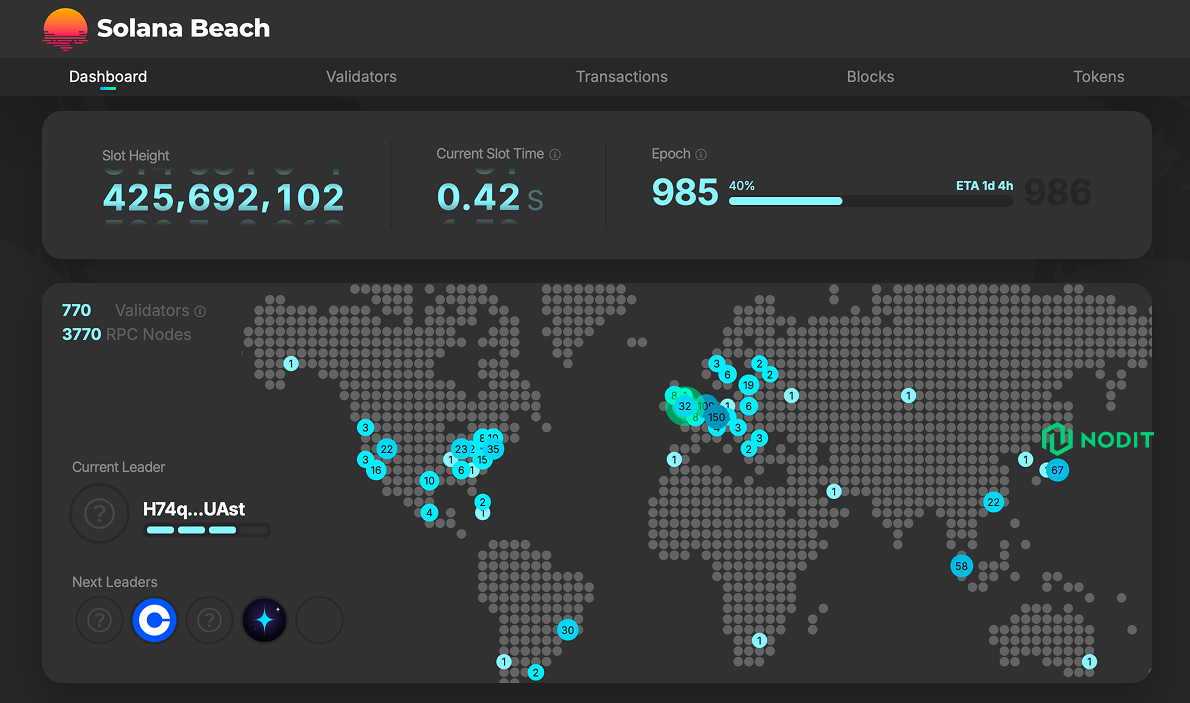
For institutions building on Solana in the region, whether in payments, tokenized assets, digital banking, or DeFi, this concentration has real consequences. Infrastructure located outside the region introduces latency variance, reduces reliability during peak activity, and creates dependencies that compliance aware operators cannot ignore.
This challenge is closely tied to Solana's broader infrastructure objective: Increase Bandwidth, Reduce Latency (IBRL). Achieving low latency performance across the network requires more than faster hardware or better software. It requires geographically distributed infrastructure capable of serving users where they operate.
That is one of the reasons APAC validator expansion has become an increasing focus across the ecosystem. Jito Foundation and Solana Company only announced their APAC validator expansion initiative in May 2026, highlighting that the infrastructure gap remains a work in progress.
And now, Nodit's validator in Japan is a direct response to that.
What It Takes to Run at This Level
Running a validator in APAC is not hard. Running one that regulated institutions can stake to is a different problem.
Nodit's validator runs on the same infrastructure the company already operates for exchange and enterprise clients across the region:
- DoubleZero dedicated fiber
Nodit is the first APAC RPC on the network. Dedicated fiber takes Solana traffic off the public internet, which cuts the latency variance that degrades vote quality and block production. This is IBRL applied at the infrastructure layer, not just talked about. - JitoBAM and Shredstream Proxy
Nodit's validator runs both JitoBAM and Shredstream Proxy. JitoBAM improves transaction sequencing transparency and reward efficiency for validators and their delegators — giving validators a more structured way to participate in block construction and enabling rewards generated through block-level activity to flow through to stakers. In additions, Shredstream Proxy helping improves validator responsiveness and vote credit performance. - SOC 2 Type II certified processes
Nodit maintains SOC 2 Type II certification across its infrastructure operations. For regulated organizations, infrastructure evaluation extends beyond uptime to include security controls, operational governance, and auditability. The validator operates within the same environment covered by that certification.
These are not investments made for validator rankings. They are the result of operating infrastructure for organizations that require reliability, transparency, and predictable performance under production conditions.
Validator Credentials
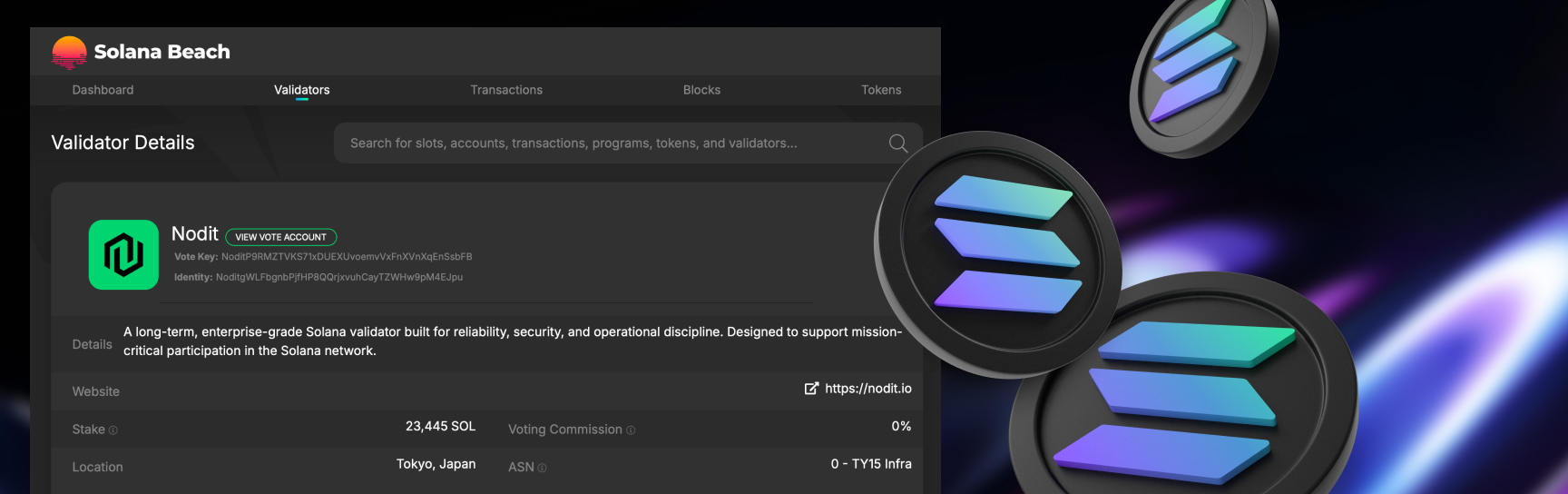
Nodit's validator is live and verifiable on-chain:
- Validator Identity: https://solscan.io/account/NoditgWLFbgnbPjfHP8QQrjxvuhCayTZWHw9pM4EJpu
- Validator Vote Account: https://solscan.io/account/NoditP9RMZTVKS71xDUEXUvoemvVxFnXVnXqEnSsbFB
Built on Infrastructure Already Trusted by Enterprise Operators
Nodit runs node infrastructure for multiple centralized exchanges. That is worth pausing on.
Centralized exchanges run some of the most demanding infrastructure requirements in the industry: high availability, consistent performance, and zero tolerance for downtime. The stack powering Nodit's validator is the same stack those exchange clients depend on today.
For institutions evaluating a staking or infrastructure partner, that operational track record answers a harder question than uptime percentages: does this operator perform under real production pressure, for clients who cannot absorb failure?
Expanding Nodit's Solana Infrastructure Offering
Institutional momentum on Solana is accelerating. RWA TVL on the network crossed $1.1 billion in January 2026, ranking third globally. State Street announced plans to tokenize funds on Solana. Visa, Stripe, and BlackRock are using the network for stablecoin settlements and asset issuance.
As that capital flows in, the infrastructure supporting it needs to meet a higher standard. Nodit's Solana stack is being built for exactly that:
- Solana RPC: Live in production
- DataShare for Solana: Early access available now
- Institutional Staking Service: Coming soon
- Solana Web3 Data API: Planned for Q3
The institutional non-custodial staking service is the next piece. More on that shortly.
🔎About Nodit
Nodit is an enterprise-grade Web3 platform that provides reliable node and consistent data infrastructure to support the scaling of decentralized applications in a multi chain environment. The core technology of Nodit is a robust data pipeline that performs the crawling, indexing, storing, and processing of blockchain data, along with a dependable node operation service. Through its new Validator as a Service (VaaS) offering, Nodit delivers secure, transparent, and compliant validator operations that ensure stability, performance visibility, and regulatory assurance.
By utilizing processed blockchain data, developers and enterprises can achieve seamless on chain and off chain integration, advanced analytics, comprehensive visualization, and artificial intelligence modeling to build outstanding Web3 products.
![[DataShare Insight] On-Chain Data as a Foundation for Market Intelligence](https://storage.ghost.io/c/00/e4/00e497ca-82e8-447b-9af3-b700db69ca26/content/images/size/w600/2026/09/Data-Analyst--_-Blog-Thumbnail.png)
![[DataShare Insight] AI-Ready On-Chain Data for Regulated Enterprises](https://storage.ghost.io/c/00/e4/00e497ca-82e8-447b-9af3-b700db69ca26/content/images/size/w600/2026/09/Group-C-_-AI-Blog-Thumbnail.png)