Nodit's All-in-One Institutional Data API Package: A Clear Reference for Digital Asset Operations
TL;DR
- Digital asset services are moving beyond experimentation. Stablecoin issuers, neobanks, crypto card providers, settlement platforms, and wallet services now need reliable on-chain data infrastructure to run their core operations.
- Most blockchain data tools are still organized by chain and endpoint type — not by how product and operations teams actually build services.
- Nodit's Institutional Data API is a structured package that maps its Web3 Data API capabilities to five operational categories: Asset & Account, Payments & Transfers, Transactions & Provenance, Monitoring & Alerts, and Controls & Audit.
- Think of it as an API menu — a reference for teams evaluating which data capabilities they need, and how those capabilities can be adopted into their services.
A Slight Recap from DAS NYC — The Shift Has Already Happened
At the Digital Asset Summit in New York earlier this year, a few signals stood out that are worth paying attention to.
1.Regulation is no longer the ceiling — it's becoming the floor.

SEC Chair Paul Atkins made his position clear: "Being free to conduct one's affairs, including financial affairs, free from government and other surveillance is a core American value." For teams building or operating on-chain, this matters less as a political statement and more as a structural one. The compliance environment is stabilizing, and the window for building serious infrastructure is open.
2.The CFTC is actively clearing the path for on-chain financial products.

Through its Innovation Advisory Task Force, the commission is working to make perpetual futures DEXes legal to operate in the US, support self-custody, and create space for prediction markets and crypto-native financial products within a proper regulatory framework. The United States is positioning itself to compete for on-chain financial activity, not push it offshore.
3.TradFi and DeFi are no longer running in parallel — they are converging.
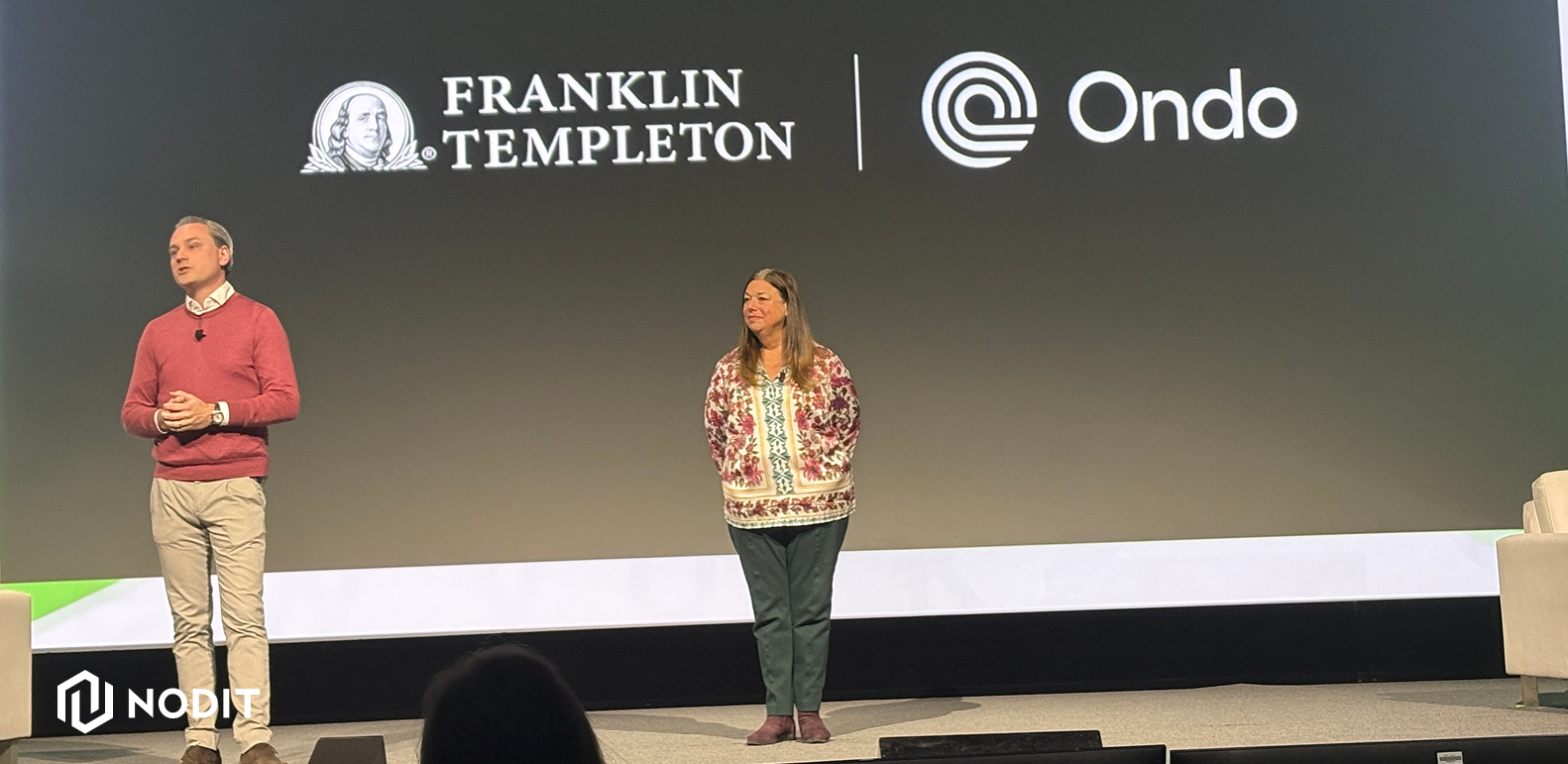
Perhaps the most telling signal came from the Ondo Finance and Franklin Templeton partnership announcement. Ondo, which has already crossed $2 billion in TVL across its tokenized treasury products and $700 million in tokenized stocks and ETFs, formalized a collaboration with Franklin Templeton to bring institutional-grade investment products — equities, bonds, private credit, real estate, infrastructure, and crypto — onto public blockchains for global investors. Franklin Templeton has been running the industry's first tokenized government money market fund since 2021, including intraday yield paid directly to wallets. The partnership signals a shift toward a future where diversified institutional portfolios are accessible on-chain to anyone, anywhere.
4.This is no longer adoption. This is absorption.
The industry has shifted from asking whether traditional finance will engage with blockchain, to watching DeFi infrastructure, liquidity, and product structures being absorbed directly into how financial services are designed and operated. Exchanges, custodians, stablecoin platforms, and treasury teams are no longer at the frontier. They are the infrastructure that the next generation of financial products runs on.
The industry is moving fast and in one direction. Like bees building a hive, every participant is contributing to a structure that is becoming the new financial backbone. Reliable Web3 data infrastructure is no longer optional, it is the condition for building services in this space at all. That is why we structured our Web3 Data API as the CIB Institutional Data API — a clear reference for teams evaluating what data capabilities they need and how to adopt them.
The Gap Between Blockchain Data and Institutional Operations
The blockchain data ecosystem was built, largely, for developers. The organizing logic is technical: here are the APIs for Ethereum, here are the APIs for Solana, here are token transfer endpoints, event log endpoints, contract read endpoints. If you know what you need and you're willing to spend engineering time normalizing, enriching, and stitching together data from different chains with different schemas, you can eventually build something operational.
That approach works for product teams building consumer applications. It doesn't work well for the treasury team that needs to know, right now, whether a $14 million transfer has cleared. It doesn't work for the compliance team that needs to reconstruct the complete flow of funds for a regulatory inquiry. It doesn't work for the operations team whose alerting system fires at 2am when a large deposit arrives and needs the context to act.
Institutional digital asset operations run on workflows, not endpoints. And those workflows have five core questions at their center: where are our assets and how much do we hold; how do we move them safely and under policy; what happened and can we prove it; are we detecting risks in real time; and who is accountable. When the data infrastructure doesn't map to those questions, institutions end up building the mapping themselves — which is expensive, brittle, and slow.
How the Nodit Institutional Data API Is Structured
To close this gap, Nodit repackaged its Web3 Data API into a dedicated institutional offering under the CIB framework by restructuring its core data capabilities around the operational realities of on-chain teams. The API categories aren't named after chains or technical functions. They're named after the business workflows they serve.
1. Asset & Account
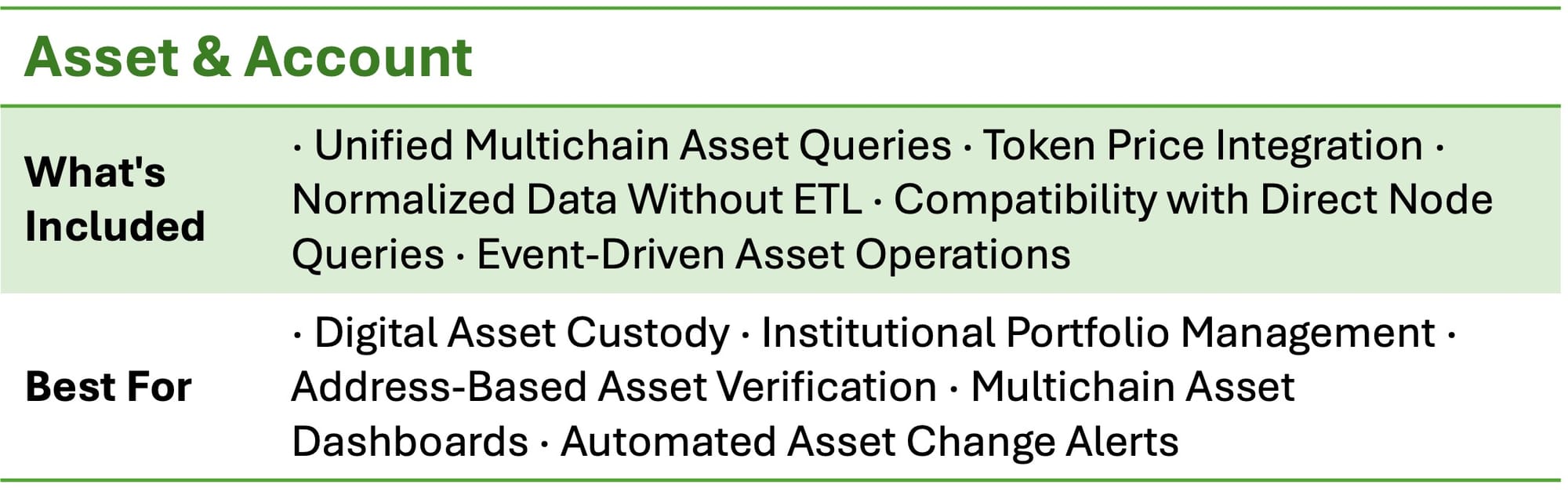
Always know what you hold, where it sits, and whether it's authorized to move.
Access and monitor on-chain asset positions at the account level with ease. Retrieve native tokens, ERC-20 assets, and NFTs across multiple chains through a unified API, eliminating the need to handle chain-specific data structures. Nodit delivers normalized, institution-grade data for scalable asset management and visibility.
2. Payments & Transfers
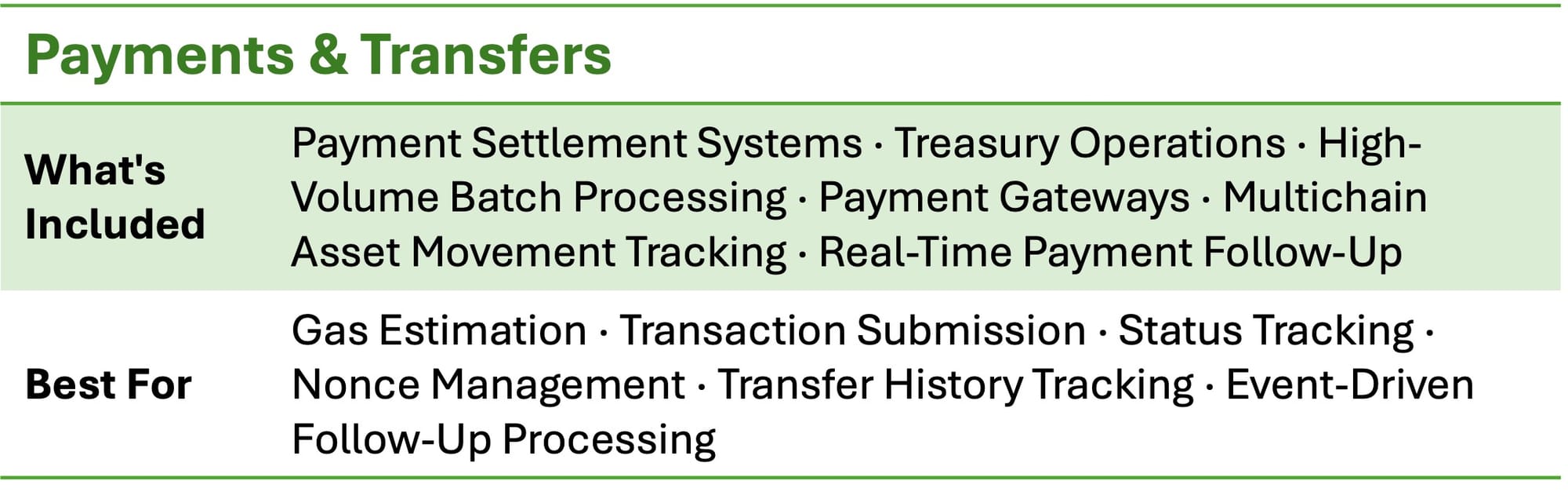
Execute asset movements with the control and auditability your operations team requires.
Develop institutional-grade payment systems powered by seamless on-chain transaction execution and lifecycle management. From gas estimation and transaction submission to receipt validation, nonce handling, indexed tracking, and event-driven workflows, Nodit supports every stage of the payment process. More than simple transfer APIs, it transforms asset movement into a controlled, reliable operational workflow.
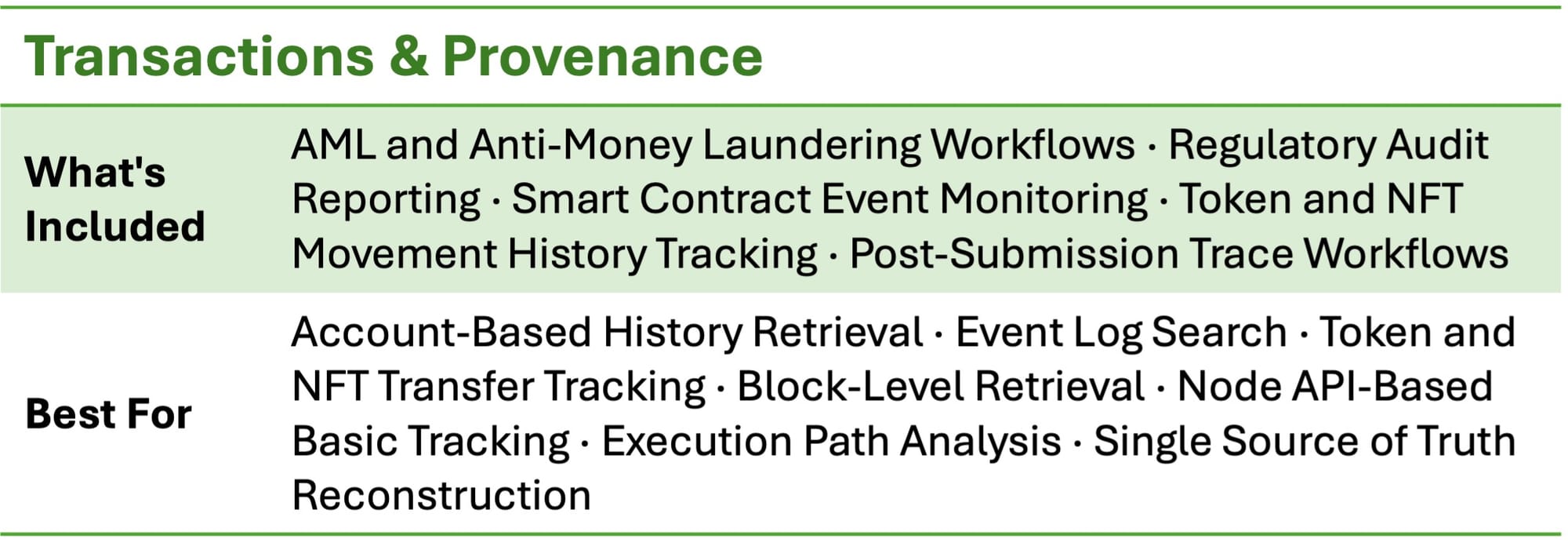
3. Transactions & Provenance
Every transaction has a reason and a trail. Make sure you can reconstruct both.
Track and reconstruct transaction activity with full visibility. Submit raw transactions via Node APIs, monitor their status, and leverage Web3 Data APIs alongside trace methods to analyze internal calls and fund flows. This provides a foundation for real-time ledger intelligence, where transactions are not only recorded but also contextualized and understood.
4. Monitoring & Alerts
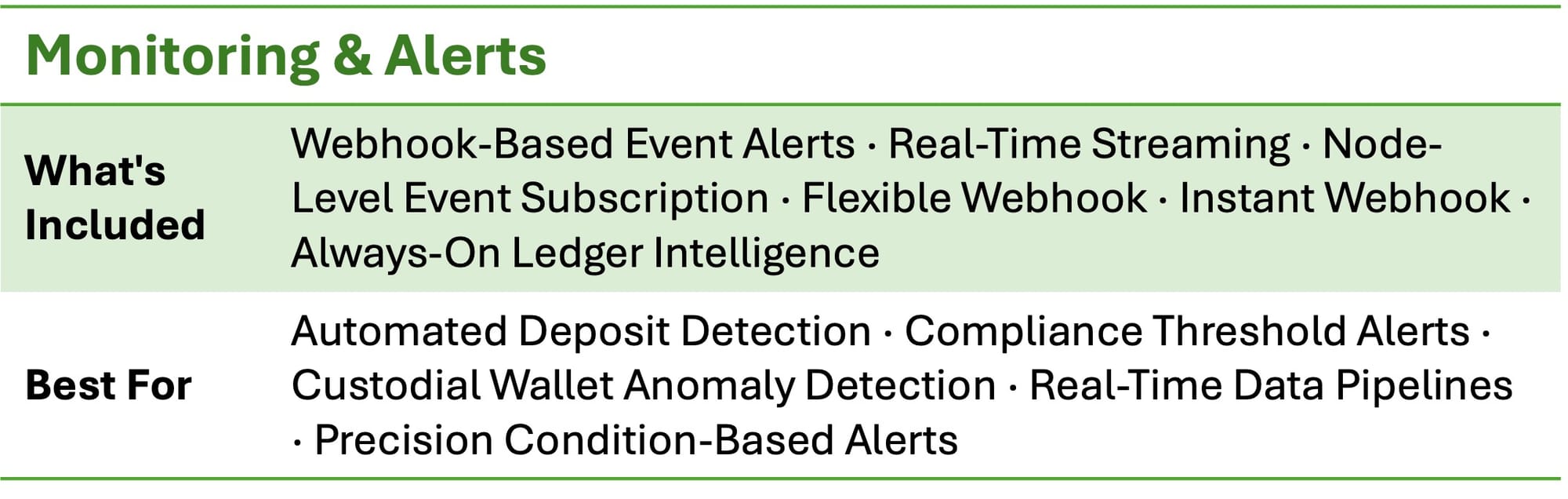
Catch what matters on-chain before it becomes an operational problem.
Automate real-time on-chain event detection and condition-based alerting to build responsive services. Instead of continuously polling blockchain nodes, use event-driven architecture to implement deposit detection, large transfer alerts, and custom event filtering without polling. From an institutional continuity perspective, the core requirement is to keep monitoring active even during disruptions.
5. Controls & Audit
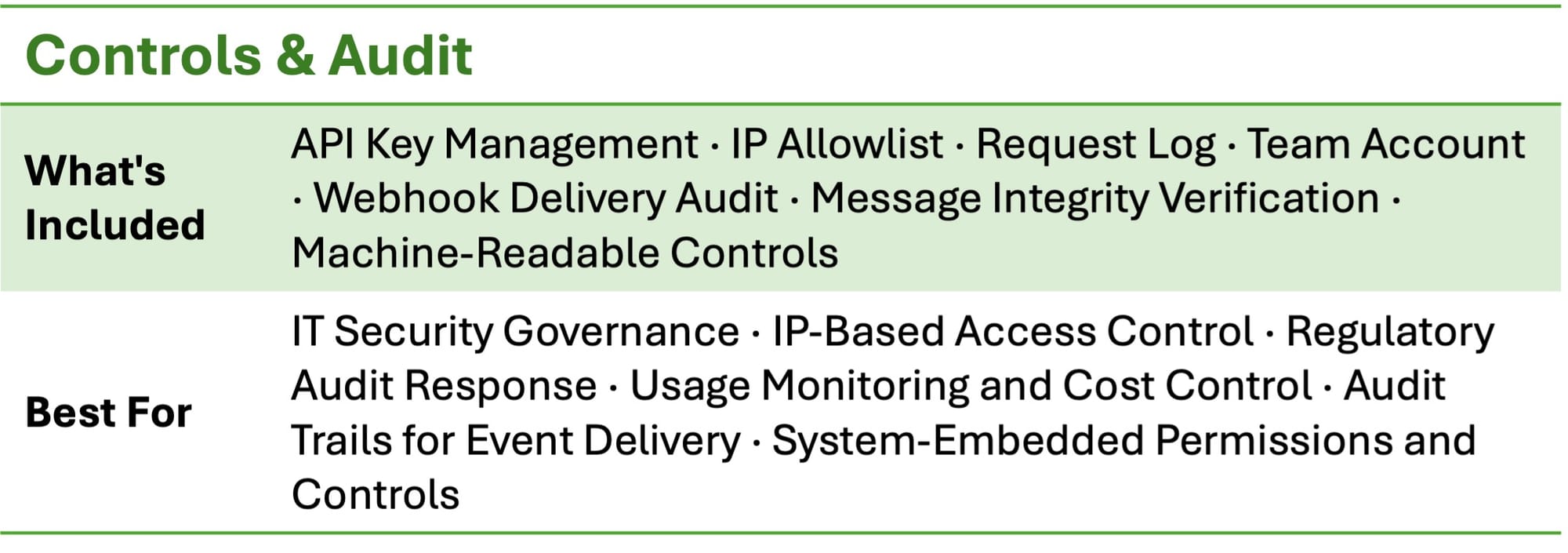
Operate with the governance structure your organization demands.
This capability covers access control and auditability for blockchain infrastructure operations. Use API key management, IP-based access control, team role management, and API request history to meet enterprise IT governance requirements. Nodit is SOC 2 Type I and Type II certified and is designed around machine-readable controls and operational evidence.
Key Outcomes for Your Operations
Choosing the right data infrastructure isn't just a technical decision — it has direct consequences for how fast your team can ship, how reliably your operations run, and how confidently you can scale. Here is what changes when your data layer is built around how your team actually works.
1.Faster integration, from day one.
When the API is organized around operational workflows, a wallet operations team doesn't need to study chain-specific documentation to figure out which endpoints map to their use case. They start from the workflow they already understand — asset visibility, transfer execution, transaction tracing — and find the data they need inside that frame. Less time decoding infrastructure, more time building what actually matters to the business.
2.Adding a new chain should not feel like starting over.
One of the most consistent complaints we heard from operations teams was that adding a new chain meant a new integration project — different schemas, different event structures, different ways of representing the same underlying operations. The Institutional Data API standardizes across chains at the workflow level. Adding Solana next to Ethereum becomes a configuration decision, not an engineering sprint.
3.Infrastructure that grows with the industry, not just with your chain count.
A perpetual futures platform needs the same transaction provenance and monitoring capabilities as a custody provider. A stablecoin issuer needs the same settlement visibility and audit controls as a corporate treasury team. Nodit's Institutional Data API is built to be that shared layer: reliable enough for a top-tier exchange processing hundreds of millions of requests a day, and organized well enough for a compliance desk or treasury function to work with directly.
Why Institutional Teams Choose Nodit (See It for Yourself)
How many times has your team had to rebuild an integration just because you added a new chain?
✔️One Reliable Data Layer Across Every Chain
Adding a new network should not mean starting a new integration project. Nodit standardizes on-chain data across supported chains so institutional teams can scale their operations without rebuilding from scratch each time.
How much of your engineering time is spent normalizing raw blockchain data before it's actually usable?
✔️Enriched Data, Without the Processing Overhead
Nodit's pre-indexed and normalized blockchain data connects directly to your reconciliation, risk, and reporting systems. No custom indexing pipeline required, and no data engineering detour between raw chain data and production use.
What happens when your data layer and your node infrastructure are managed by different vendors and something breaks?
✔️Full-Stack Infrastructure Accountability
Nodit operates its own node infrastructure alongside its data API, delivering tighter SLA coverage and a single vendor accountable for the full data stack. Fewer failure points in the critical path means fewer incidents your team has to absorb.
How much time does your team spend translating blockchain data into something your operations, compliance, and treasury functions can actually work with?
✔️Organized Around Institutional Workflows
Asset visibility, transfer execution, transaction tracking, on-chain monitoring, and audit controls are structured around what exchanges, custodians, and financial institutions actually need to operate digital assets — not around how blockchains happen to expose their data.
Who This Is Built For
The Nodit Institutional Data API is designed for organizations where digital asset operations have moved beyond experimentation and into the operational core of the business.
- Stablecoin Issuers needing real-time settlement visibility, transfer execution, and on-chain event detection across multiple chains
- Crypto Card Providers requiring balance verification, spend tracking, and real-time transaction monitoring at the account level
- Neobanks building wallet infrastructure that needs consistent, normalized data across chains without rebuilding for every network
- Settlement Platforms requiring full transaction provenance, reconciliation data, and audit-ready history across supported chains
- Wallet Services needing asset visibility, approval tracking, and event-driven alerting built into their operational layer
Trusted by Teams Operating at Scale
Infrastructure credibility isn't built on promises. It's built on what holds up under real load.
Nodit handles close to 200 million requests per day across dedicated and elastic nodes — sustained without introducing latency. That reliability is backed by SOC 2 Type I and Type II certification, meaning the security controls, access governance, and operational evidence your compliance team will ask for are already in place.
 Nodit Team
If the teams already running on Nodit trust it with production workloads at that scale, the data API you're evaluating here is built on the same foundation.
🔎About Nodit
Nodit is an enterprise-grade Web3 platform that provides reliable node and consistent data infrastructure to support the scaling of decentralized applications in a multi chain environment. The core technology of Nodit is a robust data pipeline that performs the crawling, indexing, storing, and processing of blockchain data, along with a dependable node operation service. Through its new Validator as a Service (VaaS) offering, Nodit delivers secure, transparent, and compliant validator operations that ensure stability, performance visibility, and regulatory assurance.
By utilizing processed blockchain data, developers and enterprises can achieve seamless on chain and off chain integration, advanced analytics, comprehensive visualization, and artificial intelligence modeling to build outstanding Web3 products.