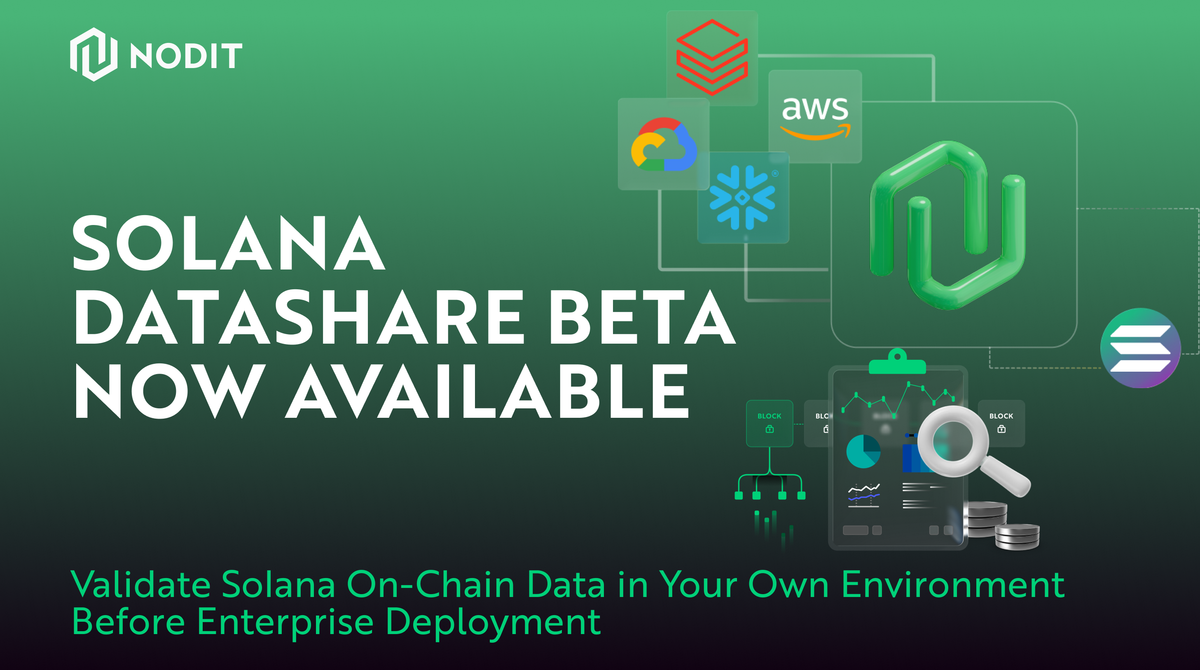
Solana DataShare Beta Launch: Free exports available During Beta
TL;DR
- Datashare Beta version allows data teams to evaluate blockchain datasets directly within their own storage environment before committing to enterprise deployment.
- Each account receives 3 free exports, with each export covering one dataset on one chain.
- The Solana datasets currently include Solana Token Transfers (Nodit Exclusive), Solana Supply Changes (Nodit Exclusive), Solana Balance Changes, SOL Transfers, and Solana Validator Rewards.
Most blockchain data evaluations follow the same pattern. Before teams can assess data quality, they often spend weeks navigating procurement processes, configuring integrations, setting up storage environments, and connecting data pipelines. By the time the first dataset arrives, a significant amount of effort has already been invested without confirming whether the data meets the organization's requirements.
Nodit Datashare Beta version reverses that sequence.
Blockchain Data: Public Does Not Mean Usable
Blockchain data is publicly available in real time. However, public availability and analytical usability are two fundamentally different things.
Traditional financial systems return structured, accounting-ready values directly through an API. Blockchain, by contrast, provides raw and unstructured records as-is. Each chain operates under its own format, and querying across them through a unified standard such as SWIFT or ISO 20022 is structurally incompatible with how blockchain data is stored.
Concepts such as swaps, transfers, balances, and positions do not exist as labeled fields anywhere on-chain. They must be inferred, reconstructed, and reassembled by reading execution records after the fact. The true threshold for data reliability is not whether the data was collected. It is whether the data was interpreted completely and correctly.
This is where pipeline architecture becomes critical. Nodit operates a unified workflow spanning node infrastructure, chain-specific indexing, reorganization and response validation, structured dataset generation, and direct delivery to the customer's storage environment. By managing each stage within a single controlled system, data is verified continuously before it reaches downstream analytical and operational environments.
Among major chains, Solana makes this challenge considerably more pronounced, as it operates on a fundamentally different data structure from EVM chains. Data quality therefore depends not only on collection, but on how consistently that data is indexed, validated, interpreted, and delivered across every stage of the pipeline.
Why Solana Requires A Different Data Approach
If blockchain data is already difficult to work with, Solana takes that challenge further. Most providers that handle Ethereum, Bitcoin, Tron, Base, and Arbitrum well have still not achieved the same depth on Solana — and there is a specific reason for that.
Problem 1: Structural difference
On Solana, token holdings are not directly associated with a wallet address. They are managed through a separate Token Account structure. This is the root reason why data providers designed around EVM chains are unable to cover Solana with the same depth and accuracy.
Problem 2: Access barrier
Working with Raw RPC requires tracing every transaction individually. Extracting large-scale historical data demands running dedicated nodes and constructing a full indexing pipeline before a single row of analysis can begin.
Problem 3: Coverage gap
Most providers limit their coverage to tokens with registered metadata, such as USDC and USDT. Newly issued tokens, meme coins, and unlisted assets fall entirely outside their scope.
1. Token Account Ownership and Authority Change History
Standard approach
To identify the original owner of a specific Token Account, organizations must manually trace back through the full transaction history themselves.
Additional coverage available through Nodit
Nodit parses Token Account creation events and delivers the initial owner and authority information, along with the complete history of subsequent changes, directly through the token_accounts and authority_changestables.
What combining both tables enables
A complete ownership trail from the initial owner of any Token Account through to the current authority holder, without requiring any backtracing logic on the client side.
Institutional use cases
fund tracing, forensic analysis, suspicious transaction investigation, custody and wallet operations.
2. Complete SPL Token Supply History
Standard approach
Supply data is typically available only for established tokens with registered metadata. Coverage beyond this category is limited across most providers in the market.
Additional coverage available through Nodit
Nodit records every mint and burn event across all SPL tokens, regardless of whether metadata has been registered. The complete dataset is available through the token_mint_burns table.
What this enables
Organizations can reconstruct the circulating supply of any token at any point in time and monitor new issuance, additional minting, and burn events across the entire SPL token universe. Teams running stablecoin flow monitoring or year-end tax reporting workflows will find this particularly relevant, as supply reconstruction at a specific historical date is a common requirement that most providers cannot fulfill for unlisted assets.
Institutional use cases
New token monitoring, meme coin supply tracking, token listing due diligence, cost basis tracking and analysis, year-end tax reporting
3. DEX-Based On-Chain Price Data
Standard approach
Price data is sourced from CEX feeds or third-party market data vendors. Tokens without a CEX listing have no price coverage.
Additional coverage available through Nodit
Nodit derives OHLCV price data from actual on-chain DEX swap transactions rather than external feeds. This provides coverage for newly issued tokens, long-tail assets, and meme coins with no CEX listing. Teams conducting on-chain alpha research, liquidity and DEX analysis, or multi-chain asset visibility assessments will have access to price data across assets that conventional market data vendors do not cover.
Institutional use cases
On-chain alpha research, liquidity and DEX analysis, new token listing due diligence, long-tail asset portfolio valuation, treasury dashboards
4. Decoded Data
Raw on-chain data stores trace inputs and log topics as hex strings. Without the ABI, it is not possible to determine which function was called, which event was triggered, or which parameters were passed.
Nodit collects function and event signatures from 4byte.directory, matches them against traces and logs, and delivers the output in a human-readable decoded format. Nodit provides uncommon decoded dataset coverage across the market, making it particularly well suited for teams building anomaly detection systems, entity clustering pipelines, or AI agent data layers where decoded data is a foundational requirement.
What We Launched: Nodit Datashare (Beta)
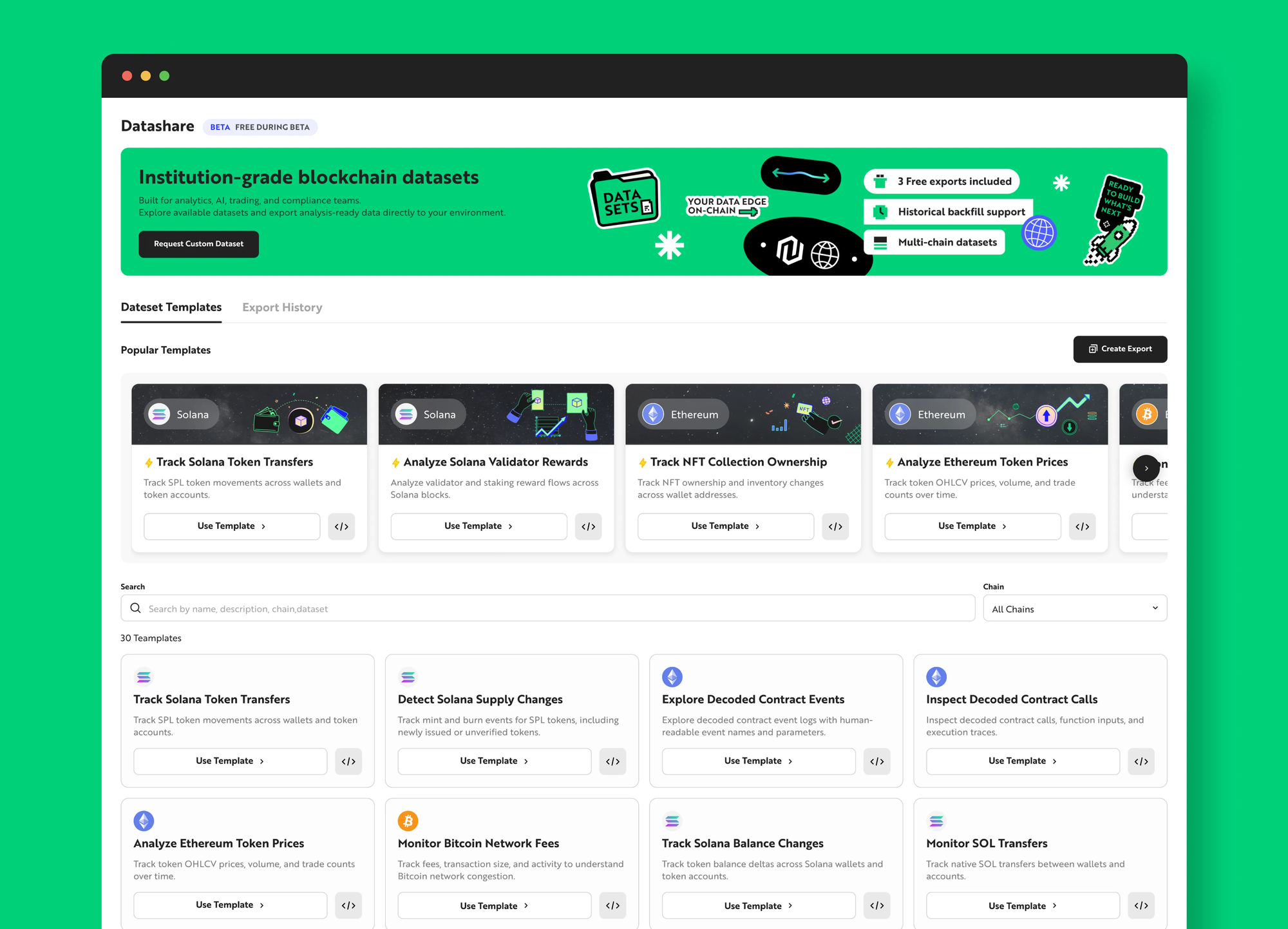
Datashare removes the infrastructure requirements that typically precede a blockchain data evaluation. There is no deployment, no indexing pipeline, and no historical backfilling. Datasets are delivered directly to your storage environment.
Exports are free during the beta period. Each export covers one dataset on one chain, using one day of data from within the past three months which enough to validate schema, assess coverage, and confirm fit before any formal deployment discussion begins.
Solana Dataset Coverage
- Token Activity
- token_transfers
- token_mint_burns
- token_accounts
- token_balance_changes
- token_meta
- token_metaplex
- Account Events
- account_close
- authority_changes
- Programs & Instructions
- programs
- instructions
- Blocks & Transactions
- blocks
- block_rewards
- transactions
- Balance Changes
- sol_balance_changes
If the Solana dataset your team requires is not listed above, or if your use case requires broader scope, please contact us to discuss coverage options.
See It in Action
Built for Enterprise Data Workflows
Nodit Datashare is SOC 2 Type I and II certified, meeting the security, availability, and confidentiality standards that enterprise and institutional environments require.
Solana datasets are currently in use by the top 5 global exchanges for operational data workflows including custody and wallet operations, internal account mapping, and multi-chain asset visibility. The same datasets are available for your team to evaluate directly before any formal deployment begins.
If you would like to learn how exchanges are using these datasets in practice, or explore how Solana data can fit your organization's workflows. We will be releasing a dedicated series covering how each segment can adopt Solana Datashare within their existing data environment.
Three segments will find this particularly relevant:
- Institutional Operations and Compliance including CEX operators, compliance teams, and custody providers
- Financial and Payment Infrastructure including payment and card platforms, digital banks, and asset managers
- Developers, DeFi, and AI Teams
Subscribe to our newsletter to stay up to date.
Request Solana Data
The free export is your starting point. Once your team has validated the data quality within your own environment, the next step is a structured, ongoing Solana data delivery partnership.
Share your Solana data requirements including dataset scope, history range, delivery cadence, storage destination, and workflow, and we will work with you to define a data delivery plan aligned with your operational and analytical needs.
🔎About Nodit
Nodit is an enterprise-grade Web3 platform that provides reliable node and consistent data infrastructure to support the scaling of decentralized applications in a multi chain environment. The core technology of Nodit is a robust data pipeline that performs the crawling, indexing, storing, and processing of blockchain data, along with a dependable node operation service. Through its new Validator as a Service (VaaS) offering, Nodit delivers secure, transparent, and compliant validator operations that ensure stability, performance visibility, and regulatory assurance.
By utilizing processed blockchain data, developers and enterprises can achieve seamless on chain and off chain integration, advanced analytics, comprehensive visualization, and artificial intelligence modeling to build outstanding Web3 products.
![[DataShare Insight] On-Chain Data as a Foundation for Market Intelligence](https://storage.ghost.io/c/00/e4/00e497ca-82e8-447b-9af3-b700db69ca26/content/images/size/w600/2026/09/Data-Analyst--_-Blog-Thumbnail.png)
![[DataShare Insight] AI-Ready On-Chain Data for Regulated Enterprises](https://storage.ghost.io/c/00/e4/00e497ca-82e8-447b-9af3-b700db69ca26/content/images/size/w600/2026/09/Group-C-_-AI-Blog-Thumbnail.png)