[DataShare Insight] The Reference Layer Between the Blockchain and Institutional Books
![[DataShare Insight] The Reference Layer Between the Blockchain and Institutional Books](https://storage.ghost.io/c/00/e4/00e497ca-82e8-447b-9af3-b700db69ca26/content/images/size/w1200/2026/09/Group-A-_-Custody-Blog-Thumbnail.png)
Why custody is becoming a problem of operational control, not technology.
TL;DR
- The focus of custody is shifting from safekeeping assets to reliably operating them.
- When the same asset is managed on a different basis in each system, operational complexity grows.
- A Reference Data Layer is a validated blockchain data foundation that an institution's systems can treat as one common reference, so the whole organization works from the same data.
- Nodit DataShare delivers blockchain data institutions can trust into their operating environment.
The questions around digital asset custody are changing. This article looks at how the defining challenge is changing as institutions operate across more chains, and what it takes to establish a single reference the whole organization can rely on.
The operational shift in institutional custody
The rapid adoption of digital assets by institutions, the expansion of stablecoin-based payment infrastructure, and the rise of tokenized real-world assets are reshaping the institutional custody landscape. As the range of networks and asset types grows, the core challenge of custody is moving from safekeeping to operational control.
In the early years, a custodian's edge came from which chains it could support securely. But now that multi-chain operations are the norm, the challenge is less about chain coverage and more about whether the institution's many systems can interpret and operate on the same asset using a consistent reference.
The defining question changes accordingly: from "which chains do we support?" to "which data does the institution treat as its operational reference?”
From safekeeping to asset-state management
The role of a digital asset custodian does not end at holding assets securely. What an institution owes its clients, auditors, and regulators is not simply custody. It is an operating framework that can explain and verify the state of an asset, at any time, against the same reference.
The blockchain records how assets move and where they stand. But translating that ledger into something the institution can actually operate on is the custodian's responsibility. Calculating balances, managing transfers between hot and cold wallets, accounting for network fees, closing the books, responding to audit and regulatory requests, and generating client reports all happen inside the institution's own operational systems.
These tasks are not performed by a single system. They run in parallel across finance, operations, risk, compliance, and client service. Each function draws on the same on-chain data, but applies a different treatment and a different point in time depending on its purpose.
The core challenge of institutional custody, then, is not holding the asset. It is getting every operational function to share the same asset reference. Custody is no longer won on safekeeping alone. The ability to have the entire operation see the same asset state is becoming a competitive capability in its own right.
One blockchain, multiple internal truths
The blockchain itself is a canonical record. Once a transaction reaches finality, its state is not in question.
The challenge begins when institutions translate that canonical state into operational data. Every system does so differently, applying its own timing, accounting policies, and business rules.
For example, a wallet platform may reflect an unconfirmed deposit immediately, while the accounting system recognizes it only after finality. Network fees may be recorded as separate ledger entries in one system and netted against balances in another. Each approach is valid for its purpose—but they produce different operational views of the same asset.
This leads to a reality most custody organizations already live with: multiple "official" balances for the same asset.None is necessarily wrong. The problem is that none serves as the institution's shared operational reference.
The blockchain remains the single source of on-chain truth. Inside the institution, however, finance, operations, audit, and reporting often rely on different representations of that truth—without a common reference that connects them.
How multiple balances emerge
The result is multiple operational views of the same asset, each reflecting a different function, policy, or point in time.
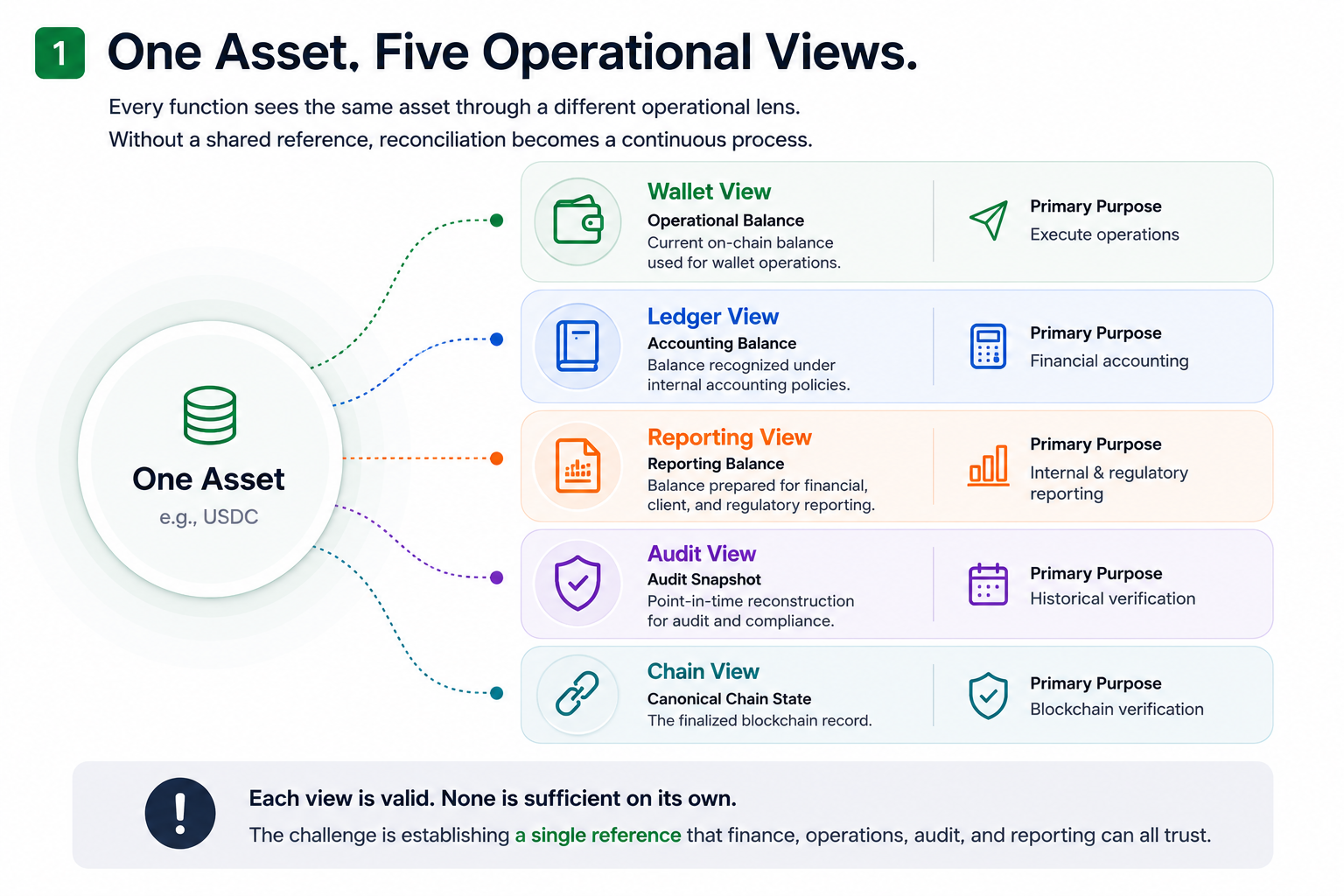
Each view describes the same asset, yet none is produced from the same data, the same point in time, or the same classification basis.
A simple test surfaces the issue. Do your finance and operations teams reconcile against the same asset balance today? Which of those balances does your auditor rely on? If the answer isn't immediate, the real problem is not that the balances differ — it is the absence of a shared reference the institution can point to across all of them.
The business impact of a missing reference
Most institutions run wallets, accounting, audit, and reporting well on their own. The difficulty is that these functions do not interpret the same asset in the same way.
This is not a data-quality problem. It is an operating-model problem. Custody operations are about managing a reference, not just an asset. Seen this way, the absence of a single reference leads to three business consequences.
The moment finance, reporting, and audit present different numbers for the same asset, it becomes hard to say immediately which data is the institution's authoritative reference. Every team has a reasonable explanation, but if there is no basis for naming one of them as the official standard, this is no longer a data problem — it is a control problem.
If every new chain requires bolting on another collection, interpretation, validation, and reconstruction stack, chain count and operating cost become linked in lockstep. When products and revenue grow while data-maintenance headcount and cost rise at the same rate, the operating model isn't scaling.
If the asset state as of a given record date cannot be reconstructed quickly, it becomes difficult to prove the completeness of the record in audit, dispute, or regulatory scenarios.
Why institutions need a shared reference layer
The answer is not more data, faster APIs, or more nodes. It is a single layer that lets finance, operations, audit, and reporting see the same asset against the same reference.
We refer to this architectural capability as a Reference Data Layer.
Reference Data Layer
In this article, we use the term Reference Data Layer to describe an architectural layer that provides validated and normalized blockchain data as a common operational reference across institutional systems. The concept builds on established enterprise data-management principles such as reference data and master data, but extends them to the operational requirements of institutional blockchain environments, including transaction, balance, asset, and historical-state data.
Rather than each function interpreting the data on its own, they work from one validated asset reference.
The questions an institution should ask are about operations, not features.
| Operational question | What a Reference Data Layer delivers |
|---|---|
| Which balance do we treat as the reference? | A single asset reference |
| Can we reconstruct past state for audit? | Point-in-time reconstruction |
| Does each new chain require a new data team? | A reusable data foundation |
| Do finance and operations see the same number? | A shared operational view |
Reading the blockchain isn't the same as operating it
A natural objection follows: the chain is public, so why not just read it directly?
Because reading data from a chain and producing reference data an institution can operate on are two different problems. Finality determination, token-standard interpretation, historical-state reconstruction, and handling chain upgrades are not one-time builds. They are operational capabilities that must be maintained continuously. Connecting a single node does not produce a consistent reference, and the more chains an institution supports, the more the burden of rebuilding that capability each time feeds the decline in operating leverage described above.
What a Reference Data Layer requires
Not every blockchain data platform can serve as an institution's Reference Data Layer. To become the reference that finance, operations, audit, and reporting all rely on, it must meet at least three conditions.
1. Independence from the execution system
Reference data must be distinct from the data produced by the systems that actually move or hold assets. Data from a custody platform or wallet system reflects that system's own operational view, and a structure in which the execution system validates itself cannot produce an independent standard the whole organization can share. A Reference Data Layer must be a reference the entire institution can trust, not one tied to a single execution platform.
2. Institution-side data control
A Reference Data Layer should be an operational asset of the institution, not a view inside a SaaS dashboard. When the data lands in the institution's own data warehouse or storage, existing access controls, retention policies, and data governance carry over unchanged. The moment ownership of the reference sits with an external platform, the institution can no longer directly govern its own operating standard.
3. An operable data structure
Reading blockchain data and producing operational reference data are different things. A Reference Data Layer must be more than a query interface: it must include finality validation, point-in-time reconstruction, multi-chain normalization, and ongoing adaptation to chain changes. Only then can finance, audit, and reporting use the same asset on the same basis.
How Nodit's DataShare implements it
DataShare is more than a blockchain data API. It is an Institutional Reference Data Layer that establishes a single asset master record across finance, operations, audit, and reporting. By standardizing how on-chain assets are represented, DataShare ensures every function works from the same source of truth.
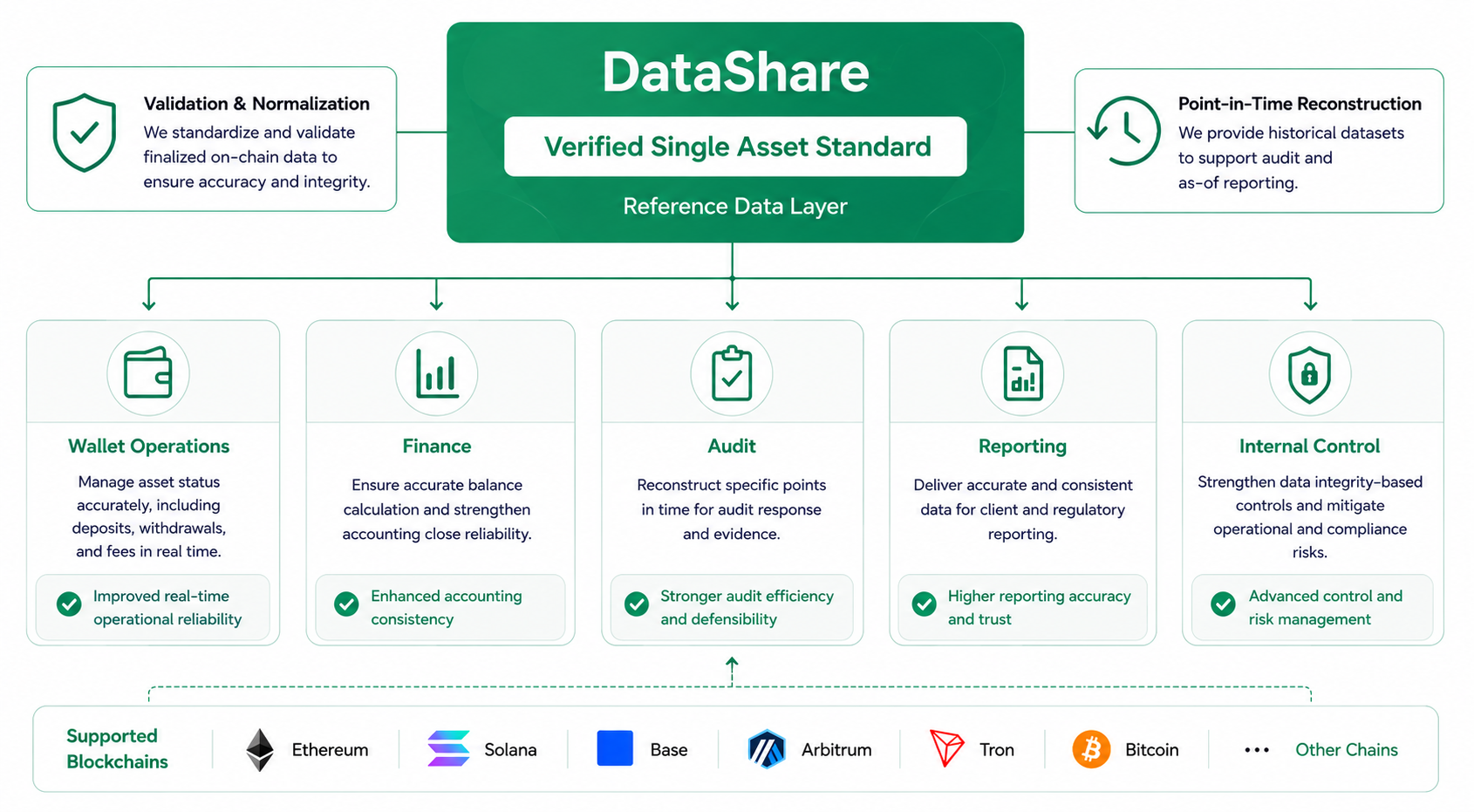
Put plainly: instead of repeating blockchain data engineering every time a new chain is supported, an institution standardizes its operational data once and reuses it across finance, reconciliation, reporting, and audit.
DataShare provides independent reference data that is not tied to any specific wallet or custody platform. Because Nodit does not itself execute custody, the data DataShare delivers is a neutral reference — not the view of the system being reconciled. The data is loaded directly into the institution's own data warehouse or storage, so existing data governance and access controls remain in place. At the data layer, DataShare performs finality validation, point-in-time reconstruction, and multi-chain normalization, so operational systems can share one asset reference.
Operational change, before and after
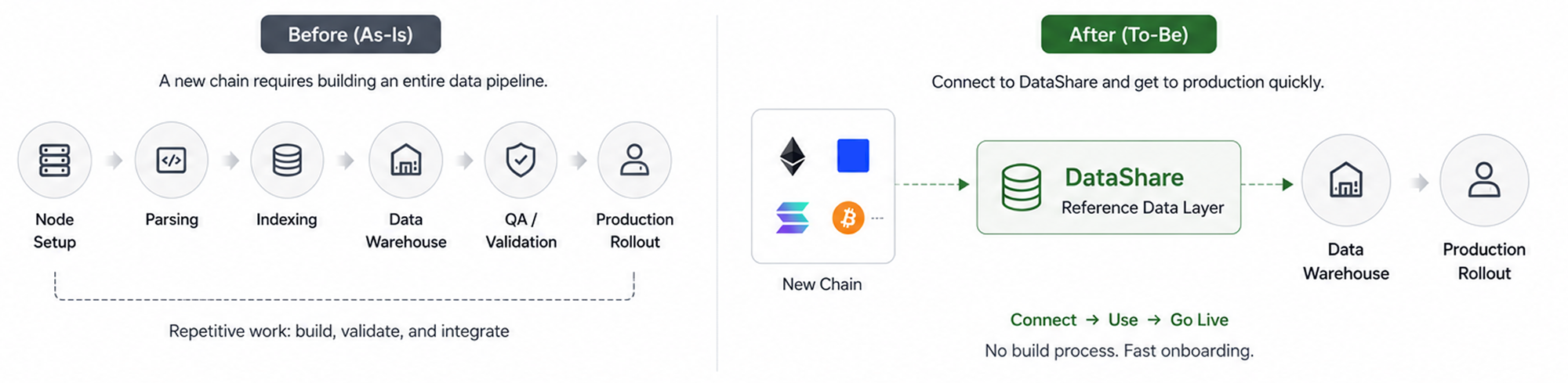
The operational changes an institution can expect:
Instead of rebuilding collection and normalization pipelines per chain, a shared data layer brings new networks into the operating environment more quickly.
Finance, operations, audit, and reporting work from the same reference data.
Point-in-time reconstruction reduces the preparation burden for audit and regulatory response.
Supporting more chains no longer requires scaling data infrastructure at the same rate.
Validated data is loaded directly into the institution's data warehouse, keeping existing security, access-control, and data-management frameworks intact.
A Reference Data Layer does not replace the institution's book of record. Accounting standards and reconciliation logic remain the institution's to define. DataShare provides the validated reference data those judgments rest on.
DataShare enables this approach by delivering more than 100 normalized blockchain datasets across major public networks, including Ethereum, Solana, Base, Arbitrum, Tron, and Bitcoin. With support for cloud and on-premises deployment, including domestic IDCs, and SOC 2 Type I and II controls, institutions can extend their existing governance and security frameworks while scaling digital asset operations.
Scaling on a single asset reference
The scalability of a custody service does not come from operating more nodes. It comes when finance, operations, audit, and reporting all move on the same validated asset reference — the point at which the linear link between chain count and operating cost is broken and a scalable operating model becomes possible.
Without a shared reference layer, every operational function builds its own version of blockchain truth. With one, every function starts from the same truth.
Where is your institution's single asset reference of truth being formed today? Is it the wallet? The ledger? The data warehouse? Or has it not yet been defined?
DataShare is the Reference Data Layer between the blockchain and an institution's operational systems. By delivering validated, normalized on-chain data directly into the data warehouse and operational systems, it lets an institution run wallet operations, reconciliation, accounting, audit, and reporting on a single reference. With it, an institution can scale its custody operating model without scaling its data organization at the same rate.
Next in this series, we will examine why DataShare matters for payment / card companies. Subscribe to the newsletter to receive the next insight.
Earlier in the series
 Nodit Team
 Nodit Team
Last but not least! We will also be at Solana Breakpoint 2026 in November to share more about the Datashare — details soon!
About Nodit
Nodit is an enterprise-grade blockchain infrastructure platform providing reliable node access and consistent on-chain data for digital asset services. Across 50+ networks, Nodit combines managed node infrastructure, standardized data processing and delivery, DataShare with specialized blockchain datasets, and Validator-as-a-Service (VaaS) to support production-scale operations, institutional analytics, and AI applications.
Backed by SOC 2 Type II and proven experience with major regulated exchanges worldwide, Nodit provides the complete on-chain data pipeline that powers the digital asset economy.
Homepage l X (Twitter) l LinkedIn
This article is provided for general informational purposes only. By using the article, you agree that the information on this article does not constitute legal, financial or any other form of professional advice. No relationship is created with you, nor any duty of care assumed to you, when you use this article. The article is not a substitute for obtaining any legal, financial or any other form of professional advice from a suitably qualified and licensed advisor. The information on this article may be changed without notice and is not guaranteed to be complete, accurate, correct or up-to-date.
![[DataShare Insight] On-Chain Data as a Foundation for Market Intelligence](https://storage.ghost.io/c/00/e4/00e497ca-82e8-447b-9af3-b700db69ca26/content/images/size/w600/2026/09/Data-Analyst--_-Blog-Thumbnail.png)
![[DataShare Insight] AI-Ready On-Chain Data for Regulated Enterprises](https://storage.ghost.io/c/00/e4/00e497ca-82e8-447b-9af3-b700db69ca26/content/images/size/w600/2026/09/Group-C-_-AI-Blog-Thumbnail.png)