[DataShare Insight] The Data Foundation for On-Chain Payment Operations

![[DataShare Insight] The Data Foundation for On-Chain Payment Operations](https://storage.ghost.io/c/00/e4/00e497ca-82e8-447b-9af3-b700db69ca26/content/images/size/w1200/2026/09/Group-B-_-Payment---Money-flow-Blog-Thumbnail-1.png)
Why reconciliation-ready data is becoming critical for enterprise payment operations.
TL;DR
- Stablecoins are becoming part of mainstream payment infrastructure, but operational readiness—not transaction speed—is now the primary challenge.
- On-chain settlement fundamentally changes reconciliation by introducing multi-chain data, blockchain-native identifiers, and continuous settlement.
- Payment providers need validated, reconciliation-ready data—not raw blockchain data—to support financial operations, compliance, and customer experiences.
- An independent data layer enables enterprises to integrate blockchain settlement into existing financial systems without building and maintaining blockchain data infrastructure.
On-chain payments have reached enterprise scale. According to Money Movement 2.0 (51 Insights, 2026), monthly stablecoin settlement reached $7.5 trillion in March 2026, while real-world stablecoin payments exceeded $400 billion in 2025, driven primarily by B2B cross-border transactions.

Global payment providers are integrating stablecoins into existing settlement infrastructure. Visa has expanded its stablecoin settlement program, while Mastercard and Stripe continue investing in digital asset payment capabilities.
The challenge is no longer transaction speed. It is operational readiness. Payment providers must be able to reconcile on-chain transactions, meet audit and regulatory requirements, and integrate blockchain settlement data into existing financial systems.
The questions payment companies are actually asking
When a payment company or card issuer begins operating stablecoin payments, the first questions aren't technical. They're operational.
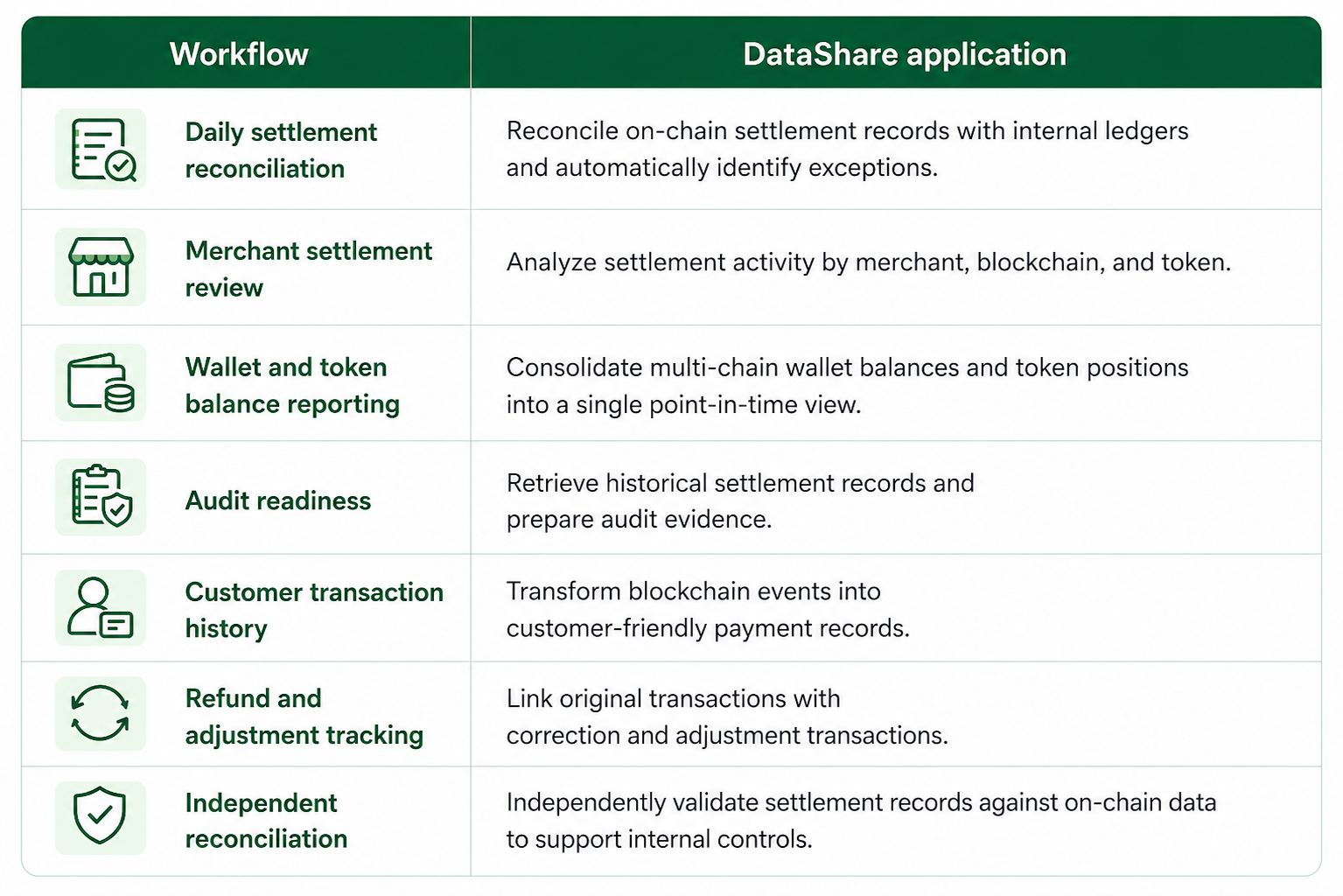
- Which customer, order, or merchant does this transaction belong to?
- Which blockchain and token was used?
- Do our internal ledgers reconcile with on-chain balances?
- Can customers see merchant names, payment amounts, and timestamps instead of transaction hashes?
- How should refunds, reversals, and adjustment transactions be handled?
These questions don't come up during the launch phase. They surface once operations begin. In traditional card payments, standardized processes already exist for all of them. In on-chain payments, a new integration layer is needed between legacy settlement data structures and on-chain data formats.
Card Payments and Stablecoin Payments Operate Differently
While the customer payment experience may look similar, the operational model behind card payments and stablecoin payments is fundamentally different.
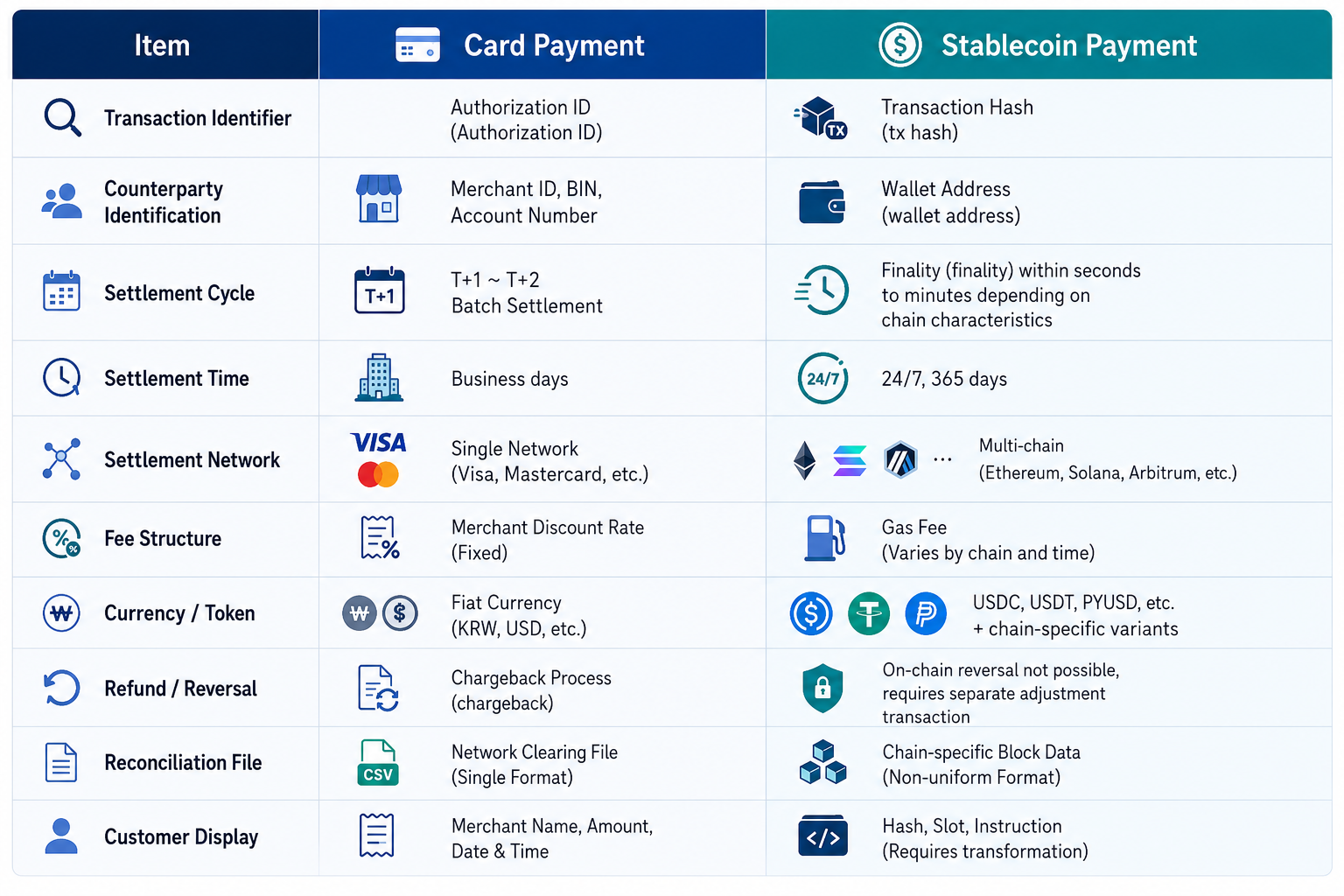
Despite these differences, stablecoin transactions must ultimately be reconciled within the same financial and settlement systems that already support card payments. Those systems were designed around standardized payment networks—not multi-chain blockchain data. As PwC notes in its treasury research, blockchain settlement infrastructure does not natively integrate with enterprise financial systems, creating the need for a data layer that bridges the two.
On-Chain Payments Redefine Reconciliation
Reconciliation is the process of continuously verifying that records from different settlement sources match. Payment companies and card issuers have been doing this for decades — cross-referencing processor reports, network clearing files, bank statements, and internal ledgers.
On-chain settlement appears to add one more source to that list. In practice, it changes the nature of reconciliation itself.
Card payments are reconciled against daily settlement cycles. In contrast, blockchain transactions reach finality within seconds or minutes, depending on the network. Reconciliation must evolve from scheduled batch processing to continuously tracking transaction-level events.
Traditional payment operations rely on standardized clearing files from a single network. On-chain payments span multiple blockchains, each with its own transaction model, data structure, fee mechanism, and token standard. Reconciliation requires a normalized view across heterogeneous data sources.
Legacy financial systems are built around merchant IDs, account numbers, and authorization IDs. Blockchain transactions are identified by wallet addresses and transaction hashes, requiring a mapping layer to connect on-chain activity with enterprise business records.
Blockchain networks operate 24/7/365 with no settlement windows or end-of-day cutoffs. Financial operations must continuously reconcile transactions while maintaining compatibility with existing accounting, treasury, and financial close processes.
Payment Ecosystems Involve More Than Two Ledgers
The global payments ecosystem is built on a specialized operating model. Wallet providers, payment service providers (PSPs), acquirers, card networks, issuers, and settlement and clearing providers each maintain their own operational systems. Every participant generates its own transaction data, maintains its own settlement records, and reconciles those records against internal financial systems.
On-chain payments introduce another settlement data source into this operating model. Unlike proprietary settlement records maintained by individual participants, blockchain transactions are recorded on a shared, publicly verifiable ledger that can be independently accessed and validated by every participant.
Stablecoins are not replacing existing card networks. Instead, payment providers are integrating them as an additional settlement rail for use cases such as cross-border payments, B2B settlement, and 24/7 treasury operations. As payment flows extend across multiple blockchains, organizations must reconcile settlement data across multiple ledgers, blockchain networks, and internal financial systems rather than a single payment network.
Regulation Is Raising the Bar for Reconciliation
As on-chain settlement becomes part of mainstream payment infrastructure, regulatory expectations for reconciliation, recordkeeping, and auditability are increasing.
In the United States, the proposed GENIUS Act would require payment stablecoin issuers to meet reserve transparency and disclosure requirements. In the European Union, MiCA requires EMT and ART issuers to maintain reserve records and undergo regular audits, while Crypto-Asset Service Providers (CASPs) must retain transaction records in standardized, machine-readable formats.
For payment providers and card issuers, compliance extends beyond accessing blockchain data. They must be able to reconcile on-chain transactions with internal financial systems, maintain auditable records, and produce consistent settlement data across multiple systems and reporting requirements.
Blockchain Transparency Doesn't Replace Reconciliation
Public blockchains make transaction data broadly accessible. But accessibility is not the same as reconciliation. Payment providers need more than transparent data—they need data that can be consistently reconciled with internal ledgers and financial systems.
As payment teams operationalize stablecoin settlement, they increasingly require an independent mechanism to verify on-chain transactions rather than relying solely on records generated by a settlement platform. This reflects a long-standing principle of financial operations: settlement records should be independently verifiable.
Traditional payment networks achieve this through standardized clearing files and agreed reconciliation processes between participants. On-chain payments introduce a different model. Because blockchain transactions are recorded on a public, independently verifiable ledger, organizations can validate settlement records against a source that is not controlled by any single payment provider or infrastructure vendor.
However, public blockchain data is not directly usable for financial operations. Raw block data and live node responses must be validated, normalized, and structured before they can support reconciliation, audit, or financial reporting. The result is not simply blockchain data, but an independent, reconciliation-ready dataset that enterprise systems can rely on.
One Dataset, Multiple Operational Use Cases
The structured settlement data used for reconciliation also powers customer-facing payment experiences.
When a customer opens their banking or payment app after making a stablecoin payment, they don't expect to see raw blockchain data:
0x89af...
Slot 123123
Instruction
Fee 0.000005 SOL
They expect payment information they can immediately understand:
Cafe
$7
July 3
Completed
Although reconciliation and customer transaction history appear to serve different purposes, they depend on the same underlying data. The data that enables finance teams to reconcile transactions is the same data that allows customer applications to display merchant names, payment amounts, timestamps, and transaction status.
A standardized, reconciliation-ready dataset therefore supports both operational processes and customer-facing experiences, eliminating the need to maintain separate data pipelines for finance and product teams.
Could we just build this ourselves?
For many engineering teams, the first instinct is to build it in-house. Operate blockchain nodes, deploy indexers, and build a custom data pipeline.
While technically feasible, the scope extends far beyond data ingestion.
Each blockchain requires dedicated parsers that must be continuously maintained. Protocol upgrades introduce changes that require parser updates and data validation. Different chains expose different transaction models and schemas, making a normalization layer essential. Schema evolution requires backward compatibility, while historical backfills are needed to maintain a complete and consistent dataset.
More importantly, data used for settlement and reconciliation must be continuously validated. Column-level integrity, table-level consistency, and cross-table relationships all need to be monitored to ensure the dataset remains reliable for financial operations.
At that point, the challenge is no longer payment infrastructure—it's blockchain data engineering. Every engineering hour spent maintaining data infrastructure is an hour not spent building payment products, improving customer experiences, or delivering new business capabilities.
DataShare: An Independent Data Layer for Settlement and Reconciliation
DataShare is an enterprise data platform that delivers validated, reconciliation-ready blockchain settlement data directly into an organization's data environment. Rather than exposing raw blockchain data, it provides standardized datasets designed for settlement, reconciliation, audit, and financial operations.
Payment providers, card issuers, and financial institutions can integrate DataShare with their existing data warehouse and operational systems to support day-to-day payment operations.
Operational Architecture
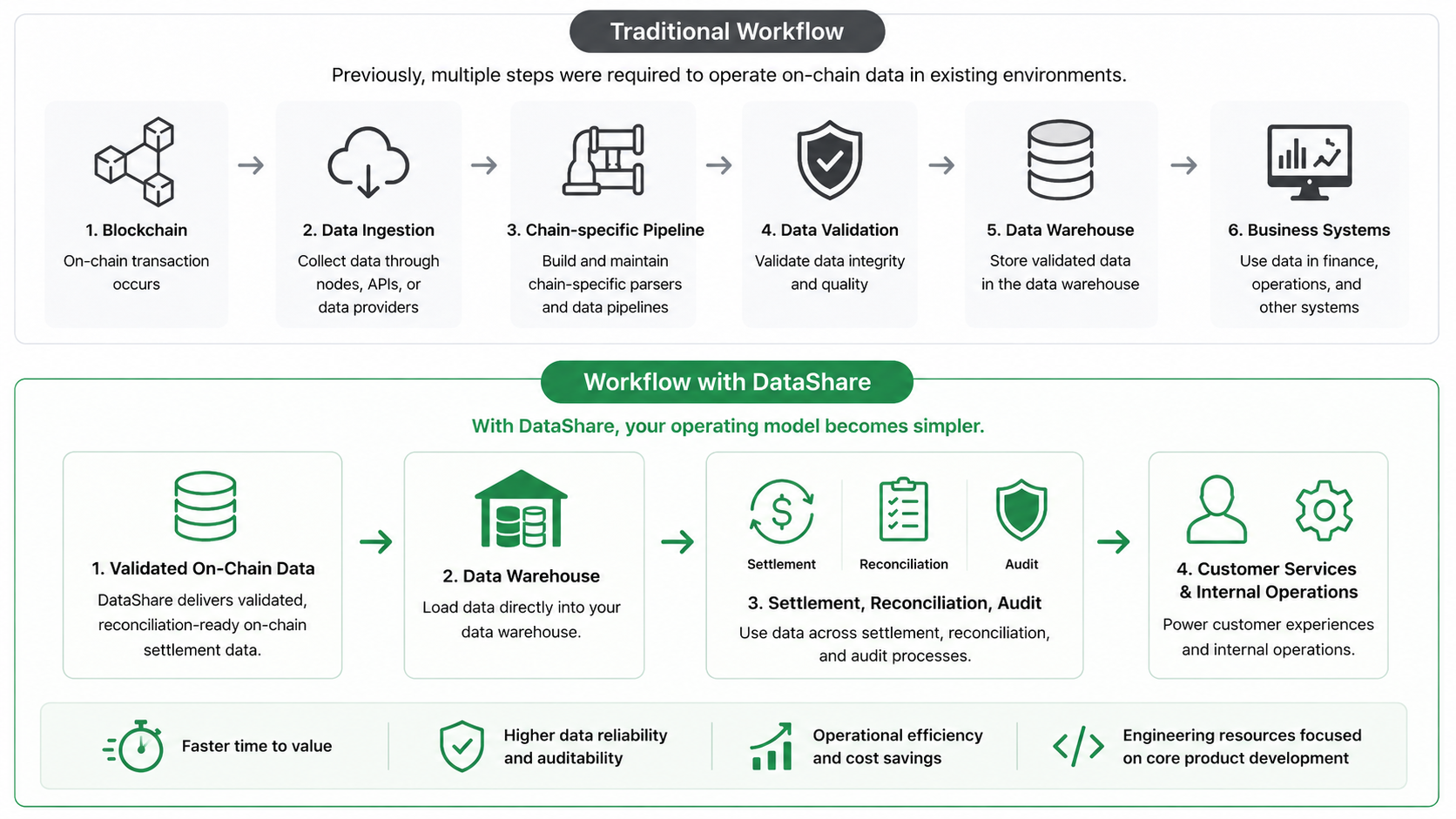
Organizations can realize measurable operational benefits, including:
- Reduced manual investigation of settlement exceptions
- Faster financial close processes
- Improved audit readiness
- Faster merchant settlement reporting
- Lower engineering overhead for blockchain data infrastructure
DataShare was developed from enterprise implementations supporting payment providers, card issuers, and financial institutions adopting stablecoin payments, tokenized assets, and digital asset services. A recurring operational challenge was not transaction execution, but integrating blockchain settlement data into existing financial systems.
For supported networks, DataShare delivers validated settlement data within minutes of block confirmation and is operated under SOC 2 Type II controls.
As programmable payments and AI agents become part of payment infrastructure, the same operational requirements apply. Machine-generated transactions must be reconciled, audited, and integrated into enterprise financial systems just like human-initiated payments. DataShare processes both through the same standardized data pipeline.
Solana Is Becoming a Key Settlement Network for On-Chain Payments
As stablecoin adoption accelerates, payment activity is increasingly concentrated on a small number of blockchain networks. Among them, Solana has emerged as a leading settlement network, driven by its high throughput and low transaction costs.
According to Money Movement 2.0 (51 Insights, 2026), total stablecoin supply exceeded $323 billion in May 2026, representing 56% year-over-year growth. As settlement volumes continue to increase, so does the volume of on-chain data that payment providers must reconcile and manage.
However, Solana introduces operational complexity. Its account-based execution model and instruction-based transaction architecture differ fundamentally from EVM-compatible chains, requiring specialized parsing, validation, and normalization before transaction data can support settlement and reconciliation workflows.
DataShare applies the same validation and standardization pipeline across Solana and other supported blockchains, enabling organizations to consume reconciliation-ready settlement data through a consistent enterprise data model.
Operational Excellence Is Becoming the Competitive Advantage
Payment companies and card issuers are absorbing stablecoins as a new settlement rail at an accelerating pace. As payment execution itself becomes standardized, competitive advantage is shifting to how well an organization runs settlement, reconciliation, and financial controls.
When validated on-chain settlement records exist inside an organization's systems, reconciliation becomes an operational process rather than a manual exercise. Customer transaction history becomes a query, not a development request. Audit readiness becomes routine, not an event.
DataShare is an independent data layer that bridges blockchain settlement and enterprise financial systems. By delivering validated, reconciliation-ready on-chain data directly into existing data platforms, it enables payment providers and card issuers to integrate on-chain settlement into established financial operations.
The next series will cover DataShare for custodial. Subscribe to the newsletter to receive it first.
Interested in reading more on DataShare?
 Nodit Team
 Nodit Team
 Nodit Team
Last but not least! We will also be at Solana Breakpoint 2026 in November to share more about the Datashare — details soon!
About Nodit
Nodit is an enterprise-grade blockchain infrastructure platform providing reliable node access and consistent on-chain data for digital asset services. Across 50+ networks, Nodit combines managed node infrastructure, standardized data processing and delivery, DataShare with specialized blockchain datasets, and Validator-as-a-Service (VaaS) to support production-scale operations, institutional analytics, and AI applications.
Backed by SOC 2 Type II and proven experience with major regulated exchanges worldwide, Nodit provides the complete on-chain data pipeline that powers the digital asset economy.
Homepage l X (Twitter) l LinkedIn
This article is provided for general informational purposes only. By using the article, you agree that the information on this article does not constitute legal, financial or any other form of professional advice. No relationship is created with you, nor any duty of care assumed to you, when you use this article. The article is not a substitute for obtaining any legal, financial or any other form of professional advice from a suitably qualified and licensed advisor. The information on this article may be changed without notice and is not guaranteed to be complete, accurate, correct or up-to-date.
![[DataShare Insight] On-Chain Data as a Foundation for Market Intelligence](https://storage.ghost.io/c/00/e4/00e497ca-82e8-447b-9af3-b700db69ca26/content/images/size/w600/2026/09/Data-Analyst--_-Blog-Thumbnail.png)
![[DataShare Insight] AI-Ready On-Chain Data for Regulated Enterprises](https://storage.ghost.io/c/00/e4/00e497ca-82e8-447b-9af3-b700db69ca26/content/images/size/w600/2026/09/Group-C-_-AI-Blog-Thumbnail.png)