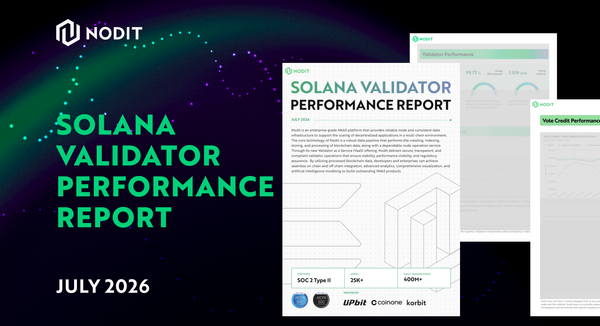
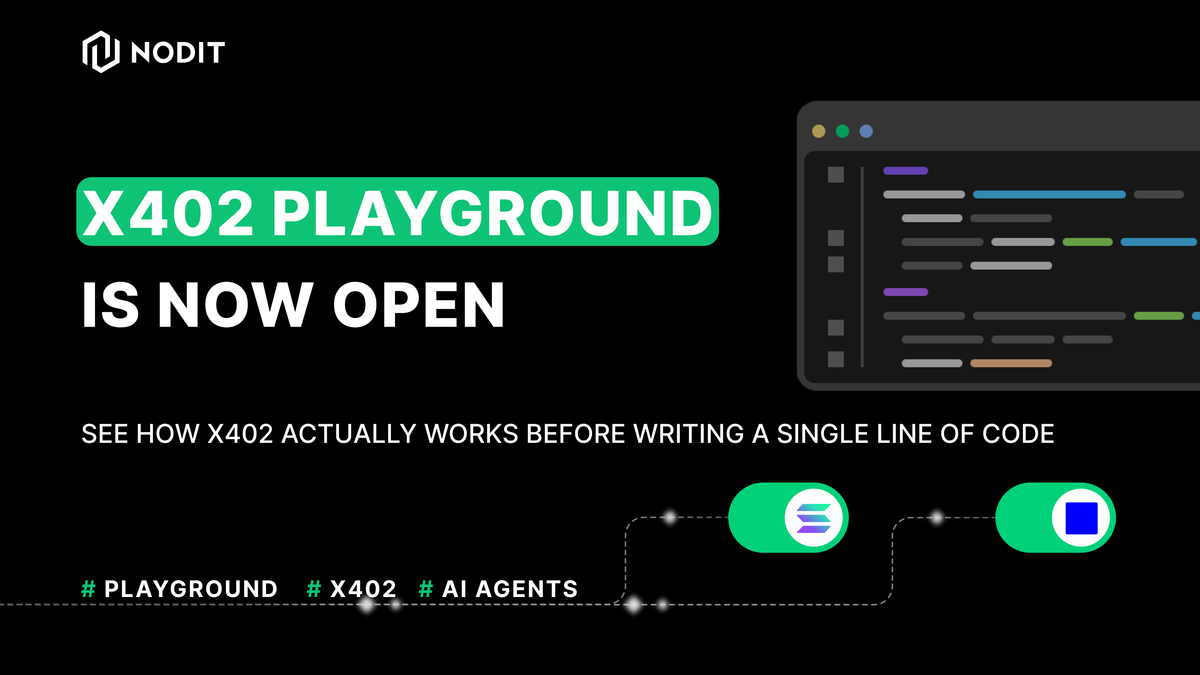
x402 Playground is now open: See how x402 actually works before writing a single line of code.
TL;DR
- Subscription and ad models break down when usage is unpredictable — x402 fills that gap with per-request, wallet-based payments in USDC
- Three use cases where it actually makes sense: content streaming and webtoons, creative tools, and AI agents or solo developers accessing APIs
- The Nodit x402 Playground has two modes: Nodit APIs (mainnet, real payments) for developers, and Pay Proxy (testnet, no cost) for teams evaluating x402 for their own API
Try it now at the Nodit x402 Playground
Most pricing models online follow the same logic: pay a flat monthly fee, whether you use the product once or a hundred times. It worked well enough when software was simpler, but the limitations are becoming harder to ignore.
Streaming platforms lose subscribers who do not watch enough to justify the cost. Creative tools charge for seats that sit unused. Developers skip APIs entirely because signing up, obtaining a key, and configuring billing takes longer than the actual task. The model is not broken, but it has a ceiling.
x402 is what comes next.
What is x402?
For a full technical background on x402, this post covers it in detail.
 Nodit Team
In brief, x402 is a payment protocol built on the HTTP 402 status code. Rather than monthly subscriptions or API keys, access is granted per request, settled in USDC, with nothing but a wallet required.
This article is intended for those who are already familiar with the concept and want to understand how to apply it in practice. Before exploring the use cases, it is worth understanding what the Playground offers, as that is where the concept becomes tangible.
Two ways to experience x402 in the Playground
There are two modes, built for different people.
- Nodit APIs (for individual developers and AI Agent)
A mainnet environment where you connect a real wallet, spend real USDC, and receive real on-chain data in return. It is designed for individual developers and AI agent builders who want to observe the full x402 payment flow — request, payment, response — without going through a registration process. The experience is live and immediate, allowing you to assess whether it fits your use case before committing to an implementation.
- Pay Proxy (for business with an existing API looking to monetize it through x402)
It runs on testnet (Base Sepolia and Solana Devnet), so there's nothing at stake while you explore. It's built for teams who want to understand how the publisher and consumer flow works before committing to an implementation.
Beyond testing, Pay Proxy works as a reference case for any business considering x402 adoption — not just a consumer facing API, but a working example of how the provider side operates end to end.
Both are at x402.nodit.io. Knowing which mode fits your situation starts with recognizing the problem you're actually trying to solve.
Does any of this sound familiar?
Before getting into the details, a quick check.
"I'm looking to add Agent Payment to my API service, but building it from scratch feels like a project in itself."
"I'm looking to try Nodit, but creating an account and setting up billing feels like a commitment."
"I'm looking to access a paid data endpoint like Bitcoin, but my usage won't be high enough to justify a subscription."
"I'm looking to understand x402 fast and start building without studying the protocol in depth."
If any of these match your situation, the use cases below will show you exactly how it plays out.
Three use cases worth knowing and should try the x402 playground — Are you facing this problem?
Type 1: Content streaming platforms — YouTube, Netflix, Disney+, webtoons, creator channels
The problem with monthly subscriptions is not that users are unwilling to pay. It is that they are unwilling to pay for content they do not consume. One underwhelming month is often enough to prompt a cancellation.
This pattern is consistent across platforms. Streaming subscribers who watch a single series and churn. Webtoon readers who follow two titles but are billed for the entire platform. YouTube channel members who pay monthly but return only for specific uploads.
x402 shifts the unit of payment from the month to the individual view. A user connects a wallet, accesses the content they want, and the corresponding credits are deducted automatically. No payment details on file, no subscription to manage. Users who would otherwise churn remain in the ecosystem and continue to generate revenue.
Type 2: Creative tools — Canva, Figma Community
The gap between "free" and "paid" in creative tools is often too wide. Free tiers are limited. Paid plans are more than most users need. So people either work around the limits or don't upgrade at all.
But x402 makes one-time use financially sensible. Download a template, pay for it once, move on. No subscription decision required. The friction that causes drop-off disappears.
Type 3: AI agents and solo developers
This is the use case most people building today will recognize.
You want to add on-chain data to an agent. The normal path: find a provider, create an account, get an API key, set up billing, read the docs, test, iterate. By the time you're calling the API, you've spent more time on setup than on the actual feature.
With Nodit x402, a wallet is all you need. The agent authenticates, pays per request, and gets data back. No console, no key management, no monthly commitment. Once you've seen how that flow works, the Playground is the fastest way to go from concept to working code.
Try it yourself
The Nodit x402 Playground has two modes. Both are live at x402.nodit.io.
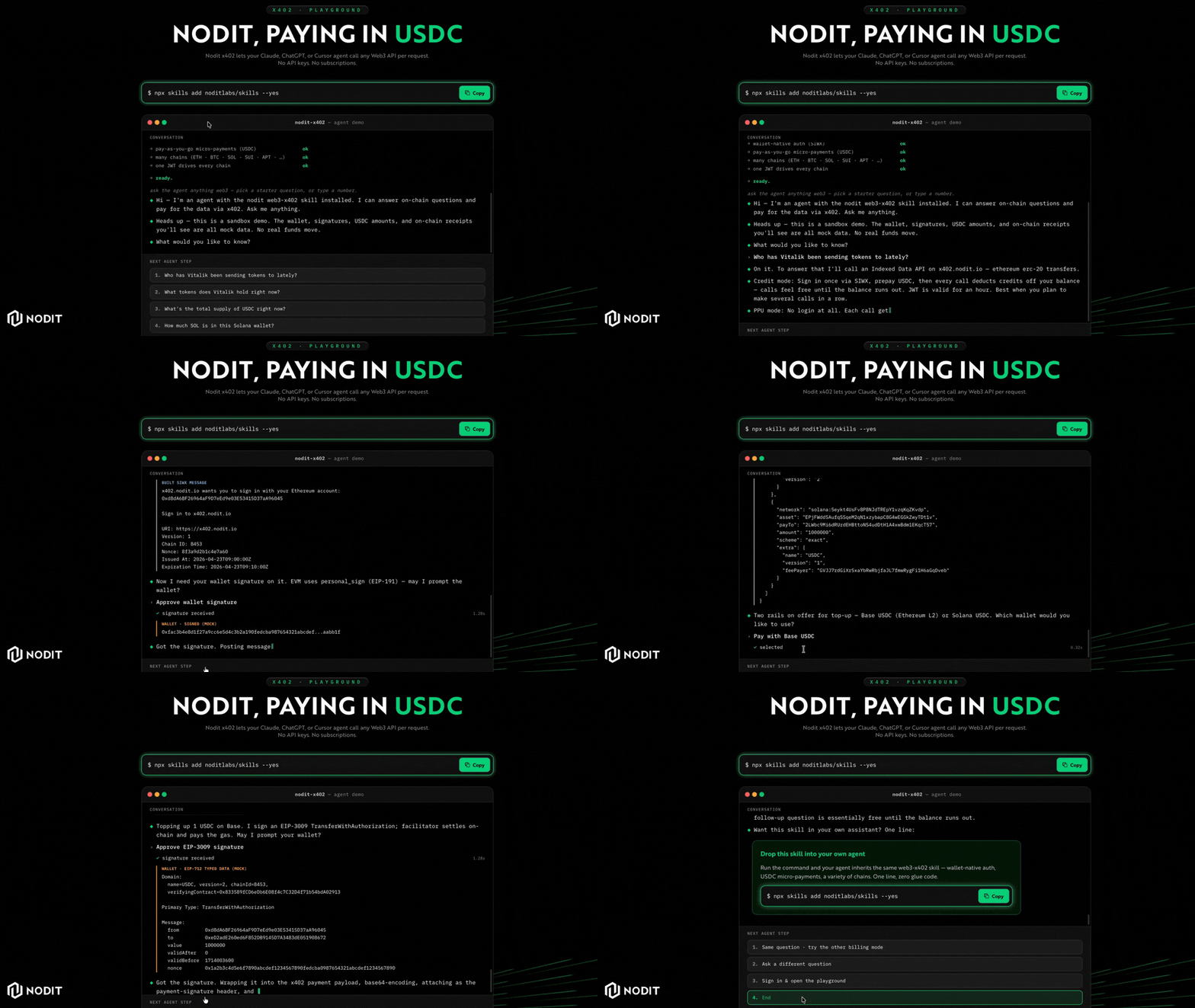
1. Nodit APIs — for individual developers and AI agent builders
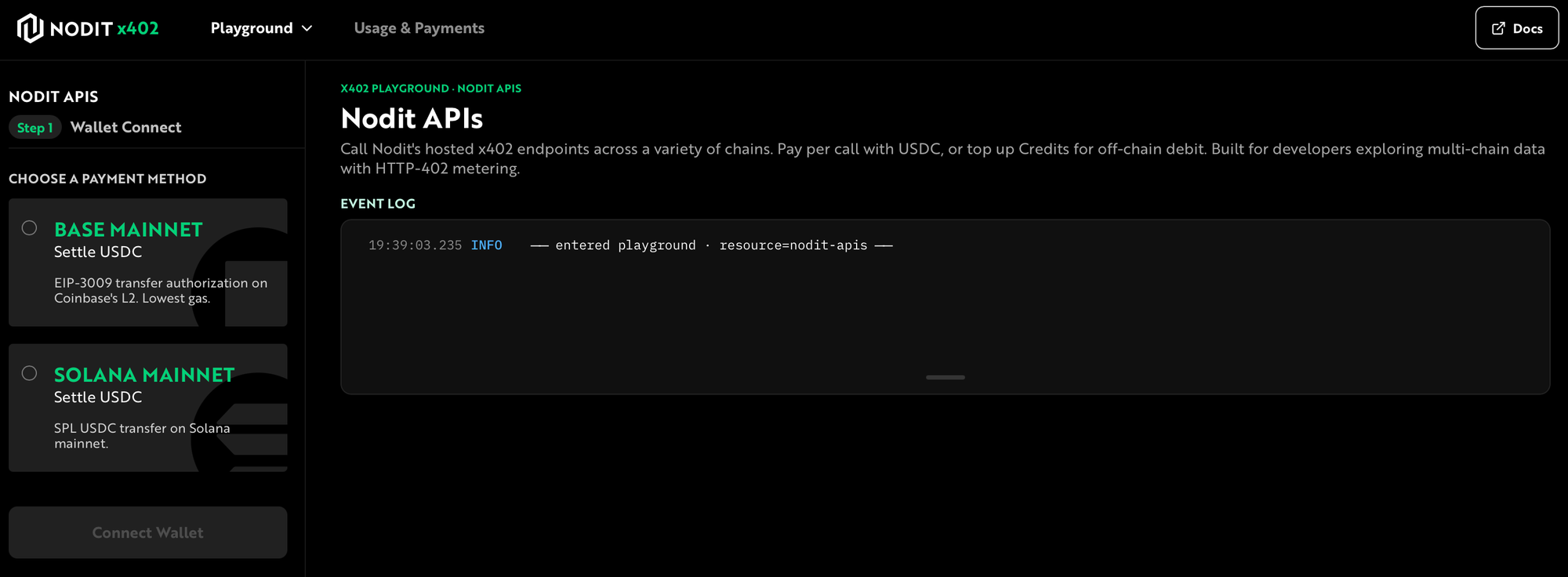
This is a mainnet environment. Real wallet, real USDC, real on-chain data.
Connect a wallet to watch the full 402 flow live: the request, the payment, and the response. Seeing each step in real time tends to be more useful than reading through documentation.
2. Pay Proxy — for teams evaluating x402 for their own APIs
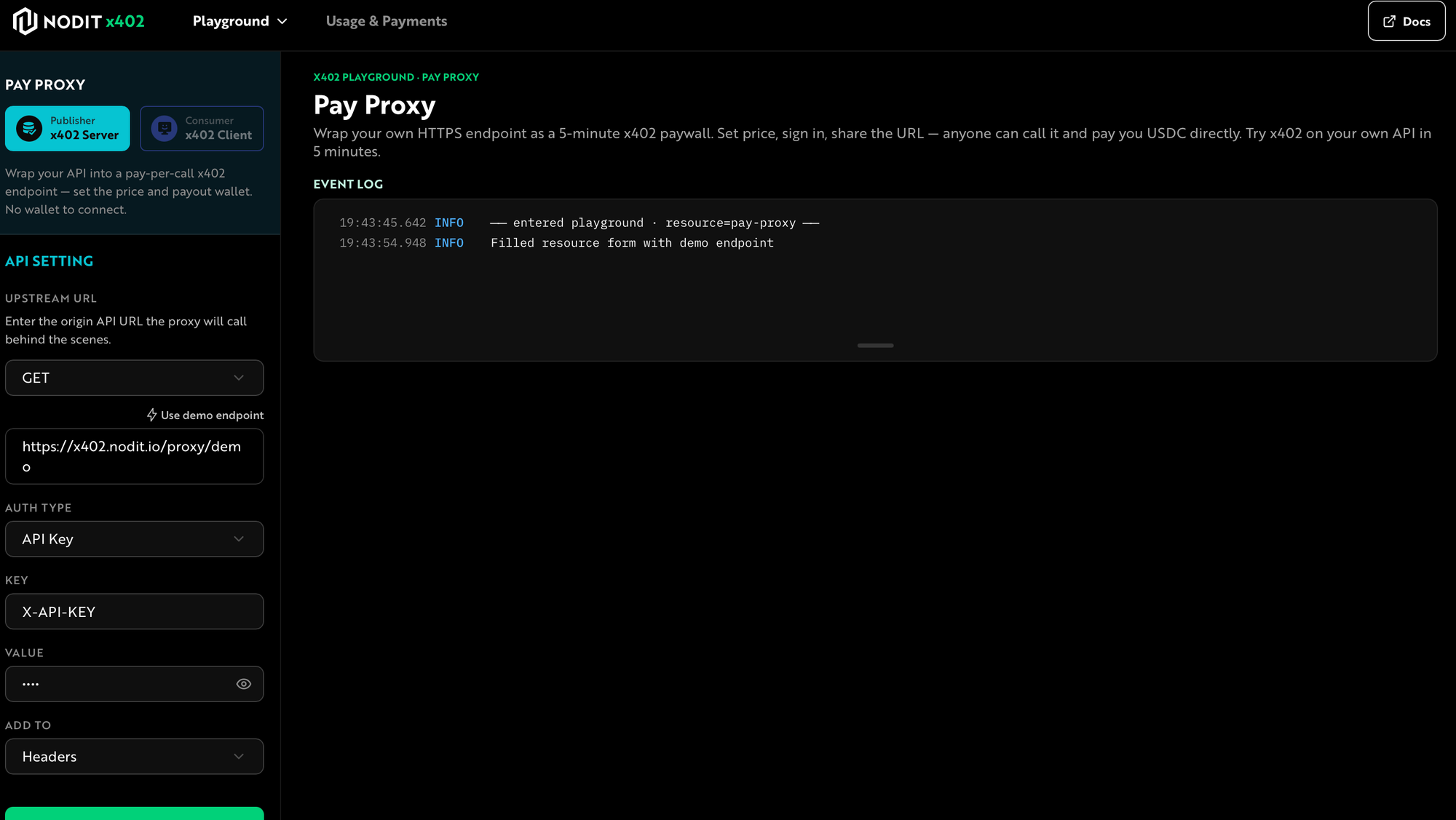
Pay Proxy runs on testnet — Base Sepolia and Solana Devnet, so there's no cost to experiment.
The setup: enter your API's upstream URL, set a price, choose an auth type. Click "Use demo endpoint" if you want to try it without your own URL first. Nodit provides a working demo endpoint at https://x402.nodit.io/proxy/demo.
Once configured, anyone with a wallet can call your endpoint and pay you USDC directly. No backend changes. No new infrastructure. The whole thing takes about five minutes to set up.
Pay Proxy has two roles: Publisher (the API provider, running the x402 Server) and Consumer (the caller, running the x402 Client). You can switch between them to see both sides of the transaction.
Usage & Payments — the dashboard
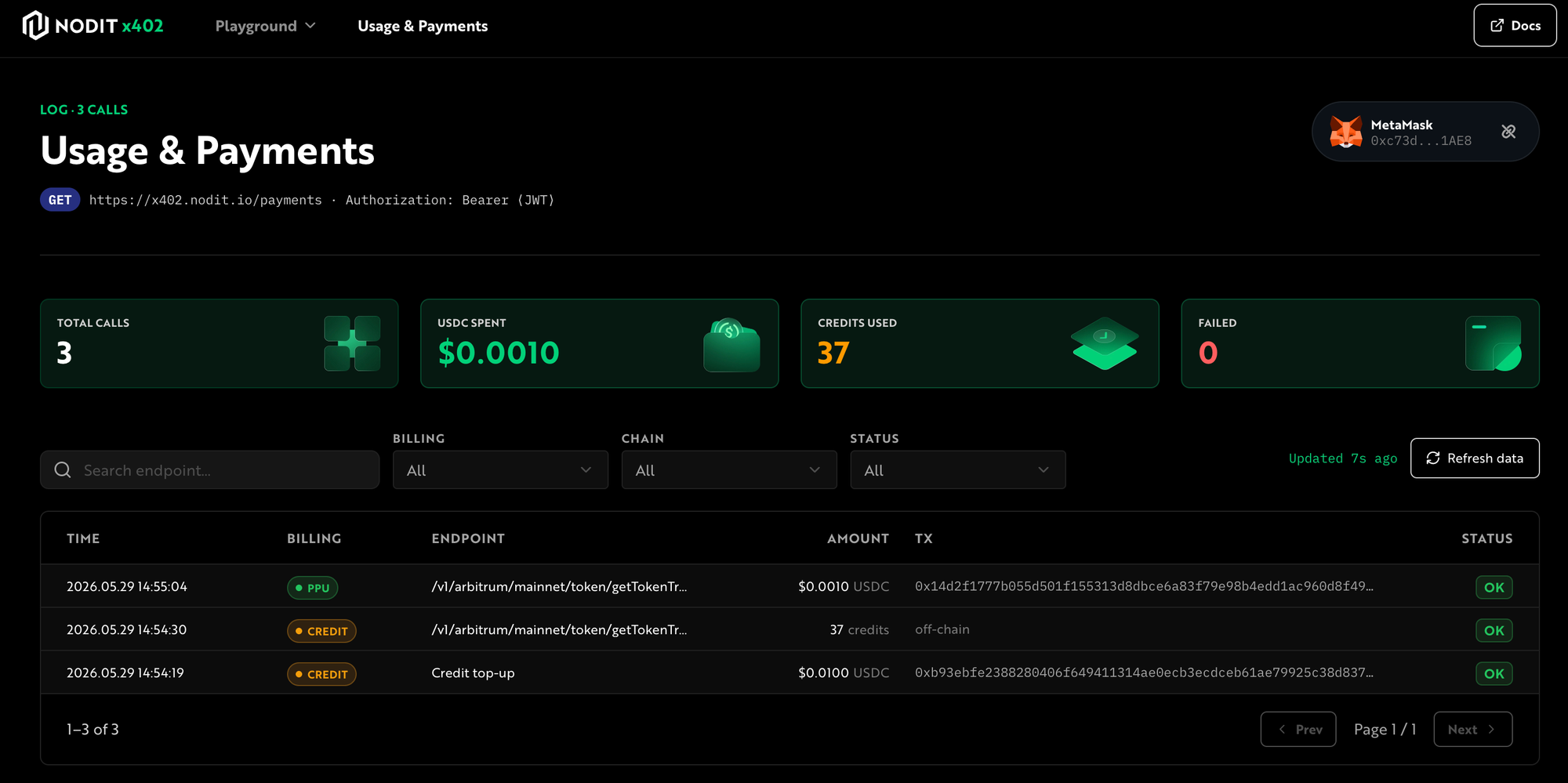
After transactions run, the Usage & Payments tab shows you what moved and where. It's the operational view — useful for understanding the payment flow in practice, not just in theory.
Digital asset regulations vary by country, so how x402 gets implemented in a production environment depends on where you're operating. If you want to talk through the specifics, that's what the Contact Us option is for.
Agent skills and billing
Nodit ships two agent skills at github.com/noditlabs/skills, compatible with Claude Code, Cursor, and Codex.
Install both in one line:
npx skills add noditlabs/skills --yes
web3-tools
gives your agent access to Nodit's Web3 Data APIs and RPC Node APIs across 20+ chains: balances, transactions, NFTs, block data, gas estimates, on-chain events.
web3-x402
handles the x402 payment layer: wallet authentication, payment execution, pay per request billing. It works alongside web3-tools so you can query on-chain data without an API key.
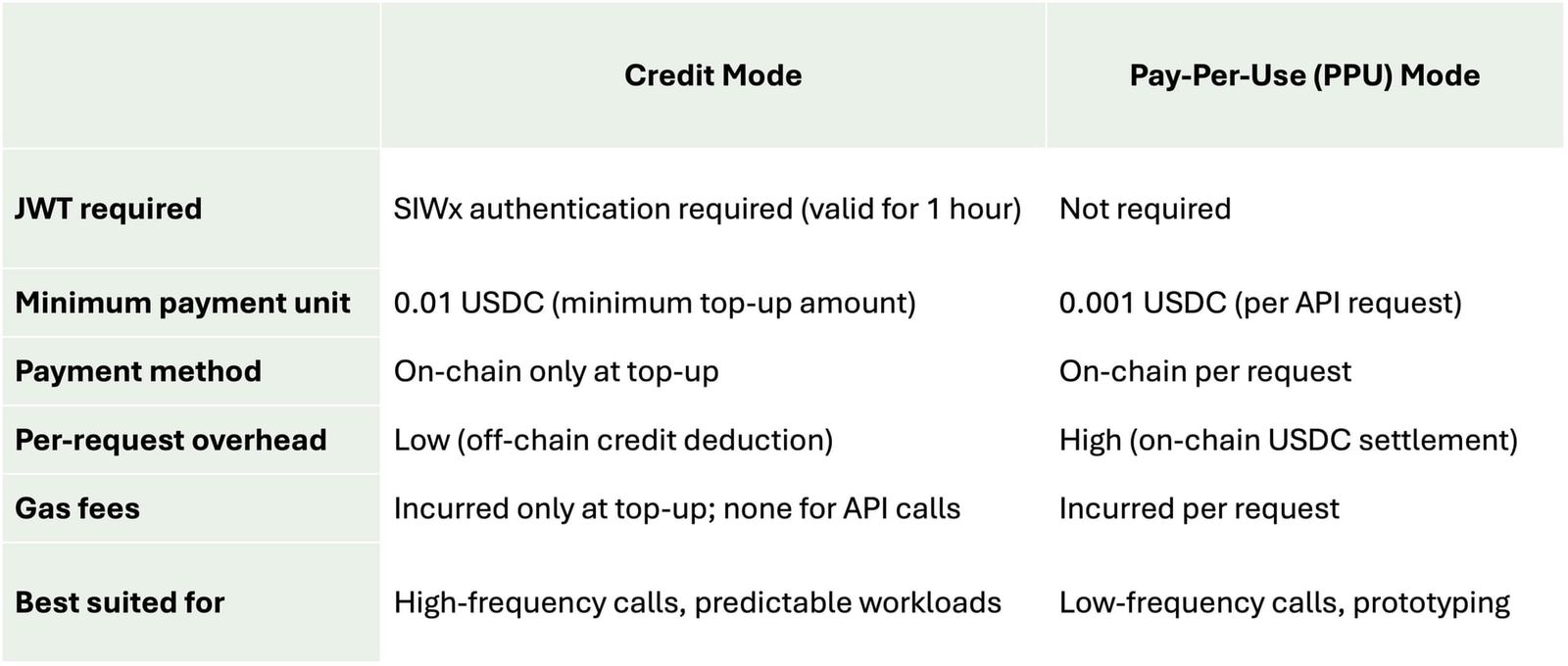
To support different usage patterns, two billing modes are available. Credit mode pre-charges USDC and deducts per request, which works better for repeated calls. Pay per use settles each request individually, which works better for one-off queries.
What the Playground is and what it isn't
The Playground is a demo. It shows you what x402 looks like in practice: the request flow, the payment mechanics, the data that comes back. Anyone can walk through the full x402 flow directly — API calls, payment execution, and response — with no setup required.
Building x402 into a real product means working through your specific setup: what chains you're on, what your billing model looks like, what regulatory requirements apply in your market. If you are considering this for your business, get in touch. We can work through the details together and provide a reference case for adopting x402 in your own environment.
FAQ
General
- Do I need a Nodit account to use the Playground?
No. Just a wallet connection. No signup, no API key, no billing setup. - What wallets are supported?
MetaMask and most EVM compatible wallets for Base. Phantom for Solana. Any wallet that supports SIWX (Sign-In with X) works. - Which chains does Nodit x402 support?
20+ chains including Ethereum, Base, Solana, Polygon, Arbitrum, Sui, Aptos, and more. - Is x402 ready for production?
The protocol is stable and the Nodit implementation is live on mainnet. For developer tools and AI agent use cases, production deployment is straightforward. For mainstream consumer products, it depends on how familiar your audience is with crypto wallets. - What if my country has specific regulations around digital asset payments?
Regulations vary by jurisdiction. Reach out via Contact Us and we can work through what a compliant implementation looks like for your market. - I want to add x402 to my product but don't have the capacity to build it myself.
The Nodit Skills are the fastest starting point for developers. For a full business implementation, contact us and we can scope it out together.
Billing
- Is real money involved?
Nodit APIs runs on mainnet — real USDC, real transactions. While Pay Proxy runs on testnet (Base Sepolia and Solana Devnet), so no real funds are involved there. - What's the difference between Credit mode and Pay Per Use?
Credit mode lets you pre-load USDC and deduct per call — better for repeated, high-frequency requests. Pay Per Use settles each request individually on-chain — better for occasional queries.
Pay Proxy setup
- Can I use Pay Proxy with my existing API without changing the backend?
Yes. Pay Proxy wraps your existing HTTPS endpoint as an x402 paywall. Your backend stays the same. - Why is my payment failing?
Most likely your wallet is on the wrong network, or your test USDC balance is empty. The Playground runs on Base Sepolia (EVM) and Solana Devnet. - How do I enable Base Sepolia on MetaMask?
MetaMask hides testnets by default. Go to account icon > Settings > Advanced > toggle Show test networks on. Then add Base Sepolia if it's not in your list:- Network name: Base Sepolia
- RPC URL: https://sepolia.base.org
- Chain ID: 84532
- Currency symbol: ETH
Or search "Base Sepolia" on Chainlist.org and add in one click.
- How do I switch Phantom to Devnet?
Settings > Developer Settings > switch network to Devnet. Other Solana wallets have the same option in settings. - Where do I get test USDC?
Circle faucet at faucet.circle.com. Pick the network, paste your wallet address, done. Covers both Base Sepolia and Solana Devnet.
🔎About Nodit
Nodit is an enterprise-grade Web3 platform that provides reliable node and consistent data infrastructure to support the scaling of decentralized applications in a multi chain environment. The core technology of Nodit is a robust data pipeline that performs the crawling, indexing, storing, and processing of blockchain data, along with a dependable node operation service. Through its new Validator as a Service (VaaS) offering, Nodit delivers secure, transparent, and compliant validator operations that ensure stability, performance visibility, and regulatory assurance.
By utilizing processed blockchain data, developers and enterprises can achieve seamless on chain and off chain integration, advanced analytics, comprehensive visualization, and artificial intelligence modeling to build outstanding Web3 products.
![[DataShare Insight] On-Chain Data as a Foundation for Market Intelligence](https://storage.ghost.io/c/00/e4/00e497ca-82e8-447b-9af3-b700db69ca26/content/images/size/w600/2026/09/Data-Analyst--_-Blog-Thumbnail.png)
![[DataShare Insight] AI-Ready On-Chain Data for Regulated Enterprises](https://storage.ghost.io/c/00/e4/00e497ca-82e8-447b-9af3-b700db69ca26/content/images/size/w600/2026/09/Group-C-_-AI-Blog-Thumbnail.png)