[DataShare Insight] The Operating Model for Asset Management in the Age of RWAs and Tokenization
![[DataShare Insight] The Operating Model for Asset Management in the Age of RWAs and Tokenization](https://storage.ghost.io/c/00/e4/00e497ca-82e8-447b-9af3-b700db69ca26/content/images/size/w1200/2026/09/Group-B-_-Asset-Managment-Blog-Thumbnail.png)
Tokenization doesn't change what asset managers invest in. It changes how they operate.
For the past two decades, launching a new investment product typically meant integrating another market data provider, custodian, or pricing source. Launching a tokenized product is fundamentally different. It introduces wallets, smart contracts, staking, onchain transfers, and digital custody into operational workflows that were never built for blockchain-native assets.
One of the defining investment themes this year is AI infrastructure. In Korea, SK hynix and Samsung Electronics have led equity markets on the back of AI memory demand. Today, exposure to similar equities is increasingly available in tokenized form. Tokenized stocks are now traded across both centralized exchanges and onchain markets, making blockchain another distribution channel for familiar investment products.
For asset managers, however, the bigger story is not the asset itself. It is the operating model behind it.
The question is no longer whether an institution can tokenize an asset. It is whether that asset can be operated at institutional scale. Custody, accounting, valuation, reconciliation, reporting, and compliance all remain. Blockchain does not replace these functions—it adds another operational layer that institutions must manage.
Key points
- Tokenization changes the operating model, not the investment universe.
- Capital, talent, and products are moving on-chain, in that order.
- Tokenization solved distribution, but not operations. NAV, accounting, reconciliation, and audit remain.
- The core challenge is reconciling two reference systems: the existing books of record and the blockchain.
- As regulation takes shape across jurisdictions, validated on-chain data becomes the foundation for compliant reporting.
A shift in operations, not in assets
Tokenized products behave differently from conventional ones. Where a traditional product ran on fixed market data and an established custody chain, a tokenized product adds a layer of onchain activity in front of all of that.
This change is not about a wider range of assets. The operating space of the capital markets itself is expanding onto the blockchain. For an asset manager, blockchain is not a new asset class; it is a new operating environment.
From capital to talent, and then products
This shift is happening in a sequence. Capital flowed in first, the talent to manage it was hired next, and the products built by those teams are only now reaching the market. Trace the three in order and it becomes clear this is not a passing trend.
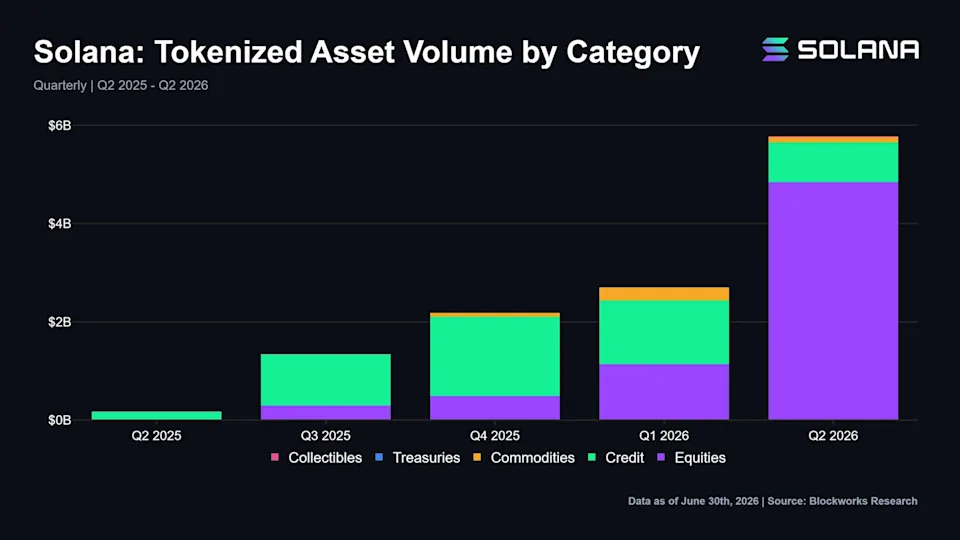
According to a report from the crypto trading firm Keyrock, on-chain asset management grew 118% in 2025 alone, reaching roughly $35 billion, with projections of $64–85 billion for 2026. Tokenized stocks alone hit a record total market capitalization of about $2.3 billion in July 2026, and trading is concentrating rapidly on a single chain: in Q2 2026, Solana's tokenized-asset trading volume reached a record $5.8 billion, up 114% from the prior quarter, and Solana now handles roughly 97% of all tokenized-stock trading across chains. It is not yet large by asset-management standards, but the pace of growth is hard to ignore. (CoinDesk, Yahoo Finance, TheStreet)
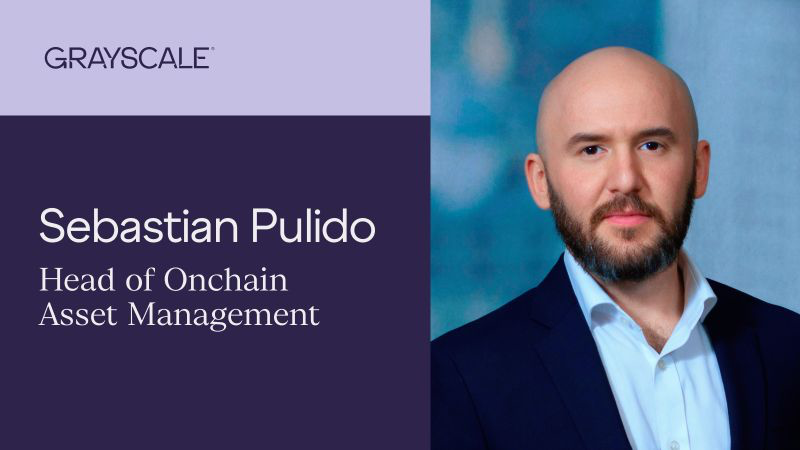
When capital arrives, organizations follow. On July 21, 2026, Grayscale created a dedicated head of on-chain asset management and filled the role with an executive who has worked at Goldman Sachs and J.P. Morgan — only recently. Putting a dedicated executive in place signals that on-chain asset management is being treated not as a one-off experiment but as a business to run for the long term. (citybiz)
Products have followed. Galaxy, a Nasdaq-listed company, tokenized its own SEC-registered common stock on Solana, with the transfer agent recording ownership directly on-chain. This is not a synthetic token or depositary receipt that merely mimics the form — it is legally the same, actual stock. (Galaxy) The market where these products trade is growing quickly too.
On the onchain exchange Hyperliquid, open interest in tokenized stock derivatives, led by Nvidia, Tesla, and the S&P 500, has reached about $2.5 billion. (Crypto Briefing)

Capital, talent, and products all point in the same direction. Institutions no longer see blockchain only as something to invest in; they have begun to treat it as an environment they must operate in. That these three trends appear at once is no coincidence. Blockchain is moving past the one-off experiment of a single product and into institutions' operating systems.
Distribution solved, operations remaining
Most discussion of tokenization centers on issuance and distribution: how to build a product and deliver it around the clock to a broader base of investors. That part is standardizing quickly.
Far less attention goes to what comes next: NAV calculation, fund accounting, reconciliation, valuation, and audit. Building a tokenized stock or fund is becoming easier. Operating it over the next five years is not.
Tokenization does not change what an asset manager invests in. It changes how they operate. Subscriptions, redemptions, transfers, staking rewards, corporate actions, valuation: every one of these activities now generates blockchain data that must reconcile with traditional fund operations. As with the exchange environment covered in the first article of this series (CEX), the problem is not the asset itself but how that asset is handled as operational data.
Operations begin after launch
The operating flow of traditional asset management was relatively simple. Once blockchain enters, an entirely new stretch appears in front of that flow.
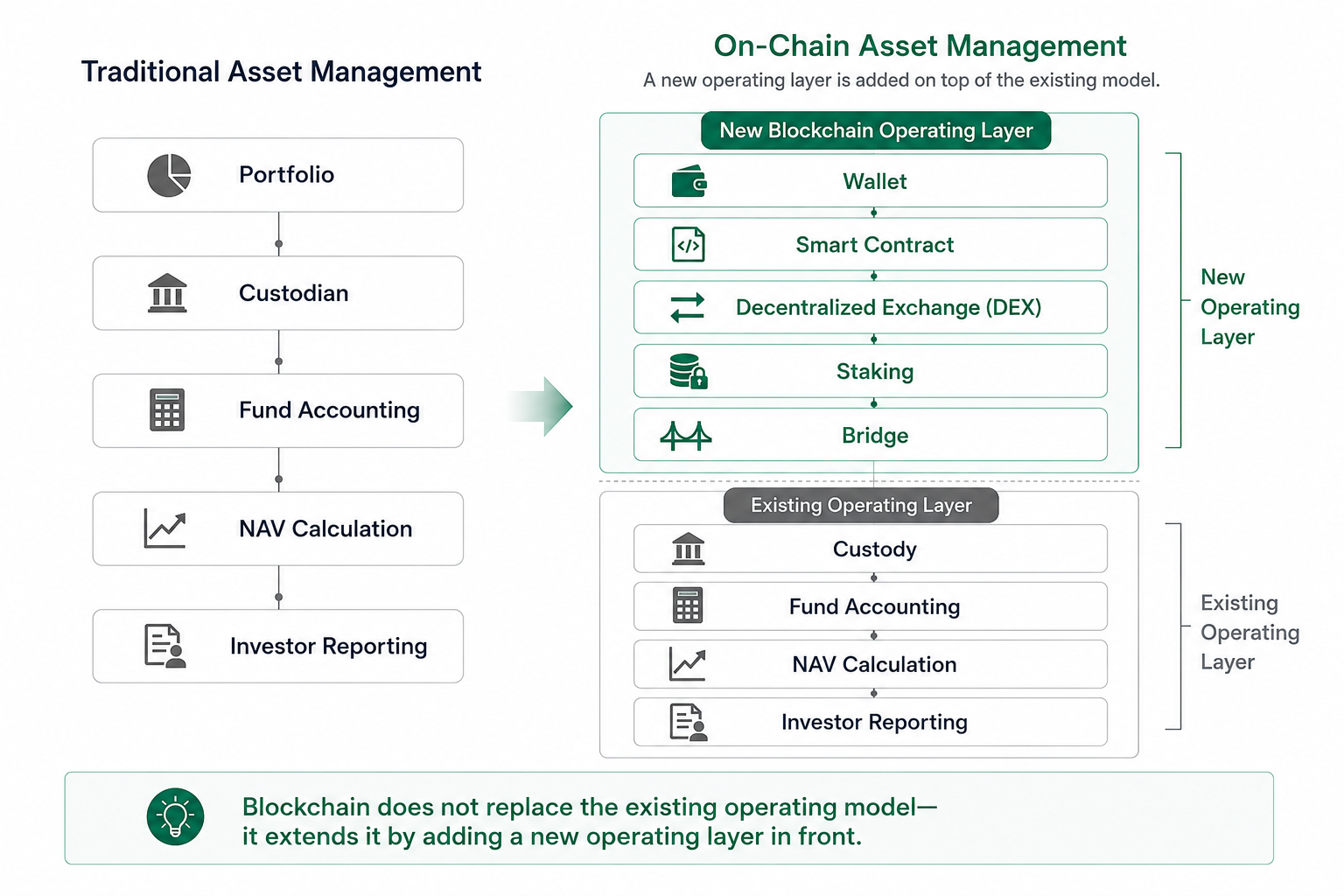
Traditional asset management ends in five steps. On-chain asset management keeps the existing flow (the tail) intact and adds, in front of it, a new operating stretch from wallets to bridges. In other words, a second operating chain now sits ahead of the existing one, and every activity added at the front end ultimately flows into NAV and reporting.
The important point is that the existing operations do not disappear. A new operating layer is added on top of them. This is why we define blockchain as an operating environment.
Adding another operating layer does not simply mean one more process. NAV close schedules, exception handling, reconciliation with external service providers, audit response: the entire existing operating process is affected. As tokenized products multiply, operational complexity grows in step with the number of products.
Not issuance, but reconciling two references
Every institution already has a book of record. Security masters, fund ledgers, and accounting systems manage the official state of each asset.
Blockchain adds another operating reference on top of this. The same position is also recorded onchain, and its state changes in real time. Institutions now face a core challenge: keeping two reference systems consistent while running both together, namely the data they already manage (the ledger) and the data that holds the authoritative record onchain (transaction history)
When that reconciliation fails, the manager, the fund administrator, and the custodian all build different records while looking at the same blockchain. And that discrepancy eventually surfaces in the numbers reported to investors.
This problem is not limited to NAV. Audit and regulatory reporting require the same data. As jurisdictions build out digital asset frameworks, such as Korea's Virtual Asset User Protection Act and Europe's MiCA, the burden of reporting onchain activity in the format regulators require is also growing.
Why existing systems alone fall short
Asset managers already run sophisticated systems such as Aladdin, Geneva, SimCorp, SS&C, and Bloomberg. So the first thing to examine is whether these systems can take on the role of bridging the two references.
These systems were designed around security masters, custodians, and pricing vendors. In traditional asset management, data from many sources has been consolidated into a single security master, known as the golden source. It is a structure proven over many years, built on the premise that each asset carries an identifier and that prices and positions arrive in a fixed format.
Onchain assets have no such single golden source yet. Blockchain uses a different data model. Wallets, smart contracts, LP positions, validator rewards, and staking do not map to the traditional security master. Until it is interpreted, this data reads neither as a balance nor as a value, not because the existing systems are inadequate, but because the data model is different.
Not every asset manager needs to build its own blockchain data layer immediately. For an organization with limited tokenization exposure, existing operating systems may suffice. But from the point where tokenized products and onchain activity become part of portfolio operations, a data model built around securities alone allows operational complexity to grow steadily.
The gap Nodit DataShare fills
Nodit DataShare is built to fill precisely this gap. Rather than replacing the books of record, it provides validated common data so that multiple operating systems can reference the same information. What it delivers is not more data, but more trustworthy data.
Many solutions that provide on-chain data focus on normalization and lineage tracking. DataShare goes further: it verifies data integrity across every stage of collection, indexing, and data-warehouse loading. It validates the integrity of each column, each table, and the relationships between tables against business logic, so that managers obtain data they can trust.
On that foundation, DeFi positions are decoded into a form that can be valued, NAV can be reconstructed for any given date, and data is loaded directly into the manager's data warehouse, preserving existing security and governance frameworks. DataShare is not another analytics dashboard, but a data warehouse suited to an institution's operating environment. It currently offers more than 100 datasets and supports major chains including Ethereum, Solana, Base, Arbitrum, Tron, and Bitcoin, with on-premise deployment in APAC IDCs and SOC 2 Type I and II controls.
Why the Solana dataset matters for the RWA market
DataShare's strengths are clearest on Solana.
 Nodit Team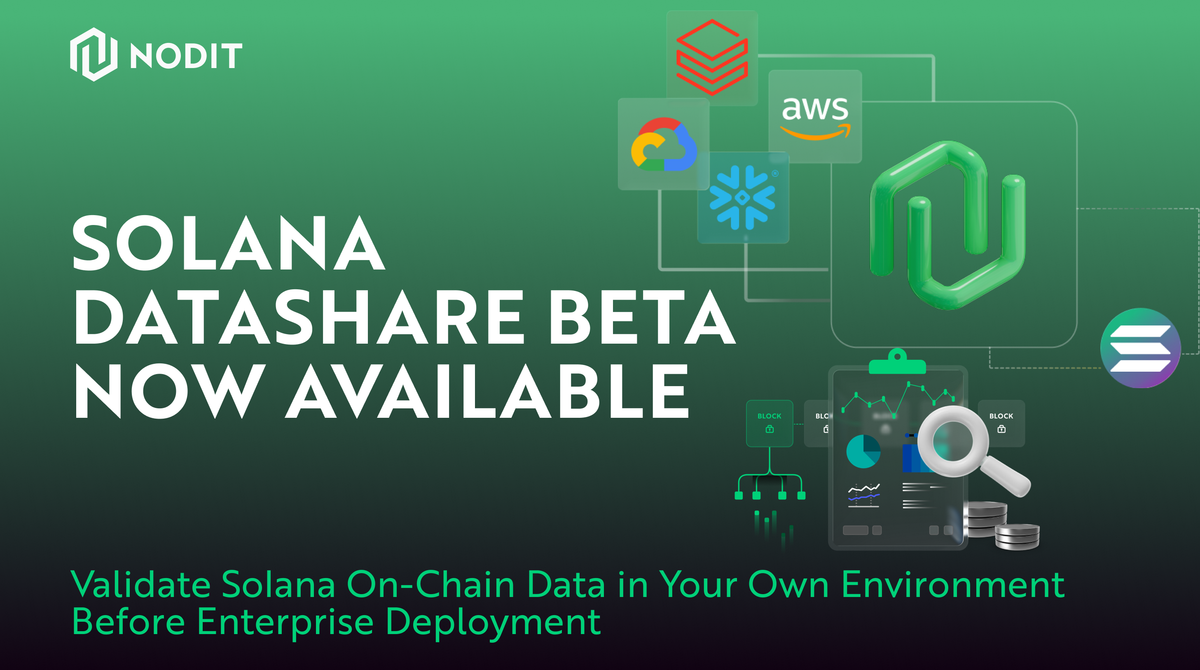
As noted above, roughly 97% of tokenized-stock trading takes place on Solana. For any institution looking to operate tokenized products, securing the reliability of Solana data is not optional but essential. (TheStreet)
Yet Solana is one of the hardest blockchains for institutions to work with. Because of its high throughput and complex program structure, collecting raw data alone makes it difficult to interpret positions, values, and transaction states in a consistent form. Turning it into data usable for operations and accounting requires additional validation and reconciliation.
Having completed that process, DataShare provides a Solana dataset that institutions can use directly. It distinguishes successful from failed transactions, interprets tokenized asset and DeFi activity, and validates data integrity so that the state at any point in time can be reconstructed.
This means more than supporting Solana. It means delivering an institutional grade, validated dataset for the most heavily used tokenization network in the market. As the tokenized market expands around Solana, the ability to use that activity as operational data will become a meaningful element of institutional competitiveness.
Competitive advantage comes from operations
Twenty years ago, competitive advantage in asset management came from better investment decisions. Going forward, it will also come from a better operating architecture. As tokenization spreads, competitiveness will not come from launching more products. It will come from whether those products can be operated reliably within the existing operating framework.
As the onchain asset management market grows, so does the importance of the layer that supports operations within it. As blockchain operations become part of asset management, the trustworthy data foundation that underpins them will become part of the core operating infrastructure.
If you would like to discuss the operating environment for digital assets, you can reach us below.
In the next article in this series, we turn to AI engineers: how DataShare provides a trustworthy data foundation for AI training, and how it can raise the accuracy and reliability of data science and research. Subscribe to the newsletter to receive the next insight.
Earlier in the series
 Nodit Team
 Nodit Team
 Nodit Team
 Nodit Team
Last but not least! We will also be at Solana Breakpoint 2026 in November to share more about the Datashare — details soon!
About Nodit
Nodit is an enterprise-grade blockchain infrastructure platform providing reliable node access and consistent on-chain data for digital asset services. Across 50+ networks, Nodit combines managed node infrastructure, standardized data processing and delivery, DataShare with specialized blockchain datasets, and Validator-as-a-Service (VaaS) to support production-scale operations, institutional analytics, and AI applications.
Backed by SOC 2 Type II and proven experience with major regulated exchanges worldwide, Nodit provides the complete on-chain data pipeline that powers the digital asset economy.
Homepage l X (Twitter) l LinkedIn
This article is provided for general informational purposes only. By using the article, you agree that the information on this article does not constitute legal, financial or any other form of professional advice. No relationship is created with you, nor any duty of care assumed to you, when you use this article. The article is not a substitute for obtaining any legal, financial or any other form of professional advice from a suitably qualified and licensed advisor. The information on this article may be changed without notice and is not guaranteed to be complete, accurate, correct or up-to-date.
![[DataShare Insight] On-Chain Data as a Foundation for Market Intelligence](https://storage.ghost.io/c/00/e4/00e497ca-82e8-447b-9af3-b700db69ca26/content/images/size/w600/2026/09/Data-Analyst--_-Blog-Thumbnail.png)
![[DataShare Insight] AI-Ready On-Chain Data for Regulated Enterprises](https://storage.ghost.io/c/00/e4/00e497ca-82e8-447b-9af3-b700db69ca26/content/images/size/w600/2026/09/Group-C-_-AI-Blog-Thumbnail.png)